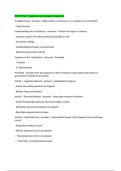
KLETC Test 1 Questions and Answers Graded A+
Probable Cause - Answers - Believe that a crime has, is, or is about to be committed
-- Search/arrest
Understanding the Constitution - Answers - Protects the rights of citizens
- Inceases chance of evidence being admissable in trial
- Avoid Civil Liability
- Fundamental principles of government
- What the government CAN do
Contents of the Constitution - Answers - Preamble
- 7 articles
- 27 amendments
Preamble - Answers lists the purposes of the Constitution and clearly states that our
government is linked to the people
Article 1: Legislative Branch - Answers - Established Congress
- Grants law making powers to Congress
- Defines House and Senate
Article 2: Executive Branch - Answers - Prescribes manner of election
- Grants Presidential Authority and Commander in Chief
- Delineates whom the president can appoint
- Describes impeachment process
Article 3: Judicial Branch - Answers - Vests judicial power in the Supreme Court and lower
courts
- Established Federal Courts
- Defines Supreme Court's jurisdiction
— Final Interpreter of the Constitution
—- "Final Say" on Constitutional issues
,Article 4: Relations Between the States - Answers - Relationship between states and citizens
- "Basic Rights" are the same as in other states
- Full Faith
— Court order in one state is recognized in another
- Extradition Clause (for felony crimes)
— Returning person to the state where the crime was committed
Article 5: Amendment/Ratification - Answers - Prescribes methods for amending the
Constitution and ratifying proposed Amendment
- 2/3 senate and 2/3 of house required
Article 6: General Provisions, Supremacy of the Constitution - Answers - Supremacy Clause
— The Constitution and Laws of the United States the supreme law of the land
— Supreme Court Ruling trumps any state law that may conflict with it
Article 7: Ratification Process - Answers - Describes how to ratify the Constitution and its
effects
- Requires Ratification of at least 9 states
Article 7: Ratification Process - Answers - Describes how to ratify the Constitution and its
effects
- Requires Ratification of at least 9 states
Amendments most applicable to CJ System - Answers - 1, 4, 5, 6, 8, and 14
1st Amendment - Answers Freedom of Religion, Speech, Press, Petition, and Assembly
Freedom of Religion - Answers - Separation of church and state
- State can't regulate belief/content
- State can regulate expression as to:
—Time
— Place
— Manner
—- can regulate for safety purposes
,—— Parades, KKK, Internet Porn, Westbourough Baptist Church (Fred Phelps),
3 Prong Test (for State to Regulate Religious Practice for safety purposes) - Answers 1. Does
the state have a secular purpose for regulation? (Safety concern)
2. Is it neutral? (Same requirements for all)
3. Does the law avoid excessive government entanglement? (Can't be based in Religious
motivation)
Ex: Kansas Funeral Privacy Act
Freedom of Speech - Answers -Government shall not abridge the freedom of speech
-Speech includes:
— words written or spoken
— movies
— video and audio recordings
— art
— expressive, nonverbal actions
Freedom of Press - Answers - Laws of Defamation and obscenity apply to Press
- Fair Trial Considerations
Not protected under 1st Amendment - Answers - False advertising
- inciting lawless action
- defamation/slander
- Libel
- Kiddie Porn
- Fighting Words (abusive/ likely to cause violence)
- obscenity
2nd Amendment - Answers Right to bear arms
3rd Amendment - Answers Quartering of troops
, 4th Amendment - Answers SEARCH AND SEIZURE
- Protect against unreasonable search/seizure
- Sets standards in search, seizure, and arrests
- Applicable to government conduct only
- Court preference for warrants
- Exclusionary Rule applies if it is violated. (can't use evidence obtained in an illegal
arrest/search).
- 4th Amendment applies if government conduct is involved (excludes private entities).
5th Amendment - Answers SELF INCRIMINATION, DOUBLE JEOPARDY, DUE PROCESS
- Can't be forced to testify against yourself (SI)
- Can't comment on defendant's failure to testify (SI)
- Can't be criminally tried twice for the same charge (DJ)
- 1 trial for all charges (DJ)
- If acquitted, can't be tried again (DJ)
- Does not apply between state charge and federal charge (DJ)
- Can't use post acquittal confession in 2nd trial (DJ)
6th Amendment - Answers Right to Jury Trial, Right to Attorney, Subpoena Power, Rights of the
Accused
● Speedy/public trial (within 150 days in jail, 180 out on bail, 90 days defense continuation
request)
● Jury trial (12 criminal, 6 civil usually)
● Impartial jury of community
● Jurisdiction (can only be charged where the crime occurred)
● Informed of nature of charges / why they were arrested / ID themselves as a police officer.
Probable Cause - Answers - Believe that a crime has, is, or is about to be committed
-- Search/arrest
Understanding the Constitution - Answers - Protects the rights of citizens
- Inceases chance of evidence being admissable in trial
- Avoid Civil Liability
- Fundamental principles of government
- What the government CAN do
Contents of the Constitution - Answers - Preamble
- 7 articles
- 27 amendments
Preamble - Answers lists the purposes of the Constitution and clearly states that our
government is linked to the people
Article 1: Legislative Branch - Answers - Established Congress
- Grants law making powers to Congress
- Defines House and Senate
Article 2: Executive Branch - Answers - Prescribes manner of election
- Grants Presidential Authority and Commander in Chief
- Delineates whom the president can appoint
- Describes impeachment process
Article 3: Judicial Branch - Answers - Vests judicial power in the Supreme Court and lower
courts
- Established Federal Courts
- Defines Supreme Court's jurisdiction
— Final Interpreter of the Constitution
—- "Final Say" on Constitutional issues
,Article 4: Relations Between the States - Answers - Relationship between states and citizens
- "Basic Rights" are the same as in other states
- Full Faith
— Court order in one state is recognized in another
- Extradition Clause (for felony crimes)
— Returning person to the state where the crime was committed
Article 5: Amendment/Ratification - Answers - Prescribes methods for amending the
Constitution and ratifying proposed Amendment
- 2/3 senate and 2/3 of house required
Article 6: General Provisions, Supremacy of the Constitution - Answers - Supremacy Clause
— The Constitution and Laws of the United States the supreme law of the land
— Supreme Court Ruling trumps any state law that may conflict with it
Article 7: Ratification Process - Answers - Describes how to ratify the Constitution and its
effects
- Requires Ratification of at least 9 states
Article 7: Ratification Process - Answers - Describes how to ratify the Constitution and its
effects
- Requires Ratification of at least 9 states
Amendments most applicable to CJ System - Answers - 1, 4, 5, 6, 8, and 14
1st Amendment - Answers Freedom of Religion, Speech, Press, Petition, and Assembly
Freedom of Religion - Answers - Separation of church and state
- State can't regulate belief/content
- State can regulate expression as to:
—Time
— Place
— Manner
—- can regulate for safety purposes
,—— Parades, KKK, Internet Porn, Westbourough Baptist Church (Fred Phelps),
3 Prong Test (for State to Regulate Religious Practice for safety purposes) - Answers 1. Does
the state have a secular purpose for regulation? (Safety concern)
2. Is it neutral? (Same requirements for all)
3. Does the law avoid excessive government entanglement? (Can't be based in Religious
motivation)
Ex: Kansas Funeral Privacy Act
Freedom of Speech - Answers -Government shall not abridge the freedom of speech
-Speech includes:
— words written or spoken
— movies
— video and audio recordings
— art
— expressive, nonverbal actions
Freedom of Press - Answers - Laws of Defamation and obscenity apply to Press
- Fair Trial Considerations
Not protected under 1st Amendment - Answers - False advertising
- inciting lawless action
- defamation/slander
- Libel
- Kiddie Porn
- Fighting Words (abusive/ likely to cause violence)
- obscenity
2nd Amendment - Answers Right to bear arms
3rd Amendment - Answers Quartering of troops
, 4th Amendment - Answers SEARCH AND SEIZURE
- Protect against unreasonable search/seizure
- Sets standards in search, seizure, and arrests
- Applicable to government conduct only
- Court preference for warrants
- Exclusionary Rule applies if it is violated. (can't use evidence obtained in an illegal
arrest/search).
- 4th Amendment applies if government conduct is involved (excludes private entities).
5th Amendment - Answers SELF INCRIMINATION, DOUBLE JEOPARDY, DUE PROCESS
- Can't be forced to testify against yourself (SI)
- Can't comment on defendant's failure to testify (SI)
- Can't be criminally tried twice for the same charge (DJ)
- 1 trial for all charges (DJ)
- If acquitted, can't be tried again (DJ)
- Does not apply between state charge and federal charge (DJ)
- Can't use post acquittal confession in 2nd trial (DJ)
6th Amendment - Answers Right to Jury Trial, Right to Attorney, Subpoena Power, Rights of the
Accused
● Speedy/public trial (within 150 days in jail, 180 out on bail, 90 days defense continuation
request)
● Jury trial (12 criminal, 6 civil usually)
● Impartial jury of community
● Jurisdiction (can only be charged where the crime occurred)
● Informed of nature of charges / why they were arrested / ID themselves as a police officer.