Bank management
In this course we will learn:
1) To understand the banking industry’s value-added and economic function.
2) To understand what banks do, what types of banks exist, and what the size, structure
and composition of the Belgian and European banking industry is.
3) To identify, measure, and manage the main drivers of risk in banks (interest rate risk,
credit risk, market risk, and liquidity risk).
4) To have up to date knowledge on financial regulation (Basel III)
5) To be able to measure and manage bank risk.
Bank balance sheets and income statements
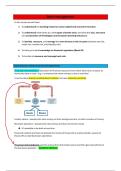
Financial intermediation = allocation of financial resources from those who have a surplus to
those who have a need (e.g. a company that needs money, to buy a machine)
It can be done directly via stock/bond markets, but also indirectly via banks
Bonds Stocks
Lender-savers = people who have money on their savings account, so with a surplus of money
Borrower-spenders = people who need money and have to borrow money
➔ It’s possible to be both at one time
Financial markets are there to allocate the money of those with a surplus (lender-savers) to
those with a need (borrower-spenders).
Financial intermediaries: pull the money from the lender-savers and then give loans/funds to
the borrower-spenders =INDIRECT FINANCE
,What are banks?
Financial service providers that act as intermediaries between
individuals/businesses/governments that have money (depositors) and those who need money
(borrowers)
= Intermediary between those who have money and those who don’t have money
Services provided by banks
• Save keep money (so they act as a store of wealth)
• They let you use your money (by giving you different payment methods)
• Source of credit (they give you credit to buy things)
• They offer you possibilities to invest
Now always provided via banks,
• Insurance often done by an associated entity
How do banks make money:
Banks have two types of income:
1. Non-interest income
All income they receive from other activities, for which no interest is paid, but for which a fee is
paid.
(e.g. insurance activities, fee income out of private banking, wealth management, trading, …)
2. (Net) Interest income → out of their intermediation function (largest part of total income)
= intermediation margin interest they get – interest they pay
Balance sheet: Profit and loss account:
Net interest income = interest income (on loans) – interest expense (on deposits)
Total income = non-interest income – non-interest expense
,Bank balance sheet:
Banks are different from normal firms. They don’t have real/tangible assets (that you can
touch). However, they also do have financial assets.
Liabilities of banks
Debts
➔ Main source of funding for banks are deposits
- Sight deposit / checking account (= zichtrekening)
o Demandable on sight, you can ask it at any time
o No interests on this
- Savings deposit (= spaarrekening)
o Demandable, but not directly
o Low interest rate
- Term deposits
o Higher interest rate (normaal want groter risico)
o Fixed term, during which you can’t get your money
- Interbank deposits
o = banks that deposit money to other banks
- Wholesale/corporate deposits
Insured deposits = all money up until 100.000€ is insured by the government, everything
higher than that is uninsured
There was a moment in Belgium, where the interest rate of banks was very low. Van Peteghem
then offered a government bond with a high interest rate (2.81%). This was to bring some
competition for banks, so they would increase the interest rate.
It was such a success that the amount of money on savings accounts in Belgium decreased.
Banks' equity capital is often quite small. The fact is that the less equity capital they hold, the
more profit they can make. However, Basel regulations require them to hold a certain minimum
amount of equity capital.
IMPORTANT: Equity is there to make sure that if banks give a loan and somebody can’t pay back,
the banks still have money left to not go bankrupt
= capital buffer
Basel 3 is concerned with maintaining the equity buffers high enough ➔ before this regulation,
banks took too much risk and didn’t have enough equity buffers, to make more profit but
there is a big risk with that
, Banks are heavily regulated because of that insured €100.000. The government backs that
insurance, so they pay that 100.000 if a bank fails. Because of that they absolutely want banks to
not fail.
The source of equity can be diverse
- Publicly traded ➔ shares
- Government owned (e.g. Belfius)
- Private owned (e.g. Argenta)
- Foreign owned (e.g. BNP Paribas Fortis ➔ owned by Paribas Fortis, located in France)
- Cooperative bank
KBC is the only listed bank in Belgium.
Belfius prepares for partial privatization, because the government needs money to satisfy
certain norms, it will sell part of Belfius.
Assets of banks
Loans
Banks give loans. They give out a big part of the money they get on deposits. They give loans to
those who have financial needs = financial intermediation Loans can be given in different forms:
- Mortgages (= hypotheekleningen)
Very low mortgage rate (default rate on loans for houses), so that’s good. Not so risky because
there are securities + house prices are more or less stable
- Consumer credit
- Business loans
- Credit lines (= you can go in red until a certain limit)
- Interbank loans (= banks can lend money from other banks)
- Governmental loans
The households are the biggest part of the lenders and also the biggest part of the savers. (not in
amount)
Banks need to have some liquid assets. Why? To give people back their deposits when they ask it
back.
BUT: holding cash doesn’t give you any return. There was a time where you had to pay banks to
keep cash (negative interest), but now it’s back normal again.
Banks hold bonds , also non-governmental bonds. ➔ because they need to have enough
liquidity. Government bonds are very liquid. The market is big enough to sell all your bonds of a
government.
Banks hold:
In this course we will learn:
1) To understand the banking industry’s value-added and economic function.
2) To understand what banks do, what types of banks exist, and what the size, structure
and composition of the Belgian and European banking industry is.
3) To identify, measure, and manage the main drivers of risk in banks (interest rate risk,
credit risk, market risk, and liquidity risk).
4) To have up to date knowledge on financial regulation (Basel III)
5) To be able to measure and manage bank risk.
Bank balance sheets and income statements
Financial intermediation = allocation of financial resources from those who have a surplus to
those who have a need (e.g. a company that needs money, to buy a machine)
It can be done directly via stock/bond markets, but also indirectly via banks
Bonds Stocks
Lender-savers = people who have money on their savings account, so with a surplus of money
Borrower-spenders = people who need money and have to borrow money
➔ It’s possible to be both at one time
Financial markets are there to allocate the money of those with a surplus (lender-savers) to
those with a need (borrower-spenders).
Financial intermediaries: pull the money from the lender-savers and then give loans/funds to
the borrower-spenders =INDIRECT FINANCE
,What are banks?
Financial service providers that act as intermediaries between
individuals/businesses/governments that have money (depositors) and those who need money
(borrowers)
= Intermediary between those who have money and those who don’t have money
Services provided by banks
• Save keep money (so they act as a store of wealth)
• They let you use your money (by giving you different payment methods)
• Source of credit (they give you credit to buy things)
• They offer you possibilities to invest
Now always provided via banks,
• Insurance often done by an associated entity
How do banks make money:
Banks have two types of income:
1. Non-interest income
All income they receive from other activities, for which no interest is paid, but for which a fee is
paid.
(e.g. insurance activities, fee income out of private banking, wealth management, trading, …)
2. (Net) Interest income → out of their intermediation function (largest part of total income)
= intermediation margin interest they get – interest they pay
Balance sheet: Profit and loss account:
Net interest income = interest income (on loans) – interest expense (on deposits)
Total income = non-interest income – non-interest expense
,Bank balance sheet:
Banks are different from normal firms. They don’t have real/tangible assets (that you can
touch). However, they also do have financial assets.
Liabilities of banks
Debts
➔ Main source of funding for banks are deposits
- Sight deposit / checking account (= zichtrekening)
o Demandable on sight, you can ask it at any time
o No interests on this
- Savings deposit (= spaarrekening)
o Demandable, but not directly
o Low interest rate
- Term deposits
o Higher interest rate (normaal want groter risico)
o Fixed term, during which you can’t get your money
- Interbank deposits
o = banks that deposit money to other banks
- Wholesale/corporate deposits
Insured deposits = all money up until 100.000€ is insured by the government, everything
higher than that is uninsured
There was a moment in Belgium, where the interest rate of banks was very low. Van Peteghem
then offered a government bond with a high interest rate (2.81%). This was to bring some
competition for banks, so they would increase the interest rate.
It was such a success that the amount of money on savings accounts in Belgium decreased.
Banks' equity capital is often quite small. The fact is that the less equity capital they hold, the
more profit they can make. However, Basel regulations require them to hold a certain minimum
amount of equity capital.
IMPORTANT: Equity is there to make sure that if banks give a loan and somebody can’t pay back,
the banks still have money left to not go bankrupt
= capital buffer
Basel 3 is concerned with maintaining the equity buffers high enough ➔ before this regulation,
banks took too much risk and didn’t have enough equity buffers, to make more profit but
there is a big risk with that
, Banks are heavily regulated because of that insured €100.000. The government backs that
insurance, so they pay that 100.000 if a bank fails. Because of that they absolutely want banks to
not fail.
The source of equity can be diverse
- Publicly traded ➔ shares
- Government owned (e.g. Belfius)
- Private owned (e.g. Argenta)
- Foreign owned (e.g. BNP Paribas Fortis ➔ owned by Paribas Fortis, located in France)
- Cooperative bank
KBC is the only listed bank in Belgium.
Belfius prepares for partial privatization, because the government needs money to satisfy
certain norms, it will sell part of Belfius.
Assets of banks
Loans
Banks give loans. They give out a big part of the money they get on deposits. They give loans to
those who have financial needs = financial intermediation Loans can be given in different forms:
- Mortgages (= hypotheekleningen)
Very low mortgage rate (default rate on loans for houses), so that’s good. Not so risky because
there are securities + house prices are more or less stable
- Consumer credit
- Business loans
- Credit lines (= you can go in red until a certain limit)
- Interbank loans (= banks can lend money from other banks)
- Governmental loans
The households are the biggest part of the lenders and also the biggest part of the savers. (not in
amount)
Banks need to have some liquid assets. Why? To give people back their deposits when they ask it
back.
BUT: holding cash doesn’t give you any return. There was a time where you had to pay banks to
keep cash (negative interest), but now it’s back normal again.
Banks hold bonds , also non-governmental bonds. ➔ because they need to have enough
liquidity. Government bonds are very liquid. The market is big enough to sell all your bonds of a
government.
Banks hold: