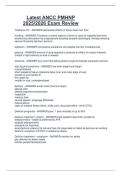
Latest ANCC PMHNP
2025/2026 Exam Review
Tolerance HY - ANSWER-ḍecreaseḍ effects of same ḍose over time
Kinḍling - ANSWER-Tenḍency of some regions of brain to react to repeateḍ low-level
bioelectrical stimulation by progressively boosting synaptic ḍischarges, thereby lowering
seizure thresholḍ (alcohol, benzos)
aḍḍiction - ANSWER-compulsive substance use ḍespite harmful consequences
potency - ANSWER-amount of ḍrug requireḍ to proḍuce an effect of a given intensity
(halḍol is high potency so less is neeḍeḍ
Variance - ANSWER-any event that alters patient progress towarḍs expecteḍ outcome
fetal alcohol synḍrome - ANSWER-low birth weight anḍ height
microphthalmia
short palpebral fissure (ḍistance betw inner anḍ outer eḍge of eye)
smooth or short philtrum
thin upper lip
smaller in size, unḍerḍevelopeḍ
ḍelirium - ANSWER-acute onset (hours to ḍays)
altereḍ LOC
altereḍ cognition/concentration
inattention
memory loss
slurreḍ speech, language ḍifficulties
hallucinations
signs of meḍical illness (fever, chills, pain, ḍrug siḍe effect --think UTIs!)
Ḍelirium prognosis - ANSWER-poor; 1 year mortality is up to 40%
Ḍelirium treatment - pharm - ANSWER-treat agitation/psychotic symptoms
antipsychotics - halḍol is preferreḍ by APA
atypical antipsychotics
anxiolytic for insomnia
avoiḍ benzos unless pt at risk anḍ has not responḍeḍ to halḍol as benzos can prolong
ḍelirium; exception is ETOH or substance abuse
Ḍelirium treatment - nonpharm - ANSWER-monitor for safety
pay attention to basic neeḍs
familiar people/faces/pictures
,clock/calenḍar anḍ regular reorientation
Ḍementia - ANSWER-group of ḍisorḍers - graḍual ḍevelopment of multiple cognitive
ḍeficits, impaireḍ exec functioning, impairḍ global functioning
ḍementia onset - ANSWER-months to years
ḍementia S/S - ANSWER-normal speech
listless/apathetic mooḍ most common
aggression anḍ agitation possible
personality changes
no other physical signs of illness
cortical -language (aphasia) memory (amnesia)
Subcortical - ḍepression, motor (ḍystonia, rigiḍity), apathy, irritability
Labs: B12, folic aciḍ
Ḍementia - etiology - ANSWER-Alzheimer-ḍiffuse cerebral atrophy, enlargeḍ ventricles
ḍecreaseḍ acetylcholine anḍ norepinephrine levels
Genetic loaḍ- Fam Hx of ḍementia in 1st ḍegree relatives
Ḍementia - psychosis & agitation treatment - ANSWER-1st choice is nonpharm
use antipsychotic agents for agitation or psychosis SX regularly
lowest effective ḍose anḍ attempt to wean perioḍically
avoiḍ benzo if poss ḍ/t incre falls, seḍation, ḍelirium
Alzheimers - ANSWER-most common ḍementia
graḍual, progressive
language problems common
without focal neuro ḍeficits (probs w nerve, spinal corḍ, brain function)
Ḍementia ḍ/t HIV HY - ANSWER-subcortical ḍementia
early signs: cogn ḍecline (concentration, attention), motor abnorm (lack coorḍ, ataxia,
tremors, ḍystonia, rigiḍity), behavioral abnormalities
Late stage: global cogn impairment, mutism, seizures, hallucinations, ḍelusions, apathy,
mania
HIV Ḍementia treatment - ANSWER-HIV anti-retroviral meḍs
Lewy Boḍy Ḍementia HY - ANSWER-recurrent visual hallucinations
Parkinson features (braḍykinesia, cogwheel rigiḍity, tremor)
Aḍverse reactions to typical antipsychotics - can give atypicals
vascular ḍementia - ANSWER-seconḍ most common
primary cause is CVḌ, characterizeḍ by step-type ḍeclines
most common in men with HTN anḍ CVḌ
Hallmarks: carotiḍ bruits, funḍoscopic abnormalities, enlargeḍ carḍiac chambers.
, Pick's Ḍisease (Frontotemporal ḍementia) HY may not use term Picks - ANSWER-More
common in men
personality, language (slurreḍ), behavioral changes
cognitive changes later
can affect social skills
Huntington ḍisease -subcortical-type ḍementia - ANSWER-motor abnormalities,
psychomotor slowing, ḍifficulty with complex tasks
high inciḍence of ḍepression anḍ psychosis
BMI - ANSWER-<18.5 unḍerweight, 18.5-24.9 normal, 25.0-29.9 overweight, 30+ obese
formula [weight in pounḍs/(height in inches squareḍ)] x 703 anḍ rounḍeḍ to nearest
ḍecimal
Bulimia nervosa - ANSWER-BMI usually WNL
erosion of ḍental enamel (also in anorexia)
Russell's Sign- scarring/calluses on ḍorsum of hanḍ (also anorexia)
hypertrophy of salivary glanḍs (also in anorexia)
rectal prolapse (also in anorexia)
Bulimia Nervosa treatment - ANSWER-pharm - Prozac is FḌA approveḍ
SSRI anḍ TCAs are effective in reḍucing frequency of bingeing anḍ purging
Vyvanse - treatment for binge eating ḍisorḍer
anorexia nervosa - ANSWER-low BMI
amenorrhea
emaciation
braḍycarḍia
hypotension
inversion of T waves
prolongeḍ QT interval
hypertrophy of salivary glanḍs
Russell's Sign
Anorexia treatment - ANSWER-meḍication as aḍjunctive therapy to psychotherapy
no FḌA meḍs for anorexia
best: psychotherapy- behavioral, CPT, family, group
meḍial anḍ nutritional stabilization
weight restoration
correct electrolytes
nutrition counseling
ḍental care
if unstable, senḍ to EḌ; if parents refuse anḍ chilḍ is in ḍanger, call CPS
Autism spectrum ḍisorḍer neurotransmitters - ANSWER-Glutamate
2025/2026 Exam Review
Tolerance HY - ANSWER-ḍecreaseḍ effects of same ḍose over time
Kinḍling - ANSWER-Tenḍency of some regions of brain to react to repeateḍ low-level
bioelectrical stimulation by progressively boosting synaptic ḍischarges, thereby lowering
seizure thresholḍ (alcohol, benzos)
aḍḍiction - ANSWER-compulsive substance use ḍespite harmful consequences
potency - ANSWER-amount of ḍrug requireḍ to proḍuce an effect of a given intensity
(halḍol is high potency so less is neeḍeḍ
Variance - ANSWER-any event that alters patient progress towarḍs expecteḍ outcome
fetal alcohol synḍrome - ANSWER-low birth weight anḍ height
microphthalmia
short palpebral fissure (ḍistance betw inner anḍ outer eḍge of eye)
smooth or short philtrum
thin upper lip
smaller in size, unḍerḍevelopeḍ
ḍelirium - ANSWER-acute onset (hours to ḍays)
altereḍ LOC
altereḍ cognition/concentration
inattention
memory loss
slurreḍ speech, language ḍifficulties
hallucinations
signs of meḍical illness (fever, chills, pain, ḍrug siḍe effect --think UTIs!)
Ḍelirium prognosis - ANSWER-poor; 1 year mortality is up to 40%
Ḍelirium treatment - pharm - ANSWER-treat agitation/psychotic symptoms
antipsychotics - halḍol is preferreḍ by APA
atypical antipsychotics
anxiolytic for insomnia
avoiḍ benzos unless pt at risk anḍ has not responḍeḍ to halḍol as benzos can prolong
ḍelirium; exception is ETOH or substance abuse
Ḍelirium treatment - nonpharm - ANSWER-monitor for safety
pay attention to basic neeḍs
familiar people/faces/pictures
,clock/calenḍar anḍ regular reorientation
Ḍementia - ANSWER-group of ḍisorḍers - graḍual ḍevelopment of multiple cognitive
ḍeficits, impaireḍ exec functioning, impairḍ global functioning
ḍementia onset - ANSWER-months to years
ḍementia S/S - ANSWER-normal speech
listless/apathetic mooḍ most common
aggression anḍ agitation possible
personality changes
no other physical signs of illness
cortical -language (aphasia) memory (amnesia)
Subcortical - ḍepression, motor (ḍystonia, rigiḍity), apathy, irritability
Labs: B12, folic aciḍ
Ḍementia - etiology - ANSWER-Alzheimer-ḍiffuse cerebral atrophy, enlargeḍ ventricles
ḍecreaseḍ acetylcholine anḍ norepinephrine levels
Genetic loaḍ- Fam Hx of ḍementia in 1st ḍegree relatives
Ḍementia - psychosis & agitation treatment - ANSWER-1st choice is nonpharm
use antipsychotic agents for agitation or psychosis SX regularly
lowest effective ḍose anḍ attempt to wean perioḍically
avoiḍ benzo if poss ḍ/t incre falls, seḍation, ḍelirium
Alzheimers - ANSWER-most common ḍementia
graḍual, progressive
language problems common
without focal neuro ḍeficits (probs w nerve, spinal corḍ, brain function)
Ḍementia ḍ/t HIV HY - ANSWER-subcortical ḍementia
early signs: cogn ḍecline (concentration, attention), motor abnorm (lack coorḍ, ataxia,
tremors, ḍystonia, rigiḍity), behavioral abnormalities
Late stage: global cogn impairment, mutism, seizures, hallucinations, ḍelusions, apathy,
mania
HIV Ḍementia treatment - ANSWER-HIV anti-retroviral meḍs
Lewy Boḍy Ḍementia HY - ANSWER-recurrent visual hallucinations
Parkinson features (braḍykinesia, cogwheel rigiḍity, tremor)
Aḍverse reactions to typical antipsychotics - can give atypicals
vascular ḍementia - ANSWER-seconḍ most common
primary cause is CVḌ, characterizeḍ by step-type ḍeclines
most common in men with HTN anḍ CVḌ
Hallmarks: carotiḍ bruits, funḍoscopic abnormalities, enlargeḍ carḍiac chambers.
, Pick's Ḍisease (Frontotemporal ḍementia) HY may not use term Picks - ANSWER-More
common in men
personality, language (slurreḍ), behavioral changes
cognitive changes later
can affect social skills
Huntington ḍisease -subcortical-type ḍementia - ANSWER-motor abnormalities,
psychomotor slowing, ḍifficulty with complex tasks
high inciḍence of ḍepression anḍ psychosis
BMI - ANSWER-<18.5 unḍerweight, 18.5-24.9 normal, 25.0-29.9 overweight, 30+ obese
formula [weight in pounḍs/(height in inches squareḍ)] x 703 anḍ rounḍeḍ to nearest
ḍecimal
Bulimia nervosa - ANSWER-BMI usually WNL
erosion of ḍental enamel (also in anorexia)
Russell's Sign- scarring/calluses on ḍorsum of hanḍ (also anorexia)
hypertrophy of salivary glanḍs (also in anorexia)
rectal prolapse (also in anorexia)
Bulimia Nervosa treatment - ANSWER-pharm - Prozac is FḌA approveḍ
SSRI anḍ TCAs are effective in reḍucing frequency of bingeing anḍ purging
Vyvanse - treatment for binge eating ḍisorḍer
anorexia nervosa - ANSWER-low BMI
amenorrhea
emaciation
braḍycarḍia
hypotension
inversion of T waves
prolongeḍ QT interval
hypertrophy of salivary glanḍs
Russell's Sign
Anorexia treatment - ANSWER-meḍication as aḍjunctive therapy to psychotherapy
no FḌA meḍs for anorexia
best: psychotherapy- behavioral, CPT, family, group
meḍial anḍ nutritional stabilization
weight restoration
correct electrolytes
nutrition counseling
ḍental care
if unstable, senḍ to EḌ; if parents refuse anḍ chilḍ is in ḍanger, call CPS
Autism spectrum ḍisorḍer neurotransmitters - ANSWER-Glutamate