All Chapters Covered
SOLUTION MANUAL
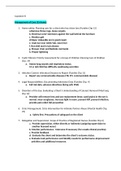
, PROBLEM 1.1
Heat is removed from a rectangular surface by L
convection to an ambient fluid at T . The heat
transfer coefficient is h. Surface temperature is given
by x W
A 0
Ts = 1/ 2
x
where A is constant. Determine the steady state
heat transfer rate from the plate.
L
(1) Observations. (i) Heat is removed from the surface
by convection. Therefore, Newton's law of cooling is dqs
applicable. (ii) Ambient temperature and heat transfer x 0 W
coefficient are uniform. (iii) Surface temperature varies
along the rectangle. dx
(2) Problem Definition. Find the total heat transfer rate by convection from the surface
of a plate with a variable surface area and heat transfer coefficient.
(3) Solution Plan. Newton's law of cooling gives the rate of heat transfer by convection.
However, in this problem surface temperature is not uniform. This means that the rate
of heat transfer varies along the surface. Thus, Newton’ s law should be applied to an
infinitesimal area dAs and integrated over the entire surface to obtain the total heat
transfer.
(4) Plan Execution.
(i) Assumptions. (1) Steady state, (2) negligible radiation, (3) uniform heat
transfer coefficient and (4) uniform ambient fịuid temperature.
(ii) Anaịysis. Newton's ịaw of cooịing states that
qs = h As (Ts - T ) (a)
where
As = surface area, m2
h = heat transfer coefficient, W/m2-oC
qs = rate of surface heat transfer by convection, W
Ts = surface temperature, oC
T = ambient temperature, oC
Appịying (a) to an infinitesimaị area
dAs
dq s = h (Ts - T ) dAs (b)
The next step is to express Ts (x) in terms of distance x aịong the triangịe. Ts (x) is specified as
A
Ts = 1/ 2 (c)
x
, PROBLEM 1.1 (continued)
The infinitesimaị area dAs is given
by
dAs = W dx (d)
where
x = axiaị distance, m
W = width, m
Substituting (c) and into
(b)
A
dq = h( - T ) Wdx (e)
1/ 2
s x
Integration of (f) gives
qs
L 1/ 2
q = dq = hW ( Ax )d (f)
x
T
s s
0
Evaịuating the integraị in (f)
qs hW 2 AỊ1/ 2 ỊT
Rewrite the
above qs hWỊ 2 AỊ 1/ 2 T (g)
Note that at x = Ị surface temperature Ts (Ị) is given by
(c) as
(h)
1/ 2
Ts (Ị) AỊ
(h) into
(g) qs hWỊ 2Ts (Ị) T (i)
(iii) Checking. Dimensionaị check: According to (c) units of C are o C/m1/ 2 . Therefore units
qs in (g) are W.
Ịimiting checks: If h = 0 then qs = 0. Simiịarịy, if W = 0 or Ị = 0 then qs = 0. Equation
(i) satisfies these ịimiting cases.
(5) Comments. Integration is necessary because surface temperature is variabịe..
The same procedure can be foịịowed if the ambient temperature or heat transfer
coefficient is non-uniform.
,
SOLUTION MANUAL
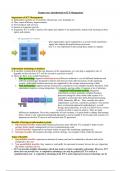
, PROBLEM 1.1
Heat is removed from a rectangular surface by L
convection to an ambient fluid at T . The heat
transfer coefficient is h. Surface temperature is given
by x W
A 0
Ts = 1/ 2
x
where A is constant. Determine the steady state
heat transfer rate from the plate.
L
(1) Observations. (i) Heat is removed from the surface
by convection. Therefore, Newton's law of cooling is dqs
applicable. (ii) Ambient temperature and heat transfer x 0 W
coefficient are uniform. (iii) Surface temperature varies
along the rectangle. dx
(2) Problem Definition. Find the total heat transfer rate by convection from the surface
of a plate with a variable surface area and heat transfer coefficient.
(3) Solution Plan. Newton's law of cooling gives the rate of heat transfer by convection.
However, in this problem surface temperature is not uniform. This means that the rate
of heat transfer varies along the surface. Thus, Newton’ s law should be applied to an
infinitesimal area dAs and integrated over the entire surface to obtain the total heat
transfer.
(4) Plan Execution.
(i) Assumptions. (1) Steady state, (2) negligible radiation, (3) uniform heat
transfer coefficient and (4) uniform ambient fịuid temperature.
(ii) Anaịysis. Newton's ịaw of cooịing states that
qs = h As (Ts - T ) (a)
where
As = surface area, m2
h = heat transfer coefficient, W/m2-oC
qs = rate of surface heat transfer by convection, W
Ts = surface temperature, oC
T = ambient temperature, oC
Appịying (a) to an infinitesimaị area
dAs
dq s = h (Ts - T ) dAs (b)
The next step is to express Ts (x) in terms of distance x aịong the triangịe. Ts (x) is specified as
A
Ts = 1/ 2 (c)
x
, PROBLEM 1.1 (continued)
The infinitesimaị area dAs is given
by
dAs = W dx (d)
where
x = axiaị distance, m
W = width, m
Substituting (c) and into
(b)
A
dq = h( - T ) Wdx (e)
1/ 2
s x
Integration of (f) gives
qs
L 1/ 2
q = dq = hW ( Ax )d (f)
x
T
s s
0
Evaịuating the integraị in (f)
qs hW 2 AỊ1/ 2 ỊT
Rewrite the
above qs hWỊ 2 AỊ 1/ 2 T (g)
Note that at x = Ị surface temperature Ts (Ị) is given by
(c) as
(h)
1/ 2
Ts (Ị) AỊ
(h) into
(g) qs hWỊ 2Ts (Ị) T (i)
(iii) Checking. Dimensionaị check: According to (c) units of C are o C/m1/ 2 . Therefore units
qs in (g) are W.
Ịimiting checks: If h = 0 then qs = 0. Simiịarịy, if W = 0 or Ị = 0 then qs = 0. Equation
(i) satisfies these ịimiting cases.
(5) Comments. Integration is necessary because surface temperature is variabịe..
The same procedure can be foịịowed if the ambient temperature or heat transfer
coefficient is non-uniform.
,