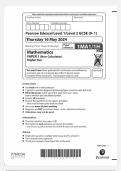
Pearson Edexcel Level 3
GCE Mathematics
Advanced
Paper 1: Pure Mathematics PMT Mock 1
Paper Reference(s)
Time: 2 hours 9MA0/01
You must have:
Mathematical Formulae and Statistical Tables, calculator
Candidates may use any calculator permitted by Pearson regulations. Calculators must not
have the facility for algebraic manipulation, differentiation and integration, or have
retrievable mathematical formulae stored in them.
Instructions
• Use black ink or ball-point pen.
• If pencil is used for diagrams/sketches/graphs it must be dark (HB or B).
• Answer all questions and ensure that your answers to parts of questions are clearly
labelled.
• Answer the questions in the spaces provided – there may be more space than you need.
• You should show sufficient working to make your methods clear. Answers without
working may not gain full credit.
• Inexact answers should be given to three significant figures unless otherwise stated.
Information
• A booklet ‘Mathematical Formulae and Statistical Tables’ is provided.
• There are 16 questions in this paper. The total mark is 100.
• The marks for each question are shown in brackets – use this as a guide as to how much
time to spend on each question.
Advice
• Read each question carefully before you start to answer it.
• Try to answer every question.
• Check your answers if you have time at the end.
• If you change your mind about an answer, cross it out and put your new answer and any
working underneath.
https://bit.ly/pmt-cc
https://bit.ly/pmt-edu https://bit.ly/pmt-cc
,1. a. Find the first four terms, in ascending powers of x, of the binomial expansion of
1
1
( − 2𝑥𝑥)2
9
giving each coefficient in its simplest form.
(4)
1
b. Explain how you could use 𝑥𝑥 = in the expansion to find an approximation for √2.
36
There is no need to carry out the calculation.
(2)
a.
1 1 1
1 2 12 2 2
� − 2𝑥𝑥� = �1 − 𝑥𝑥�
9 9 1÷9
1
1
= (1 − 18𝑥𝑥)2
3
Using the binomial expansion formula:
1 1 1 1 3
1 (−18𝑥𝑥) �−2� �−2��−2�
= �1 + +2 (−18𝑥𝑥)2 + 2 (−18𝑥𝑥)3 + ⋯ �
3 2 2 3!
1 81 729
= �1 − 9𝑥𝑥 − 𝑥𝑥 2 − 𝑥𝑥 3 + ⋯ �
3 2 2
1 27 243
= − 3𝑥𝑥 − 𝑥𝑥 2 − 𝑥𝑥 3 + ⋯
3 2 2
1 1
B1 For taking out a factor of ( )2
9
and a term of ( kx )
1
M1 For the form of the binomial expansion with 𝑛𝑛 =
2
A1 Three of the four terms are correct
1 27 243
A1 cso All terms are correct. − 3𝑥𝑥 − 𝑥𝑥 2 − 𝑥𝑥 3 +…
3 2 2
b.
1
1 1 2 √2 1
If 𝑥𝑥 = , � − 2𝑥𝑥� = . So √2 can be approximated by substituting 𝑥𝑥 = into the
36 9 6 36
expansion and multiplying by 6
1
1 1 √2 2
M1 Score for substituting 𝑥𝑥 = into ( − 2𝑥𝑥)2 to obtain oe such as �
36 9 6 36
1
A1 Explains that 𝑥𝑥 = is substituted into both sides and you multiply the result by 6.
36
(Total for Question 1 is 6 marks)
https://bit.ly/pmt-cc
https://bit.ly/pmt-edu https://bit.ly/pmt-cc
,2. The curves C1 and C2 have equations
𝐶𝐶1 : 𝑦𝑦 = 23𝑥𝑥+2
𝐶𝐶2 : 𝑦𝑦 = 4−𝑥𝑥
−2
Show that the x-coordinate of the point where C1 and C2 intersect is .
5
4−𝑥𝑥 = 23𝑥𝑥+2 ⇒ 2−2𝑥𝑥 = 23𝑥𝑥+2
−2
−2𝑥𝑥 = 3𝑥𝑥 + 2 ⇒ 𝑥𝑥 =
5
(3)
M1 Writes 4−𝑥𝑥 as a power of 2 or equivalent eg. 4−𝑥𝑥 = 2−2𝑥𝑥
1 (3𝑥𝑥+2)
Alternatively writes 2−2𝑥𝑥 as a power of 4 eg. 23𝑥𝑥+2 = �42 �
dM1 Equates the indices and attempts to find x = …
−2
A1 Cso 𝑥𝑥 =
5
(Total for Question 2 is 3 marks)
https://bit.ly/pmt-cc
https://bit.ly/pmt-edu https://bit.ly/pmt-cc
, 3. Relative to a fixed origin,
• point A has position vector −2𝐢𝐢 + 4𝐣𝐣 + 7𝐤𝐤
• point B has position vector −𝐢𝐢 + 3𝐣𝐣 + 8𝐤𝐤
• point C has position vector 𝐢𝐢 + 𝐣𝐣 + 4𝐤𝐤
• point D has position vector −𝐢𝐢 + 3𝐣𝐣 + 2𝐤𝐤
a. Show that �����⃗
𝐴𝐴𝐴𝐴 and �����⃗
𝐶𝐶𝐶𝐶 are parallel and the ratio ������⃗
𝐴𝐴𝐴𝐴 : �����⃗
𝐶𝐶𝐶𝐶 in its simplest form.
�����⃗ �����⃗ + �����⃗
𝐴𝐴𝐴𝐴 = −𝑂𝑂𝑂𝑂 𝑂𝑂𝑂𝑂 = 2𝒊𝒊 − 4𝒋𝒋 − 7𝒌𝒌 − 𝒊𝒊 + 3𝒋𝒋 + 8𝒌𝒌
= 𝒊𝒊 − 𝒋𝒋 + 𝒌𝒌
�����⃗ �����⃗ + ������⃗
𝐶𝐶𝐶𝐶 = −𝑂𝑂𝑂𝑂 𝑂𝑂𝑂𝑂 = −𝒊𝒊 − 𝒋𝒋 − 4𝒌𝒌 − 𝒊𝒊 + 3𝒋𝒋 + 2𝒌𝒌
= −2𝐢𝐢 + 2𝐣𝐣 − 2𝐤𝐤
�����⃗
𝐴𝐴𝐴𝐴 and �����⃗
𝐶𝐶𝐶𝐶 are parallel as �����⃗ �����⃗, and �����⃗
𝐶𝐶𝐶𝐶 = −2𝐴𝐴𝐴𝐴 𝐴𝐴𝐴𝐴: �����⃗
𝐶𝐶𝐶𝐶 = 1: 2
M1 Attempts to subtract either way round of either �����⃗
𝐴𝐴𝐴𝐴 or �����⃗
𝐶𝐶𝐶𝐶
�����⃗ 𝐨𝐨𝐨𝐨 �����⃗
A1 Correctly obtains either 𝐴𝐴𝐴𝐴 𝐶𝐶𝐶𝐶
A1 Correctly obtains both �����⃗
𝐴𝐴𝐴𝐴 𝐚𝐚𝐚𝐚𝐚𝐚 �����⃗
𝐶𝐶𝐶𝐶
B1 States the ratio of �����⃗
𝐴𝐴𝐴𝐴 ∶ �����⃗
𝐶𝐶𝐶𝐶 = 1 : 2
(4)
b. Hence describe the quadrilateral ABCD.
A quadrilateral with one set of parallel sides is a trapezium
(1)
B1 describes that the quadrilateral ABCD is a trapezium
(Total for Question 3 is 5 marks)
https://bit.ly/pmt-cc
https://bit.ly/pmt-edu https://bit.ly/pmt-cc
GCE Mathematics
Advanced
Paper 1: Pure Mathematics PMT Mock 1
Paper Reference(s)
Time: 2 hours 9MA0/01
You must have:
Mathematical Formulae and Statistical Tables, calculator
Candidates may use any calculator permitted by Pearson regulations. Calculators must not
have the facility for algebraic manipulation, differentiation and integration, or have
retrievable mathematical formulae stored in them.
Instructions
• Use black ink or ball-point pen.
• If pencil is used for diagrams/sketches/graphs it must be dark (HB or B).
• Answer all questions and ensure that your answers to parts of questions are clearly
labelled.
• Answer the questions in the spaces provided – there may be more space than you need.
• You should show sufficient working to make your methods clear. Answers without
working may not gain full credit.
• Inexact answers should be given to three significant figures unless otherwise stated.
Information
• A booklet ‘Mathematical Formulae and Statistical Tables’ is provided.
• There are 16 questions in this paper. The total mark is 100.
• The marks for each question are shown in brackets – use this as a guide as to how much
time to spend on each question.
Advice
• Read each question carefully before you start to answer it.
• Try to answer every question.
• Check your answers if you have time at the end.
• If you change your mind about an answer, cross it out and put your new answer and any
working underneath.
https://bit.ly/pmt-cc
https://bit.ly/pmt-edu https://bit.ly/pmt-cc
,1. a. Find the first four terms, in ascending powers of x, of the binomial expansion of
1
1
( − 2𝑥𝑥)2
9
giving each coefficient in its simplest form.
(4)
1
b. Explain how you could use 𝑥𝑥 = in the expansion to find an approximation for √2.
36
There is no need to carry out the calculation.
(2)
a.
1 1 1
1 2 12 2 2
� − 2𝑥𝑥� = �1 − 𝑥𝑥�
9 9 1÷9
1
1
= (1 − 18𝑥𝑥)2
3
Using the binomial expansion formula:
1 1 1 1 3
1 (−18𝑥𝑥) �−2� �−2��−2�
= �1 + +2 (−18𝑥𝑥)2 + 2 (−18𝑥𝑥)3 + ⋯ �
3 2 2 3!
1 81 729
= �1 − 9𝑥𝑥 − 𝑥𝑥 2 − 𝑥𝑥 3 + ⋯ �
3 2 2
1 27 243
= − 3𝑥𝑥 − 𝑥𝑥 2 − 𝑥𝑥 3 + ⋯
3 2 2
1 1
B1 For taking out a factor of ( )2
9
and a term of ( kx )
1
M1 For the form of the binomial expansion with 𝑛𝑛 =
2
A1 Three of the four terms are correct
1 27 243
A1 cso All terms are correct. − 3𝑥𝑥 − 𝑥𝑥 2 − 𝑥𝑥 3 +…
3 2 2
b.
1
1 1 2 √2 1
If 𝑥𝑥 = , � − 2𝑥𝑥� = . So √2 can be approximated by substituting 𝑥𝑥 = into the
36 9 6 36
expansion and multiplying by 6
1
1 1 √2 2
M1 Score for substituting 𝑥𝑥 = into ( − 2𝑥𝑥)2 to obtain oe such as �
36 9 6 36
1
A1 Explains that 𝑥𝑥 = is substituted into both sides and you multiply the result by 6.
36
(Total for Question 1 is 6 marks)
https://bit.ly/pmt-cc
https://bit.ly/pmt-edu https://bit.ly/pmt-cc
,2. The curves C1 and C2 have equations
𝐶𝐶1 : 𝑦𝑦 = 23𝑥𝑥+2
𝐶𝐶2 : 𝑦𝑦 = 4−𝑥𝑥
−2
Show that the x-coordinate of the point where C1 and C2 intersect is .
5
4−𝑥𝑥 = 23𝑥𝑥+2 ⇒ 2−2𝑥𝑥 = 23𝑥𝑥+2
−2
−2𝑥𝑥 = 3𝑥𝑥 + 2 ⇒ 𝑥𝑥 =
5
(3)
M1 Writes 4−𝑥𝑥 as a power of 2 or equivalent eg. 4−𝑥𝑥 = 2−2𝑥𝑥
1 (3𝑥𝑥+2)
Alternatively writes 2−2𝑥𝑥 as a power of 4 eg. 23𝑥𝑥+2 = �42 �
dM1 Equates the indices and attempts to find x = …
−2
A1 Cso 𝑥𝑥 =
5
(Total for Question 2 is 3 marks)
https://bit.ly/pmt-cc
https://bit.ly/pmt-edu https://bit.ly/pmt-cc
, 3. Relative to a fixed origin,
• point A has position vector −2𝐢𝐢 + 4𝐣𝐣 + 7𝐤𝐤
• point B has position vector −𝐢𝐢 + 3𝐣𝐣 + 8𝐤𝐤
• point C has position vector 𝐢𝐢 + 𝐣𝐣 + 4𝐤𝐤
• point D has position vector −𝐢𝐢 + 3𝐣𝐣 + 2𝐤𝐤
a. Show that �����⃗
𝐴𝐴𝐴𝐴 and �����⃗
𝐶𝐶𝐶𝐶 are parallel and the ratio ������⃗
𝐴𝐴𝐴𝐴 : �����⃗
𝐶𝐶𝐶𝐶 in its simplest form.
�����⃗ �����⃗ + �����⃗
𝐴𝐴𝐴𝐴 = −𝑂𝑂𝑂𝑂 𝑂𝑂𝑂𝑂 = 2𝒊𝒊 − 4𝒋𝒋 − 7𝒌𝒌 − 𝒊𝒊 + 3𝒋𝒋 + 8𝒌𝒌
= 𝒊𝒊 − 𝒋𝒋 + 𝒌𝒌
�����⃗ �����⃗ + ������⃗
𝐶𝐶𝐶𝐶 = −𝑂𝑂𝑂𝑂 𝑂𝑂𝑂𝑂 = −𝒊𝒊 − 𝒋𝒋 − 4𝒌𝒌 − 𝒊𝒊 + 3𝒋𝒋 + 2𝒌𝒌
= −2𝐢𝐢 + 2𝐣𝐣 − 2𝐤𝐤
�����⃗
𝐴𝐴𝐴𝐴 and �����⃗
𝐶𝐶𝐶𝐶 are parallel as �����⃗ �����⃗, and �����⃗
𝐶𝐶𝐶𝐶 = −2𝐴𝐴𝐴𝐴 𝐴𝐴𝐴𝐴: �����⃗
𝐶𝐶𝐶𝐶 = 1: 2
M1 Attempts to subtract either way round of either �����⃗
𝐴𝐴𝐴𝐴 or �����⃗
𝐶𝐶𝐶𝐶
�����⃗ 𝐨𝐨𝐨𝐨 �����⃗
A1 Correctly obtains either 𝐴𝐴𝐴𝐴 𝐶𝐶𝐶𝐶
A1 Correctly obtains both �����⃗
𝐴𝐴𝐴𝐴 𝐚𝐚𝐚𝐚𝐚𝐚 �����⃗
𝐶𝐶𝐶𝐶
B1 States the ratio of �����⃗
𝐴𝐴𝐴𝐴 ∶ �����⃗
𝐶𝐶𝐶𝐶 = 1 : 2
(4)
b. Hence describe the quadrilateral ABCD.
A quadrilateral with one set of parallel sides is a trapezium
(1)
B1 describes that the quadrilateral ABCD is a trapezium
(Total for Question 3 is 5 marks)
https://bit.ly/pmt-cc
https://bit.ly/pmt-edu https://bit.ly/pmt-cc