Negligence - Duty of Care
Introduction
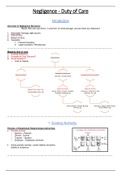
Overview of Negligence Structure:
Recall: Who can sue whom, in what tort, for what damage, and are there any defences?
1. Actionable Damage (not ‘actual’)
2. Duty of Care
3. Breach of Duty
4. Causation
1. Factual Causation
2. Legal Causation/ Remoteness
Mapping duty of care:
1. Existing Authority?
2. Exceptional Duty Scenario? Duty of Care
3. Novel Situation?
o Look to Caparo
Established Authority?
Novel situation? Exceptional Duty Scenario?
(Darnley v Croydon NHS)
Apply the Pocket: Apply the Pocket:
Caparo three-stage test:
Doctor-Patient; Teacher-Student; Omissions; Third Party; Pub
Foreseeability, Prox, FJR
Employer-Employee etc Authority; PEL; etc
Doctor-Patient: Cassidy; Barnett; Omissions: Stovin; Smith; Dorset
Darnley; etc Yacht; Michael; etc
1. Existing Authority
Pockets of Established Relationships/Authorities:
• Pockets include:
o Doctors – Patients
o Drivers - Drivers
o Teacher – Student
o Employer – Employee (contract)
• Some pockets overlap = police liability and police
liability & omissions.
, 1.1 Doctor – Patient
Case Authority:
McFarlane v Tayside Health Board [2000] 2 AC 59 - Medical negligence case-unwanted child-recovery of costs of
upbringing.
Facts:
• Patient/doctor relationship
• The facts are that Mr. McFarlane underwent a vasectomy operation on 16 October 1989; by letter of 23 March
1990 he was told that his sperm counts were negative.
• In September 1991 (following the resumption of intercourse without contraceptive measures), Mrs. McFarlane
became pregnant and their fifth child, Catherine, was born on 6 May 1992.
• High levels of duty of care, breached by wrongful information (told that his sperm counts were negative) results in
wrongful conception.
Claim:
• They made a claim for damages for the financial costs of raising the child. The mother claimed damages for the
physical discomfort caused by pregnancy and birth. Both claims were rejected at first instance by the Lord
Ordinary (Lord Gill).
• Mr. McFarlane appealed a rejection (by Lord Gill) of his claim.
• Lord Gill - considered the pregnancy could not be equiparated with a physical injury, but that even if it could it was
not an injury for which damages are recoverable. The existence of the child and the mother's happiness derived
from it could not be ignored and they outweighed the pain and discomfort.
Held:
• The doctor undertakes a duty of care in regard to the prevention of pregnancy: it does not follow that the duty
includes also avoiding the costs of rearing the child if born and accepted into the family.
• This is not the result of a public policy rule which would otherwise produce a different conclusion; it comes from
the inherent limitation of the liability relied on.
• The claim for compensation/apology stood, and the claim for expenses caused directly and immediately by the
pregnancy and birth, including medical expenses (if any) and the costs of the layette, but the claim for damages in
respect of the rearing of the child is dismissed.
• Lord Steyn – distributive justice requires ‘a focus on the just distribution of burdens and losses among members of
society’. Thus, in terms of distributive justice, this doesn’t satisfy it, but in terms of corrective justice, there is
liability.
Rees v Darlington Memorial Hospital NHS Trust [2004] 1 AC 309 – Medical negligence case-unwanted child-recovery
of costs of upbringing.
Facts:
• R’s severe visual disability had led her to seek sterilisation on the basis that she could not discharge ordinary
maternal duties.
• She had communicated her concerns to the consultant who performed the operation.
Issue:
• Did the decision in McFarlane mean that none of the costs of bringing up a healthy child could ever be claimed
whatever the circumstances. (In other words, the Court of Appeal were faced with the precise reverse of the
situation in Parkinson i.e. disabled mother, healthy child).
Held:
• The Court of Appeal, by a majority, concluded, that while R was precluded from recovering the costs of bringing
up a healthy child, she could recover the extra costs attributable to her disability.
• This was overthrown by the House of Lords who held that a disabled mother who gave birth to a healthy child after
a negligently-performed sterilisation operation was not entitled to recover the extra costs of childcare occasioned
by her disability.
• However, fairness and reasonableness meant there should be a conventional sum awarded to the parents by way
of general damages, not for the birth of the child, but for the denial of an important aspect of their personal
autonomy, the right to limit the size of their family.
• The parents, particularly even today the mother, had been denied through the negligence of another the
opportunity to live her life as she wished and planned. Accordingly, in all such cases there should be a
conventional award in the sum of £15,000 to mark the injury and loss.
Darnley v Croydon Health Services NHS Trust (2018) - Medical negligence case
• C went to hospital complaining of a headache after getting into a fight.
• Hospital warned him of the long wait, which was incorrect as patients comparing of head injury have to be seen
soon.
• C leave after some time, goes home, wakes in excruciating pain. He is brought back to the hospital but suffers
brain damage.
• He sues the NHS about the wrongful information.
Introduction
Overview of Negligence Structure:
Recall: Who can sue whom, in what tort, for what damage, and are there any defences?
1. Actionable Damage (not ‘actual’)
2. Duty of Care
3. Breach of Duty
4. Causation
1. Factual Causation
2. Legal Causation/ Remoteness
Mapping duty of care:
1. Existing Authority?
2. Exceptional Duty Scenario? Duty of Care
3. Novel Situation?
o Look to Caparo
Established Authority?
Novel situation? Exceptional Duty Scenario?
(Darnley v Croydon NHS)
Apply the Pocket: Apply the Pocket:
Caparo three-stage test:
Doctor-Patient; Teacher-Student; Omissions; Third Party; Pub
Foreseeability, Prox, FJR
Employer-Employee etc Authority; PEL; etc
Doctor-Patient: Cassidy; Barnett; Omissions: Stovin; Smith; Dorset
Darnley; etc Yacht; Michael; etc
1. Existing Authority
Pockets of Established Relationships/Authorities:
• Pockets include:
o Doctors – Patients
o Drivers - Drivers
o Teacher – Student
o Employer – Employee (contract)
• Some pockets overlap = police liability and police
liability & omissions.
, 1.1 Doctor – Patient
Case Authority:
McFarlane v Tayside Health Board [2000] 2 AC 59 - Medical negligence case-unwanted child-recovery of costs of
upbringing.
Facts:
• Patient/doctor relationship
• The facts are that Mr. McFarlane underwent a vasectomy operation on 16 October 1989; by letter of 23 March
1990 he was told that his sperm counts were negative.
• In September 1991 (following the resumption of intercourse without contraceptive measures), Mrs. McFarlane
became pregnant and their fifth child, Catherine, was born on 6 May 1992.
• High levels of duty of care, breached by wrongful information (told that his sperm counts were negative) results in
wrongful conception.
Claim:
• They made a claim for damages for the financial costs of raising the child. The mother claimed damages for the
physical discomfort caused by pregnancy and birth. Both claims were rejected at first instance by the Lord
Ordinary (Lord Gill).
• Mr. McFarlane appealed a rejection (by Lord Gill) of his claim.
• Lord Gill - considered the pregnancy could not be equiparated with a physical injury, but that even if it could it was
not an injury for which damages are recoverable. The existence of the child and the mother's happiness derived
from it could not be ignored and they outweighed the pain and discomfort.
Held:
• The doctor undertakes a duty of care in regard to the prevention of pregnancy: it does not follow that the duty
includes also avoiding the costs of rearing the child if born and accepted into the family.
• This is not the result of a public policy rule which would otherwise produce a different conclusion; it comes from
the inherent limitation of the liability relied on.
• The claim for compensation/apology stood, and the claim for expenses caused directly and immediately by the
pregnancy and birth, including medical expenses (if any) and the costs of the layette, but the claim for damages in
respect of the rearing of the child is dismissed.
• Lord Steyn – distributive justice requires ‘a focus on the just distribution of burdens and losses among members of
society’. Thus, in terms of distributive justice, this doesn’t satisfy it, but in terms of corrective justice, there is
liability.
Rees v Darlington Memorial Hospital NHS Trust [2004] 1 AC 309 – Medical negligence case-unwanted child-recovery
of costs of upbringing.
Facts:
• R’s severe visual disability had led her to seek sterilisation on the basis that she could not discharge ordinary
maternal duties.
• She had communicated her concerns to the consultant who performed the operation.
Issue:
• Did the decision in McFarlane mean that none of the costs of bringing up a healthy child could ever be claimed
whatever the circumstances. (In other words, the Court of Appeal were faced with the precise reverse of the
situation in Parkinson i.e. disabled mother, healthy child).
Held:
• The Court of Appeal, by a majority, concluded, that while R was precluded from recovering the costs of bringing
up a healthy child, she could recover the extra costs attributable to her disability.
• This was overthrown by the House of Lords who held that a disabled mother who gave birth to a healthy child after
a negligently-performed sterilisation operation was not entitled to recover the extra costs of childcare occasioned
by her disability.
• However, fairness and reasonableness meant there should be a conventional sum awarded to the parents by way
of general damages, not for the birth of the child, but for the denial of an important aspect of their personal
autonomy, the right to limit the size of their family.
• The parents, particularly even today the mother, had been denied through the negligence of another the
opportunity to live her life as she wished and planned. Accordingly, in all such cases there should be a
conventional award in the sum of £15,000 to mark the injury and loss.
Darnley v Croydon Health Services NHS Trust (2018) - Medical negligence case
• C went to hospital complaining of a headache after getting into a fight.
• Hospital warned him of the long wait, which was incorrect as patients comparing of head injury have to be seen
soon.
• C leave after some time, goes home, wakes in excruciating pain. He is brought back to the hospital but suffers
brain damage.
• He sues the NHS about the wrongful information.