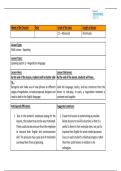
Name of the Teacher Date Level of the class Length of lesson
C1 – Advanced 60 minutes
Lesson Type:
Skills Lesson – Speaking
Lesson Topic:
Speaking option 2 – Negotiation language
Lesson Aims: Lesson Outcomes:
By the end of the lesson, students will be better able By the end of the lesson, students will have…
to…
Recognize and make use of new phrases at different Used the language, tactics, and key structures from the
stages of negotiation, to make proposals, bargains and lesson to role-play, in pairs, a negotiation between a
reach a deal in the English language. customer and supplier.
Anticipated difficulties: Suggested solutions:
1. Due to the student’s employee paying for the 1. Create the lessons as entertaining as possible.
lessons, the student may not be very motivated. Relate lessons to real-life situations so that it is
There could also be pressure from the employee useful to them in their everyday lives, not just to
to improve their English and communication improve their English for work-related purposes.
skill. The pressure may cause lack of motivation Focus on each student’s individual progress rather
and keep them from progressing. than their performance in relation to his
colleagues.
, 2. The students probably know each other as they 2. Activities and exercises that require peer correction
work for the same telecommunications should be avoided as employees may feel
company. Therefore, it is possible that there uncomfortable to correct their peer in higher
might be competition among the group. Issues positions than themselves. To include activities that
that exist in the workplace or outside of class give all students the opportunity to participate in
might be brought into the class. class and avoid exercises where students need to
compete.
3. The students are likely to get the /r/ and /l/ 3. Give them practice with minimal pairs to help them
sounds mixed up due to Japanese speakers are with this error. I.e., rook and look.
not able to tell the difference between the two
sounds. Japanese doesn’t have a /l/ sound and
the /r/ sound, is it also different to that we have
in English.
Target Language Analysis
Include an analysis of the target language you will present in order for your learners to complete the ‘real-life’
task you have chosen.
● Choose your set phrases (8-12 is appropriate)
● Analyse them in a paragraph or table
● Include meaning, function/use, features of pronunciation (speaking) or spelling and punctuation (writing),
plus anything else you think is interesting
, Set Phrases Meaning of the Functions/ use of the CCQ’s Pronunciation
phrase phrase
Phrase 1: Let’s start by To begin with having a Function as an opening 1. Will you make a lɛts stɑːt baɪ ˈhævɪŋ ə lʊk
having a look at the look at a list of items to statement to negotiations statement at the start æt ði əˈʤɛndə.
agenda. be discussed at a meeting by agreeing on the of the negotiation
or to set an agenda. agenda, the negotiations process?
can start. 2. Will this be a polite and
efficient way to start
the discussion?
3. Will both parties
understand what needs
to be discussed to
reach an outcome?
Phrase 2: What are your The meeting will give Functions to understand 1. Are you listening to the wɒt ɑː jɔː vjuːz ɒn…?
views on…? people the opportunity to their views (stance and other parties’ views?
express their views about needs) and to ask for a 2. Will you receive
the topic being discussed. proposal. significant information
that you can use at a
later stage?
3. Are you delivering your
request of needs or
searching out their
requests of needs from
the negotiation?
Phrase 3: I’d like to You have a proposal that Functions as an 1. Are you being forceful aɪd laɪk tuː səˈʤɛst ə
suggest a solution. you believe will be the introduction to the in your proposal to səˈluːʃən.
best option. proposal. receive an agreement
from the other party?
2. Are you presenting
your proposal clearly?
3. Will this be the time to
present a solution
when the negotiation
C1 – Advanced 60 minutes
Lesson Type:
Skills Lesson – Speaking
Lesson Topic:
Speaking option 2 – Negotiation language
Lesson Aims: Lesson Outcomes:
By the end of the lesson, students will be better able By the end of the lesson, students will have…
to…
Recognize and make use of new phrases at different Used the language, tactics, and key structures from the
stages of negotiation, to make proposals, bargains and lesson to role-play, in pairs, a negotiation between a
reach a deal in the English language. customer and supplier.
Anticipated difficulties: Suggested solutions:
1. Due to the student’s employee paying for the 1. Create the lessons as entertaining as possible.
lessons, the student may not be very motivated. Relate lessons to real-life situations so that it is
There could also be pressure from the employee useful to them in their everyday lives, not just to
to improve their English and communication improve their English for work-related purposes.
skill. The pressure may cause lack of motivation Focus on each student’s individual progress rather
and keep them from progressing. than their performance in relation to his
colleagues.
, 2. The students probably know each other as they 2. Activities and exercises that require peer correction
work for the same telecommunications should be avoided as employees may feel
company. Therefore, it is possible that there uncomfortable to correct their peer in higher
might be competition among the group. Issues positions than themselves. To include activities that
that exist in the workplace or outside of class give all students the opportunity to participate in
might be brought into the class. class and avoid exercises where students need to
compete.
3. The students are likely to get the /r/ and /l/ 3. Give them practice with minimal pairs to help them
sounds mixed up due to Japanese speakers are with this error. I.e., rook and look.
not able to tell the difference between the two
sounds. Japanese doesn’t have a /l/ sound and
the /r/ sound, is it also different to that we have
in English.
Target Language Analysis
Include an analysis of the target language you will present in order for your learners to complete the ‘real-life’
task you have chosen.
● Choose your set phrases (8-12 is appropriate)
● Analyse them in a paragraph or table
● Include meaning, function/use, features of pronunciation (speaking) or spelling and punctuation (writing),
plus anything else you think is interesting
, Set Phrases Meaning of the Functions/ use of the CCQ’s Pronunciation
phrase phrase
Phrase 1: Let’s start by To begin with having a Function as an opening 1. Will you make a lɛts stɑːt baɪ ˈhævɪŋ ə lʊk
having a look at the look at a list of items to statement to negotiations statement at the start æt ði əˈʤɛndə.
agenda. be discussed at a meeting by agreeing on the of the negotiation
or to set an agenda. agenda, the negotiations process?
can start. 2. Will this be a polite and
efficient way to start
the discussion?
3. Will both parties
understand what needs
to be discussed to
reach an outcome?
Phrase 2: What are your The meeting will give Functions to understand 1. Are you listening to the wɒt ɑː jɔː vjuːz ɒn…?
views on…? people the opportunity to their views (stance and other parties’ views?
express their views about needs) and to ask for a 2. Will you receive
the topic being discussed. proposal. significant information
that you can use at a
later stage?
3. Are you delivering your
request of needs or
searching out their
requests of needs from
the negotiation?
Phrase 3: I’d like to You have a proposal that Functions as an 1. Are you being forceful aɪd laɪk tuː səˈʤɛst ə
suggest a solution. you believe will be the introduction to the in your proposal to səˈluːʃən.
best option. proposal. receive an agreement
from the other party?
2. Are you presenting
your proposal clearly?
3. Will this be the time to
present a solution
when the negotiation