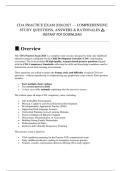
CDA PRACTICE EXAM 2026/2027 — COMPREHENSIVE
STUDY QUESTIONS, ANSWERS & RATIONALES 📥
INSTANT PDF DOWNLOAD
📘 Overview
This CDA Practice Exam 2025 is a complete study resource designed to help early childhood
educators prepare confidently for the Child Development Associate (CDA) credentialing
assessment. The exam includes 85 high-quality, scenario-based practice questions aligned
with the CDA Competency Standards, reflecting the skills and knowledge candidates need to
demonstrate in real early learning environments.
These questions are crafted to mirror the format, style, and difficulty of typical CDA test
questions—without reproducing or compromising any proprietary exam content. Each question
includes:
Four multiple-choice options
The correct answer in bold
A clear, accessible rationale explaining why the answer is correct
The content spans all major CDA competency areas, including:
Safe & Healthy Environments
Physical, Cognitive, and Social-Emotional Development
Developmentally Appropriate Practice (DAP)
Supporting Dual Language Learners
Curriculum Planning Across Learning Domains
Positive Guidance & Behavior Support
Observation, Documentation, & Assessment
Building Strong Family Partnerships
Professionalism & Ethics
Inclusive and Culturally Responsive Teaching
This practice exam is ideal for:
CDA candidates preparing for the Pearson VUE computerized exam
Early childhood educators seeking to strengthen classroom practice
Trainers, coaches, and program directors offering CDA study support
, Anyone refreshing their knowledge of high-quality early childhood education principles
With authentic scenarios, clear explanations, and coverage of real-world teaching practices,
this resource helps you build the confidence and competency needed to succeed—not just on the
exam, but in your everyday work with young children and families.
1. Which activity best promotes fine motor development in a
3-year-old?
A. Running on the playground
B. Singing songs
C. Using tweezers to pick up pom-poms
D. Listening to a story
Rationale: Fine motor tasks involve small movements of hands/fingers; tweezers strengthen
pincer grasp.
2. A child repeatedly dumps out toys and walks away. The
teacher should first:
A. Remove all toys from the area
B. Send the child to time-out
C. Observe to understand the child’s behavior pattern
D. Tell the child to stop and sit down
Rationale: Observation comes before intervention; the teacher must understand why the
behavior occurs.
3. Which item is required in a safe infant sleep environment?
A. Soft blanket
B. Crib bumpers
C. Pillow
D. Fitted sheet only
, Rationale: Safe sleep guidelines (AAP) require a firm mattress with a tight fitted sheet and
nothing else.
4. The best example of scaffolding is:
A. Letting children solve problems completely alone
B. Giving hints and step-by-step support as needed
C. Correcting every mistake immediately
D. Showing the child the correct final answer
Rationale: Scaffolding provides temporary support based on the child’s current skill level.
5. A culturally responsive classroom practice is to:
A. Teach only mainstream holidays
B. Include materials that reflect all children’s home languages and cultures
C. Expect families to adapt to school norms
D. Avoid discussing cultural differences
Rationale: Materials should authentically reflect and honor children’s home cultures.
6. A teacher notices a bruise in the shape of a belt. The
teacher should:
A. Ask the parent what happened
B. Ignore it
C. Follow mandated reporter requirements
D. Post about concerns on staff group chat
Rationale: Suspected abuse must be reported; teachers should not investigate themselves.
7. Which activity promotes emergent literacy in toddlers?
A. Worksheets
B. Memorizing the alphabet
STUDY QUESTIONS, ANSWERS & RATIONALES 📥
INSTANT PDF DOWNLOAD
📘 Overview
This CDA Practice Exam 2025 is a complete study resource designed to help early childhood
educators prepare confidently for the Child Development Associate (CDA) credentialing
assessment. The exam includes 85 high-quality, scenario-based practice questions aligned
with the CDA Competency Standards, reflecting the skills and knowledge candidates need to
demonstrate in real early learning environments.
These questions are crafted to mirror the format, style, and difficulty of typical CDA test
questions—without reproducing or compromising any proprietary exam content. Each question
includes:
Four multiple-choice options
The correct answer in bold
A clear, accessible rationale explaining why the answer is correct
The content spans all major CDA competency areas, including:
Safe & Healthy Environments
Physical, Cognitive, and Social-Emotional Development
Developmentally Appropriate Practice (DAP)
Supporting Dual Language Learners
Curriculum Planning Across Learning Domains
Positive Guidance & Behavior Support
Observation, Documentation, & Assessment
Building Strong Family Partnerships
Professionalism & Ethics
Inclusive and Culturally Responsive Teaching
This practice exam is ideal for:
CDA candidates preparing for the Pearson VUE computerized exam
Early childhood educators seeking to strengthen classroom practice
Trainers, coaches, and program directors offering CDA study support
, Anyone refreshing their knowledge of high-quality early childhood education principles
With authentic scenarios, clear explanations, and coverage of real-world teaching practices,
this resource helps you build the confidence and competency needed to succeed—not just on the
exam, but in your everyday work with young children and families.
1. Which activity best promotes fine motor development in a
3-year-old?
A. Running on the playground
B. Singing songs
C. Using tweezers to pick up pom-poms
D. Listening to a story
Rationale: Fine motor tasks involve small movements of hands/fingers; tweezers strengthen
pincer grasp.
2. A child repeatedly dumps out toys and walks away. The
teacher should first:
A. Remove all toys from the area
B. Send the child to time-out
C. Observe to understand the child’s behavior pattern
D. Tell the child to stop and sit down
Rationale: Observation comes before intervention; the teacher must understand why the
behavior occurs.
3. Which item is required in a safe infant sleep environment?
A. Soft blanket
B. Crib bumpers
C. Pillow
D. Fitted sheet only
, Rationale: Safe sleep guidelines (AAP) require a firm mattress with a tight fitted sheet and
nothing else.
4. The best example of scaffolding is:
A. Letting children solve problems completely alone
B. Giving hints and step-by-step support as needed
C. Correcting every mistake immediately
D. Showing the child the correct final answer
Rationale: Scaffolding provides temporary support based on the child’s current skill level.
5. A culturally responsive classroom practice is to:
A. Teach only mainstream holidays
B. Include materials that reflect all children’s home languages and cultures
C. Expect families to adapt to school norms
D. Avoid discussing cultural differences
Rationale: Materials should authentically reflect and honor children’s home cultures.
6. A teacher notices a bruise in the shape of a belt. The
teacher should:
A. Ask the parent what happened
B. Ignore it
C. Follow mandated reporter requirements
D. Post about concerns on staff group chat
Rationale: Suspected abuse must be reported; teachers should not investigate themselves.
7. Which activity promotes emergent literacy in toddlers?
A. Worksheets
B. Memorizing the alphabet