INTERNATIONAL BUSINESS STRATEGY (MSc)
GENERAL INFO: This summary is created in academic year 2020-2021 for MSc
International Business and Management for the course International Business Strategy
EBM088A05. I advise you to use this summary together with the summary of the
articles which is also available, written by me. This exam was an open book exam which
I finished with an 8. Good luck with studying! (:
LECTURE 1: THE CONCEPT OF STRATEGY
What kind of role CEOs play in facilitating firms’ adaptation to environmental changes?
What kind of CEO characteristics you should look for when striving for your strategic goals?
Strategy
The essence of strategy is to find a way to cope with competition (Porter, 1979).
Three typical views of strategy formulation:
- Industry structure affects strategy
- Firm resources affect strategy (= resource-based view), where competitive advantage
comes from a firm’s internal resources
- Strategy is an emerging process (learning-by-doing), a strategy may form gradually. A
strategy is formed when there is an observed, consistent pattern in a decision stream
(Mintzberg, 1978). Think about painting, the painting skills emerge over time due to
different market demands and or skills development. Strategy is formulated on basis of
a feedback loop where feedback is directly implemented to adapt strategy.
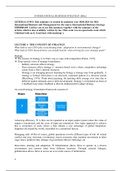
An overall strategy formulation framework consists of:
Achieving efficiency A firm can be regarded as an input-output system where the value of
output is maximized, and the costs of input are minimized. One major approach to achieve
this is economies of scale, where a firm obtains a cost advantage of global integration.
Suppliers all around the world, assembled in a centralized factory.
Managing risks But of course, global operations involve different types of risk violent
conflict risk (war, terrorism, revolutions), macro-economic risks (random movements in labor
wage rates), political risks (change of government, Brexit, lobbying), etc.
Innovation, learning and adaptation Globalization allows firms to operate in a diverse
environment and connect ideas from different locations. Through external linkages,
globalization allows firms to access an even wider source of information.
1
, 2
GENERAL INFO: This summary is created in academic year 2020-2021 for MSc
International Business and Management for the course International Business Strategy
EBM088A05. I advise you to use this summary together with the summary of the
articles which is also available, written by me. This exam was an open book exam which
I finished with an 8. Good luck with studying! (:
LECTURE 1: THE CONCEPT OF STRATEGY
What kind of role CEOs play in facilitating firms’ adaptation to environmental changes?
What kind of CEO characteristics you should look for when striving for your strategic goals?
Strategy
The essence of strategy is to find a way to cope with competition (Porter, 1979).
Three typical views of strategy formulation:
- Industry structure affects strategy
- Firm resources affect strategy (= resource-based view), where competitive advantage
comes from a firm’s internal resources
- Strategy is an emerging process (learning-by-doing), a strategy may form gradually. A
strategy is formed when there is an observed, consistent pattern in a decision stream
(Mintzberg, 1978). Think about painting, the painting skills emerge over time due to
different market demands and or skills development. Strategy is formulated on basis of
a feedback loop where feedback is directly implemented to adapt strategy.
An overall strategy formulation framework consists of:
Achieving efficiency A firm can be regarded as an input-output system where the value of
output is maximized, and the costs of input are minimized. One major approach to achieve
this is economies of scale, where a firm obtains a cost advantage of global integration.
Suppliers all around the world, assembled in a centralized factory.
Managing risks But of course, global operations involve different types of risk violent
conflict risk (war, terrorism, revolutions), macro-economic risks (random movements in labor
wage rates), political risks (change of government, Brexit, lobbying), etc.
Innovation, learning and adaptation Globalization allows firms to operate in a diverse
environment and connect ideas from different locations. Through external linkages,
globalization allows firms to access an even wider source of information.
1
, 2