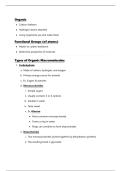
Organic:
Carbon skeleton
Hydrogen atoms attached
Living organisms use and make them
Functional Groups (of atoms):
Attach to carbon backbone
Determine properties of molecule
Types of Organic Macromolecules:
1. Carbohydrate
a. Made of carbon, hydrogen, and oxygen
b. Primary energy source for animals
c. Ex. Sugars & starches
d. Monosaccharides
i. Simple sugars
ii. Usually contains 5 or 6 carbons
iii. Soluble in water
iv. Taste sweet
v. Ex. Glucose
Most common monosaccharide
Forms a ring in water
Rings can combine to form disaccharides
e. Disaccharides
i. Two monosaccharides joined together by dehydration synthesis
ii. The resulting bond is glycosidic
Carbon skeleton
Hydrogen atoms attached
Living organisms use and make them
Functional Groups (of atoms):
Attach to carbon backbone
Determine properties of molecule
Types of Organic Macromolecules:
1. Carbohydrate
a. Made of carbon, hydrogen, and oxygen
b. Primary energy source for animals
c. Ex. Sugars & starches
d. Monosaccharides
i. Simple sugars
ii. Usually contains 5 or 6 carbons
iii. Soluble in water
iv. Taste sweet
v. Ex. Glucose
Most common monosaccharide
Forms a ring in water
Rings can combine to form disaccharides
e. Disaccharides
i. Two monosaccharides joined together by dehydration synthesis
ii. The resulting bond is glycosidic