Bio 161 midterm cal pol neal Questions and
Answers with Complete Solutions 100% Correct |
New Update 2025-2026
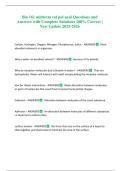
Carbon, Hydrogen, Oxygen, Nitrogen, Phosphorous, Sulfur - ANSWERS Most
abundant elements in organisms
Why is water an excellent solvent? - ANSWERS because of its polarity
Why do nonpolar molecules don't dissolve in water? - ANSWERS They are
hydrophobic. Water will interact with itself, encapsulating the nonpolar molecule.
Van der Waals interactions - ANSWERS Weak attractions between molecules
or parts of molecules that result from transient local partial charges.
Cohesion - ANSWERS Attraction between molecules of the same substance
Adhesion - ANSWERS An attraction between molecules of different substances
i.e liquid and a solid surface
surface tension - ANSWERS the force that acts on the surface of a liquid to
stick together and that tends to minimize the area of the surface
, specific heat - ANSWERS The amount of energy required to raise the
temperature of 1 gram of a substance by 1 degree C
heat of vaporization - ANSWERS the quantity of heat a liquid must absorb for
1 g of it to be converted from the liquid to the gaseous state
What bonds break when water vaporizes? - ANSWERS hydrogen bonds
Bonds with low potential energy - ANSWERS Polar, short, strong bonds.
Electrons are held tightly and are more stable.
Bonds with high potential energy - ANSWERS nonpolar, long, weak bonds.
Electrons are loosely held and easier to break
potential energy - ANSWERS stored energy that results from the position or
shape of an object
kinetic energy - ANSWERS energy due to motion
chemical energy - ANSWERS Energy stored in chemical bonds
If products have lower potential energy than the reactants then - ANSWERS
the reaction is spontanteous
chemical reactions are spontaneous if - ANSWERS -they proceed without any
continuous external influence
Answers with Complete Solutions 100% Correct |
New Update 2025-2026
Carbon, Hydrogen, Oxygen, Nitrogen, Phosphorous, Sulfur - ANSWERS Most
abundant elements in organisms
Why is water an excellent solvent? - ANSWERS because of its polarity
Why do nonpolar molecules don't dissolve in water? - ANSWERS They are
hydrophobic. Water will interact with itself, encapsulating the nonpolar molecule.
Van der Waals interactions - ANSWERS Weak attractions between molecules
or parts of molecules that result from transient local partial charges.
Cohesion - ANSWERS Attraction between molecules of the same substance
Adhesion - ANSWERS An attraction between molecules of different substances
i.e liquid and a solid surface
surface tension - ANSWERS the force that acts on the surface of a liquid to
stick together and that tends to minimize the area of the surface
, specific heat - ANSWERS The amount of energy required to raise the
temperature of 1 gram of a substance by 1 degree C
heat of vaporization - ANSWERS the quantity of heat a liquid must absorb for
1 g of it to be converted from the liquid to the gaseous state
What bonds break when water vaporizes? - ANSWERS hydrogen bonds
Bonds with low potential energy - ANSWERS Polar, short, strong bonds.
Electrons are held tightly and are more stable.
Bonds with high potential energy - ANSWERS nonpolar, long, weak bonds.
Electrons are loosely held and easier to break
potential energy - ANSWERS stored energy that results from the position or
shape of an object
kinetic energy - ANSWERS energy due to motion
chemical energy - ANSWERS Energy stored in chemical bonds
If products have lower potential energy than the reactants then - ANSWERS
the reaction is spontanteous
chemical reactions are spontaneous if - ANSWERS -they proceed without any
continuous external influence