MBA 706- LSUS Chen- Mod 5
Study online at https://quizlet.com/_bq44i7
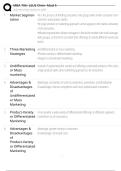
1. Market Segmen- •It is the process of dividing consumers into groups with similar consumer char-
tation acteristics and product needs.
•A single product or marketing approach cannot appeal to the needs and wants
of all consumers.
•Market segmentation allows managers to break the market into small manage-
able groups, so that firms can tailor their offerings to satisfy different needs and
wants.
2. Three Marketing •Undifferentiated or mass marketing
Strategies •Product-variety or differentiated marketing
•Target or concentrated marketing
3. Undifferentiated Instead of segmenting the market and offering customized products, firms sell a
or Mass single product (with same marketing approach) to all consumers
marketing
4. Advantages & Advantage: economies of scale in production, promotion, and distribution.
Disadvantages Disadvantage: intense competition and more sophisticated consumers.
of
Undifferentiated
or Mass
Marketing
5. Product-Variety Firms provide a wide variety of differentiated offerings to different segments
or Differentiated (sometimes to all consumers).
Marketing
6. Advantages & Advantage: greater variety to consumers
Disadvantages Disadvantage: increased costs
of
Product-Variety
or Differentiated
Marketing
1/5
, MBA 706- LSUS Chen- Mod 5
Study online at https://quizlet.com/_bq44i7
7. Target or Concen- Usually, firms identify the major market segments, and then target a single seg-
trated Marketing ment with a single marketing mix.
8. Advantages & Advantages: concentrated effort to that specific segment; control cost to appeal
Disadvantages of only to that primary target segment.
Target or Concen- Disadvantage: possibility of missed opportunities; vulnerable to competition.
trated Marketing
9. Multiple segmen- Firms target different segments with a unique marketing mix for each segment.
tation
10. Procedures of 1. Survey Stage
segmentation 2. Analysis Stage
3. Profiling Stage
11. Factors affecting •Measurable: data should be available to evaluate the attractiveness of the seg-
the feasibility of ment.
segmentation •Accessible: segment should be accessible to firms.
•Substantial: segment should be large and valuable.
•Unique: segment should be distinguishable from other segments.
•Appropriate: the development of the segment should align with firm's objectives
and resources.
•Stable: firms should be able to predict the behavior of the segment in the future.
12. Bases for Seg- •Geographic and geodemographic
mentation •Demographic
•Behavioral
•Psychographic
13. Geographic and Geographic:
Geodemographic One of the easiest and most commonly used methods.
Markets are divided into groups based on region, climate, population density
2/5
Study online at https://quizlet.com/_bq44i7
1. Market Segmen- •It is the process of dividing consumers into groups with similar consumer char-
tation acteristics and product needs.
•A single product or marketing approach cannot appeal to the needs and wants
of all consumers.
•Market segmentation allows managers to break the market into small manage-
able groups, so that firms can tailor their offerings to satisfy different needs and
wants.
2. Three Marketing •Undifferentiated or mass marketing
Strategies •Product-variety or differentiated marketing
•Target or concentrated marketing
3. Undifferentiated Instead of segmenting the market and offering customized products, firms sell a
or Mass single product (with same marketing approach) to all consumers
marketing
4. Advantages & Advantage: economies of scale in production, promotion, and distribution.
Disadvantages Disadvantage: intense competition and more sophisticated consumers.
of
Undifferentiated
or Mass
Marketing
5. Product-Variety Firms provide a wide variety of differentiated offerings to different segments
or Differentiated (sometimes to all consumers).
Marketing
6. Advantages & Advantage: greater variety to consumers
Disadvantages Disadvantage: increased costs
of
Product-Variety
or Differentiated
Marketing
1/5
, MBA 706- LSUS Chen- Mod 5
Study online at https://quizlet.com/_bq44i7
7. Target or Concen- Usually, firms identify the major market segments, and then target a single seg-
trated Marketing ment with a single marketing mix.
8. Advantages & Advantages: concentrated effort to that specific segment; control cost to appeal
Disadvantages of only to that primary target segment.
Target or Concen- Disadvantage: possibility of missed opportunities; vulnerable to competition.
trated Marketing
9. Multiple segmen- Firms target different segments with a unique marketing mix for each segment.
tation
10. Procedures of 1. Survey Stage
segmentation 2. Analysis Stage
3. Profiling Stage
11. Factors affecting •Measurable: data should be available to evaluate the attractiveness of the seg-
the feasibility of ment.
segmentation •Accessible: segment should be accessible to firms.
•Substantial: segment should be large and valuable.
•Unique: segment should be distinguishable from other segments.
•Appropriate: the development of the segment should align with firm's objectives
and resources.
•Stable: firms should be able to predict the behavior of the segment in the future.
12. Bases for Seg- •Geographic and geodemographic
mentation •Demographic
•Behavioral
•Psychographic
13. Geographic and Geographic:
Geodemographic One of the easiest and most commonly used methods.
Markets are divided into groups based on region, climate, population density
2/5