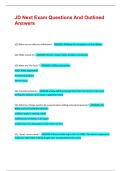
JD Next Exam Questions And Outlined
Answers
\Q\.When can an offer be withdrawn? - ANSWER-✔Before the acceptance of the offeree.
\Q\.FIRAC stands for - ANSWER-✔Facts, Issues, Rules, Analysis, Conclusion
\Q\.What are "the facts"? - ANSWER-✔Who sues whom.
Why? What happened?
Procedural posture.
Tell the story.
\Q\.Procedural Posture - ANSWER-✔How did the case get from the trial courts to the court
writing the opinion. (trial court > appellate court)
\Q\.What four things need to be covered when stating procedural posture? - ANSWER-✔1)
What court is issuing the opinion?
2) Which party is seeking relief?
3) What sort of motion is at issue?
4) What was the disposition of the lower courts?
\Q\."Issue" means what? - ANSWER-✔Issue is referring to the I in FIRAC. This term is suppose to
make you state what is being fought over and decided by the court.
, \Q\."Rules" means what? - ANSWER-✔Rules is referring to the R in FIRAC. This refers to guide
the courts decision as a matter of fact. This often involves previous cases and statutes.
\Q\."Application / Analysis" means what? - ANSWER-✔Application / Analysis refers to the courts
reasoning and how the decision is made.
\Q\.What four things must be included in the application / analysis? - ANSWER-✔1) What
argument does the plaintiff make.
2) What argument does the defendant make.
3) How did the court respond to those arguments?
4) Why did the court rule the way it did?
\Q\."Conclusion" means what? - ANSWER-✔The outcome of the courts ruling.
Includes damages.
\Q\.What should you reformulate in the conclusion? - ANSWER-✔You should reformulate the
issue by answering it in the conclusion.
\Q\.What is a contract? - ANSWER-✔Agreement between parties, creating mutual obligations
that are enforceable by law.
\Q\.What three things must a contract have? - ANSWER-✔1) Offer
2) Consideration
3) Acceptance
\Q\.Bilateral Contract - ANSWER-✔Seeks acceptance by return promise.
Answers
\Q\.When can an offer be withdrawn? - ANSWER-✔Before the acceptance of the offeree.
\Q\.FIRAC stands for - ANSWER-✔Facts, Issues, Rules, Analysis, Conclusion
\Q\.What are "the facts"? - ANSWER-✔Who sues whom.
Why? What happened?
Procedural posture.
Tell the story.
\Q\.Procedural Posture - ANSWER-✔How did the case get from the trial courts to the court
writing the opinion. (trial court > appellate court)
\Q\.What four things need to be covered when stating procedural posture? - ANSWER-✔1)
What court is issuing the opinion?
2) Which party is seeking relief?
3) What sort of motion is at issue?
4) What was the disposition of the lower courts?
\Q\."Issue" means what? - ANSWER-✔Issue is referring to the I in FIRAC. This term is suppose to
make you state what is being fought over and decided by the court.
, \Q\."Rules" means what? - ANSWER-✔Rules is referring to the R in FIRAC. This refers to guide
the courts decision as a matter of fact. This often involves previous cases and statutes.
\Q\."Application / Analysis" means what? - ANSWER-✔Application / Analysis refers to the courts
reasoning and how the decision is made.
\Q\.What four things must be included in the application / analysis? - ANSWER-✔1) What
argument does the plaintiff make.
2) What argument does the defendant make.
3) How did the court respond to those arguments?
4) Why did the court rule the way it did?
\Q\."Conclusion" means what? - ANSWER-✔The outcome of the courts ruling.
Includes damages.
\Q\.What should you reformulate in the conclusion? - ANSWER-✔You should reformulate the
issue by answering it in the conclusion.
\Q\.What is a contract? - ANSWER-✔Agreement between parties, creating mutual obligations
that are enforceable by law.
\Q\.What three things must a contract have? - ANSWER-✔1) Offer
2) Consideration
3) Acceptance
\Q\.Bilateral Contract - ANSWER-✔Seeks acceptance by return promise.