PRAXIS 5422 SCHOOL COUNSELOR STUDY GUIDE
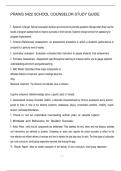
1. Systemic Change: School counselors build an environment to promote systemic change when they use the
results of program assessments to improve a process in their schools. Systemic change comes from assessing for
program improvement.
2. Criterion-Referenced Assessment: an assessment procedure in which a student's performance is
compared to a particular level of mastery
3. summative evaluation: Evaluation conducted after instruction to assess students' final achievement.
4. Formative Assessment: Assessment used throughout teaching of a lesson and/or unit to gauge students'
understanding and inform and guide teaching
5. ABC Model: Describes three major components of
attitudes Attective component- person's feelings about the
thing
Behavioral component- The influence that attitudes have on behavior
Cognitive component- Beliefs/knowledge about a specific object of interests
6. Generalized Anxiety Disorder (GAD): a disorder characterized by chronic excessive worry accom-
panied by three or more of the following symptoms: restlessness, fatigue, concentration problems, irritability, muscle
tension, and sleep disturbance
7. There is not an individual counseling action plan or results report.:
8. Mindsets and Behaviors for Student Success:
9. Action Plans: verify that all components are deliberated. They address the why, when and how lessons, activities
and interventions are delivered to students. Completing an action plan requires the school counselor to reflect on the
most ettective and eflcient delivery of services and how to express the best data story for each. The three types of action plan
are: core curriculum, small group responsive services and closing-the-gap.
10. Results Report: allow an honest evaluation of the delivery of core curriculum, small group responsive
,services and closing-the-gap action plans. They also provide the opportunity to describe how to do it better the next
time.
11. Closing-the-Gap Action Plan: This plan addresses academic, attendance or behavioral discrepancies
discovered through school data. It might target students with excessive absences, below expectation achievement, or
multiple disciplinary infractions.
12. Title II of the Civil Rights Act of 1964: Prohibits intentional discrimination on the basis of race,
color, religion, or national origin in places of public accommodation.
, 13. student learning outcome (SLO: focuses on the skills that students are expected to master in a
course. Unlike a learning objective, it's measurable. For example, an SLO would say ''Students will be able to identify and
describe assigned cell organelles with 80% accuracy.'' This example would be considered a student learning outcome
because it specifically describes what a student needs to be able to do, including the level of accuracy they are expected to
attain.
14. What are the basic goals of Bowen's approach: to assess family dynamics in order to
prescribe recommendations to individuals on how to function best in social relationships at home, work, or elsewhere.
15. What is Bowen's family systems theory?: a scientific theory of human behavior that views the
family as a living system whose relationships are primarily influenced by emotion. Each family member influences the
others to some degree.
16. Preconventional Morality: level of moral reasoning occurs during the early years and up to pre-ado-
lescence. Children in this level are prone to obey parents and other authority figures in order to obtain approval and
avoid punishment
17. conventional morality: level of moral development is characterized by the adherence to societal norms
as a standard of moral conduct. While level one is marked by compliance, level two is marked by conformity with social
norms. Adolescents moving toward young adulthood begin to shift from a narrow individual moral perspective that is
essentially self-serving to a more expansive approach slanted toward an external locus of control.
18. pot conventional morality: level of moral reasoning is marked by a more abstract approach to ethical
dilemmas. Individuals in this stage are driven by personal values and universal ethical principles
19. Henry believes it would be bad to cheat on his math exam because, if he
gets caught, his teacher will punish him. Henry is in the stage
of moral development.: Pre-conventional
20. Tyrone is a teenager who really wants to get in with the popular crowd.
Recently he was offered drugs at a party. He decided to turn the offer down
because he knew that his true friends would think less of him for taking drugs,
which would make him feel like a bad person. Tyrone is in the
1. Systemic Change: School counselors build an environment to promote systemic change when they use the
results of program assessments to improve a process in their schools. Systemic change comes from assessing for
program improvement.
2. Criterion-Referenced Assessment: an assessment procedure in which a student's performance is
compared to a particular level of mastery
3. summative evaluation: Evaluation conducted after instruction to assess students' final achievement.
4. Formative Assessment: Assessment used throughout teaching of a lesson and/or unit to gauge students'
understanding and inform and guide teaching
5. ABC Model: Describes three major components of
attitudes Attective component- person's feelings about the
thing
Behavioral component- The influence that attitudes have on behavior
Cognitive component- Beliefs/knowledge about a specific object of interests
6. Generalized Anxiety Disorder (GAD): a disorder characterized by chronic excessive worry accom-
panied by three or more of the following symptoms: restlessness, fatigue, concentration problems, irritability, muscle
tension, and sleep disturbance
7. There is not an individual counseling action plan or results report.:
8. Mindsets and Behaviors for Student Success:
9. Action Plans: verify that all components are deliberated. They address the why, when and how lessons, activities
and interventions are delivered to students. Completing an action plan requires the school counselor to reflect on the
most ettective and eflcient delivery of services and how to express the best data story for each. The three types of action plan
are: core curriculum, small group responsive services and closing-the-gap.
10. Results Report: allow an honest evaluation of the delivery of core curriculum, small group responsive
,services and closing-the-gap action plans. They also provide the opportunity to describe how to do it better the next
time.
11. Closing-the-Gap Action Plan: This plan addresses academic, attendance or behavioral discrepancies
discovered through school data. It might target students with excessive absences, below expectation achievement, or
multiple disciplinary infractions.
12. Title II of the Civil Rights Act of 1964: Prohibits intentional discrimination on the basis of race,
color, religion, or national origin in places of public accommodation.
, 13. student learning outcome (SLO: focuses on the skills that students are expected to master in a
course. Unlike a learning objective, it's measurable. For example, an SLO would say ''Students will be able to identify and
describe assigned cell organelles with 80% accuracy.'' This example would be considered a student learning outcome
because it specifically describes what a student needs to be able to do, including the level of accuracy they are expected to
attain.
14. What are the basic goals of Bowen's approach: to assess family dynamics in order to
prescribe recommendations to individuals on how to function best in social relationships at home, work, or elsewhere.
15. What is Bowen's family systems theory?: a scientific theory of human behavior that views the
family as a living system whose relationships are primarily influenced by emotion. Each family member influences the
others to some degree.
16. Preconventional Morality: level of moral reasoning occurs during the early years and up to pre-ado-
lescence. Children in this level are prone to obey parents and other authority figures in order to obtain approval and
avoid punishment
17. conventional morality: level of moral development is characterized by the adherence to societal norms
as a standard of moral conduct. While level one is marked by compliance, level two is marked by conformity with social
norms. Adolescents moving toward young adulthood begin to shift from a narrow individual moral perspective that is
essentially self-serving to a more expansive approach slanted toward an external locus of control.
18. pot conventional morality: level of moral reasoning is marked by a more abstract approach to ethical
dilemmas. Individuals in this stage are driven by personal values and universal ethical principles
19. Henry believes it would be bad to cheat on his math exam because, if he
gets caught, his teacher will punish him. Henry is in the stage
of moral development.: Pre-conventional
20. Tyrone is a teenager who really wants to get in with the popular crowd.
Recently he was offered drugs at a party. He decided to turn the offer down
because he knew that his true friends would think less of him for taking drugs,
which would make him feel like a bad person. Tyrone is in the