Criminology WJEC level 3
Study online at https://quizlet.com/_esheip
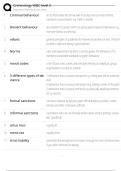
1. Criminal behaviour an act that breaks the formal laws of society and can lead to forma
sanctions or punishments e.g. theft or murder
2. Deviant behaviour any violation of society's norms or going against expected behaviour e.g.
excessive tattoos or piercings
3. values general principles or guidelines for how we should live our lives. They tell
us what is right and wrong/ good and bad
4. Norms rules and expectations by which a society guides the behaviour of its
members/acceptable standards to govern behaviour
5. moral codes a set of basic rules, values and principles held by an individual, group,
organisation or society as a whole
6. 3 different types of de- 1) behaviour that is unusual and good (e.g. risking your life for someone
viance else)
2) behaviour that is unusual and bizarre (e.g. talking to trees in the park)
3) behaviour that is unusual and bad (e.g. physically attacking someone
for no reason)
7. formal sanctions sanctions imposed by persons given official bodies e.g. police, courts,
schools and other institutions (official)
8. informal sanctions used where rules are not formally written down and are perhaps 'unspo-
ken' (unofficial)
9. actus reus a guilty act
10. mens rea a guilty mind
11. strict liability sometimes the wrongful act on its own is enough to convict someone even
if you didn't intend to do wrong.
, Criminology WJEC level 3
Study online at https://quizlet.com/_esheip
12. self-defence assaulting someone when it is self defence is not a crime so long as the
force used was reasonable
13. social definition of the public often have different views of what acts are really a crime e.g.
criminal behaviour following people, fare-dodgers, going a little over speed limit wouldn't be
considered a crime to many, sometimes laws are changed the fit public
opinion- e.g. stalking law- protection of freedoms act 2012
14. seriousness of the of- summary offences- less serious e.g. speeding
fence indictable offences- more serious e.g. rape or murder
15. court sanctions 1) custodial sentences (prison)
2) community sentences (probation, curfews, community payback, fines
etc.)
3) discharge (a conditional discharge involves the offender committing
no further offence for a given period)
16. police sanctions 1) cautions (warnings given out for low level crimes e.g. speeding, graf-
fiti)
2) conditional cautions (you have to stick to certain rules e.g. going to AA)
3) penalty notices (used for minor crimes e.g. shoplifting you won't get a
conviction if you pay the penalty)
17. implications of commit- - exclusion for certain jobs
ting a criminal act - could be put on sex offenders register
- banned from travelling to certain countries e.g USA
- restrictions on adoption, jury duty and standing for elected office
18. Polygamy the practise of having more than one wife or husband at the same time
19. Polygyny a form of marriage in which men have more than one wife- legal in 58
countries
20. Polyandry
Study online at https://quizlet.com/_esheip
1. Criminal behaviour an act that breaks the formal laws of society and can lead to forma
sanctions or punishments e.g. theft or murder
2. Deviant behaviour any violation of society's norms or going against expected behaviour e.g.
excessive tattoos or piercings
3. values general principles or guidelines for how we should live our lives. They tell
us what is right and wrong/ good and bad
4. Norms rules and expectations by which a society guides the behaviour of its
members/acceptable standards to govern behaviour
5. moral codes a set of basic rules, values and principles held by an individual, group,
organisation or society as a whole
6. 3 different types of de- 1) behaviour that is unusual and good (e.g. risking your life for someone
viance else)
2) behaviour that is unusual and bizarre (e.g. talking to trees in the park)
3) behaviour that is unusual and bad (e.g. physically attacking someone
for no reason)
7. formal sanctions sanctions imposed by persons given official bodies e.g. police, courts,
schools and other institutions (official)
8. informal sanctions used where rules are not formally written down and are perhaps 'unspo-
ken' (unofficial)
9. actus reus a guilty act
10. mens rea a guilty mind
11. strict liability sometimes the wrongful act on its own is enough to convict someone even
if you didn't intend to do wrong.
, Criminology WJEC level 3
Study online at https://quizlet.com/_esheip
12. self-defence assaulting someone when it is self defence is not a crime so long as the
force used was reasonable
13. social definition of the public often have different views of what acts are really a crime e.g.
criminal behaviour following people, fare-dodgers, going a little over speed limit wouldn't be
considered a crime to many, sometimes laws are changed the fit public
opinion- e.g. stalking law- protection of freedoms act 2012
14. seriousness of the of- summary offences- less serious e.g. speeding
fence indictable offences- more serious e.g. rape or murder
15. court sanctions 1) custodial sentences (prison)
2) community sentences (probation, curfews, community payback, fines
etc.)
3) discharge (a conditional discharge involves the offender committing
no further offence for a given period)
16. police sanctions 1) cautions (warnings given out for low level crimes e.g. speeding, graf-
fiti)
2) conditional cautions (you have to stick to certain rules e.g. going to AA)
3) penalty notices (used for minor crimes e.g. shoplifting you won't get a
conviction if you pay the penalty)
17. implications of commit- - exclusion for certain jobs
ting a criminal act - could be put on sex offenders register
- banned from travelling to certain countries e.g USA
- restrictions on adoption, jury duty and standing for elected office
18. Polygamy the practise of having more than one wife or husband at the same time
19. Polygyny a form of marriage in which men have more than one wife- legal in 58
countries
20. Polyandry