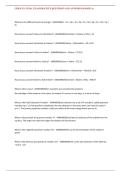
EPIC BRIDGES EXAM QUESTIONS AND ANSWERS 2025
Trigger - (ANSWER)A single, clearly defined action that generates an interface message.
An interface message contains... - (ANSWER)Data about an event (like a patient being admitted to the
hospital)
MSH-11 - (ANSWER)HL7 Processing ID
MSH-12 - (ANSWER)HL7 Version ID
Segment Identifier - (ANSWER)Three character code that identifies the kind of data the segment
contains
PID-3 - (ANSWER)Patient ID
PID-5 - (ANSWER)Patient Name
PID-7 - (ANSWER)Patient Date of Birth
Encoding Character - (ANSWER)Break HL7 message down into smaller pieces
FCRES
1. Field Separator |
2. Component Separator ^
3. Repetition Separator ~
4. Escape Character \
5. Subcomponent Separator &
Escape Sequence (assumes Escape character is \) - (ANSWER)1. Field Separator \F\
2. Component Separator \S\
,EPIC BRIDGES EXAM QUESTIONS AND ANSWERS 2025
3. Repetition Separator \R\
4. Escape Character \E\
5. Subcomponent Separator \T\
NTE Segment - (ANSWER)"Note" segment containing custom data that relates to the segment it follows.
Z Segment - (ANSWER)Custom segment
Are empty fields needed following the final entered value in an HL7 message? - (ANSWER)No
Blank Fields - (ANSWER)These are not filed
HL7 Delete Character - (ANSWER)Defined by information between double quotations ("-")
FHIR - (ANSWER)Specifies RESTful exchange method via HTTPs to access data. Developed to address
limitations of HL7.
Bridges supports these standards - (ANSWER)HL7, X12, FHIR, NCPDP, and Direct
Event - (ANSWER)Small set of values. Contains needed info to build a message (like Patient ID) and
contains directions for where Interface should pull contents to build a message.
Queue - (ANSWER)Storage location outside Chronicles database structure.
Event Daemon - (ANSWER)Processes the Event Queue
Outgoing: Pulls from Event Queue, builds message, and removes the event from the event Queue
Incoming:
, EPIC BRIDGES EXAM QUESTIONS AND ANSWERS 2025
Daemon (Outgoing) - (ANSWER)Background process that does not require user action.
Data Queue - (ANSWER)Outgoing: Contains the full text of the message along with additional metadata
(i.e. timestamp)
Control Queue - (ANSWER)Outgoing: Contains very little data. Processed by Communications Daemon.
Maintains list of messages waiting to be processed.
Incoming: Processed by Filer Daemon.
Comm Daemon - (ANSWER)Outgoing: TCP/IP. Reads instruction from Control Queue and copies
corresponding message from Data Queue. Sends message out of Epic and waits for ACK. Deletes
instruction from Control Queue.
Incoming: TCP/IP. Constantly listens for incoming messages. Validates MSH-11 and MSH-12 before
accepting.
Filer Daemon - (ANSWER)Pulls instruction from Control Queue, retrieves corresponding message from
Data Queue, then attempts to file message. If there is a problem, an interface error is logged.
What happens when Filer Daemon tries to file? - (ANSWER)1. Message is successfully filed.
2. Message is unable to be filed because something is critically wrong with it (fatal or critical error).
3. Message is sent to the Holding Queue because the target record is locked.
Resequencing - (ANSWER)Messages sent to the holding queue are re-sequenced so that they are filed in
the order they are sent.
Holding Queue - (ANSWER)Messages that cannot be filed to Chronicles due to a locked record are sent
to the Holding Queue.
Interconnect - (ANSWER)Epic's web service framework. Enables Epic applications to initiate and receive
web service requests with an external application. Uses HTTPS.
Trigger - (ANSWER)A single, clearly defined action that generates an interface message.
An interface message contains... - (ANSWER)Data about an event (like a patient being admitted to the
hospital)
MSH-11 - (ANSWER)HL7 Processing ID
MSH-12 - (ANSWER)HL7 Version ID
Segment Identifier - (ANSWER)Three character code that identifies the kind of data the segment
contains
PID-3 - (ANSWER)Patient ID
PID-5 - (ANSWER)Patient Name
PID-7 - (ANSWER)Patient Date of Birth
Encoding Character - (ANSWER)Break HL7 message down into smaller pieces
FCRES
1. Field Separator |
2. Component Separator ^
3. Repetition Separator ~
4. Escape Character \
5. Subcomponent Separator &
Escape Sequence (assumes Escape character is \) - (ANSWER)1. Field Separator \F\
2. Component Separator \S\
,EPIC BRIDGES EXAM QUESTIONS AND ANSWERS 2025
3. Repetition Separator \R\
4. Escape Character \E\
5. Subcomponent Separator \T\
NTE Segment - (ANSWER)"Note" segment containing custom data that relates to the segment it follows.
Z Segment - (ANSWER)Custom segment
Are empty fields needed following the final entered value in an HL7 message? - (ANSWER)No
Blank Fields - (ANSWER)These are not filed
HL7 Delete Character - (ANSWER)Defined by information between double quotations ("-")
FHIR - (ANSWER)Specifies RESTful exchange method via HTTPs to access data. Developed to address
limitations of HL7.
Bridges supports these standards - (ANSWER)HL7, X12, FHIR, NCPDP, and Direct
Event - (ANSWER)Small set of values. Contains needed info to build a message (like Patient ID) and
contains directions for where Interface should pull contents to build a message.
Queue - (ANSWER)Storage location outside Chronicles database structure.
Event Daemon - (ANSWER)Processes the Event Queue
Outgoing: Pulls from Event Queue, builds message, and removes the event from the event Queue
Incoming:
, EPIC BRIDGES EXAM QUESTIONS AND ANSWERS 2025
Daemon (Outgoing) - (ANSWER)Background process that does not require user action.
Data Queue - (ANSWER)Outgoing: Contains the full text of the message along with additional metadata
(i.e. timestamp)
Control Queue - (ANSWER)Outgoing: Contains very little data. Processed by Communications Daemon.
Maintains list of messages waiting to be processed.
Incoming: Processed by Filer Daemon.
Comm Daemon - (ANSWER)Outgoing: TCP/IP. Reads instruction from Control Queue and copies
corresponding message from Data Queue. Sends message out of Epic and waits for ACK. Deletes
instruction from Control Queue.
Incoming: TCP/IP. Constantly listens for incoming messages. Validates MSH-11 and MSH-12 before
accepting.
Filer Daemon - (ANSWER)Pulls instruction from Control Queue, retrieves corresponding message from
Data Queue, then attempts to file message. If there is a problem, an interface error is logged.
What happens when Filer Daemon tries to file? - (ANSWER)1. Message is successfully filed.
2. Message is unable to be filed because something is critically wrong with it (fatal or critical error).
3. Message is sent to the Holding Queue because the target record is locked.
Resequencing - (ANSWER)Messages sent to the holding queue are re-sequenced so that they are filed in
the order they are sent.
Holding Queue - (ANSWER)Messages that cannot be filed to Chronicles due to a locked record are sent
to the Holding Queue.
Interconnect - (ANSWER)Epic's web service framework. Enables Epic applications to initiate and receive
web service requests with an external application. Uses HTTPS.