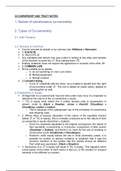
CO-OWNERSHIP AND TRUST NOTES
1. Nature of simultaneous co-ownership
2. Types of Co-ownership
2.1 Joint Tenancy
2.2 Tenancy in Common
Can be severed by statute or by common law (Williams v Hensman)
1. STATUTE
S. 36(2) LPA 25
Any equitable joint tenant may give notice in writing to the other joint tenants
of his intention to sever the JT, thus making them TIC.
Entirely unilateral, does not require the agreement or consent of the other JR
2. COMMON LAW
Not as reliable as by statute.
o A. an act operating on one’s own share
o B. Mutual agreement
o C. Mutual conduct
3. Unlawful killing
o if one JT unlawfully kills the other, he is unable to benefit from the right
of survivorship under JT. The rule is based on public policy, applies to
manslaughter as well.
2.3 Distinction in Equity
All legal title to co-owned land must be held under trust, thus it is important to
determine the nature of the co-ownership in equity.
1. TIC in equity exist where the 4 unities (except unity in possession) is
absent. (refer to Stack v Dowden, Jones v Kernott, Chaudhary v
Chaudhary, Laskar v Laskar).
o This is because of the widespread use of the principles of constructive
and resulting rusts.
2. Where there is express stipulation of the nature of the equitable interest
(either JT or TIC in equity), this is normally conclusive as to the nature of their
co-ownership in equity (Goodman v Gallant).
o Once it is expressly stipulated in the original conveyance, the nature of
their equitable co-ownership is conclusive, irrespective of later events
(Goodman v Gallant), and there is no room for the use of resulting or
constructive trusts (Pankhania v Chandengra).
o However, while equity follows the law in most (domestic) cases, it is
possible for parties to adduce evidence to establish that it was the
common intention of the parties that the shares should be different
from what was expressed. (Stack v Dowden).
3. Severance of a JT in equity will result in TIC in equity. This happens when
a description of the share of each owner is laid out, or the creation of unequal
interests in the different co-owners.
, 4. Where there is no express declaration concerning the equitable interests or
words of severance (TIC), and if all four unities are present, there is a
presumption that equity follows the law.
o Consequently, because legal title must be JT, in the absence of all
other evidence, equitable title follows the law, and it is deemed to be JT
in equity also.
o This presumption can be rebutted by facts. Usually this happens it is
recognised that the existence of JT may cause hardship to the co-
owners because the right of survivorship would be inappropriate (land
held by business partners or business arrangements. Malayan Credit
Ltd v Jack Chia MPH), or where there is evidence that the parties had
a common intention to hold other than as JT (Jones v Kernott).
o Situations where there is a presumption against JT in equity include
i. land held by business partners
ii. co-owned interest is of a mortgage held by co-mortgagees
iii. The purchaser have provided the purchase money in unequal
shares which establishes the lack of a unity in interest (such as
when one co-owner was making a gift to another)
o In all three examples, there is a presumption against JT in equity
because of the substantial disadvantage of construing the arrangement
as a JT, and a right of survivorship would deprive the dependants of
the co-owner of interest in the property.
o Stack v Dowden and Jones v Kernott held that equity will not follow
the law if:
i. one of the legal co-owners is able to establish a common
intention that the equitable interest should be held differently
ii. and this intention existed at the time of acquisition of land
iii. or later during the time that the parties were using the
property
o WHY IS THIS SO?
A constructive trust may arise to give effect to that intention,
effectively redistributing the equitable shares in accordance with
that intention, despite the absence of any written instrument
o
3. Statutory Machinery
3.1 Effects of Land Property Act 1925 and TOLATA 1996
1. Only joint tenancy can exist in law. Tenancy in common cannot exist in law,
but only in equity. (s. 1(6) LPA25)
Thus, legal JT cannot be severed into legal TIC (s. 36(2) LPA 25)
2. The co-owners are trustees of that legal title under a trust of land, that is
imposed by statute (ss. 34 and 36 LPA 25)
o Thus, in every case of co-ownership of the legal title of land, that legal
title is held by joint tenant trustees, on a trust of land. (ss. 4 and 5
TOLATA)
Duties include duty to hold the land for the persons beneficially
interested in the land (equitable owners)
1. Nature of simultaneous co-ownership
2. Types of Co-ownership
2.1 Joint Tenancy
2.2 Tenancy in Common
Can be severed by statute or by common law (Williams v Hensman)
1. STATUTE
S. 36(2) LPA 25
Any equitable joint tenant may give notice in writing to the other joint tenants
of his intention to sever the JT, thus making them TIC.
Entirely unilateral, does not require the agreement or consent of the other JR
2. COMMON LAW
Not as reliable as by statute.
o A. an act operating on one’s own share
o B. Mutual agreement
o C. Mutual conduct
3. Unlawful killing
o if one JT unlawfully kills the other, he is unable to benefit from the right
of survivorship under JT. The rule is based on public policy, applies to
manslaughter as well.
2.3 Distinction in Equity
All legal title to co-owned land must be held under trust, thus it is important to
determine the nature of the co-ownership in equity.
1. TIC in equity exist where the 4 unities (except unity in possession) is
absent. (refer to Stack v Dowden, Jones v Kernott, Chaudhary v
Chaudhary, Laskar v Laskar).
o This is because of the widespread use of the principles of constructive
and resulting rusts.
2. Where there is express stipulation of the nature of the equitable interest
(either JT or TIC in equity), this is normally conclusive as to the nature of their
co-ownership in equity (Goodman v Gallant).
o Once it is expressly stipulated in the original conveyance, the nature of
their equitable co-ownership is conclusive, irrespective of later events
(Goodman v Gallant), and there is no room for the use of resulting or
constructive trusts (Pankhania v Chandengra).
o However, while equity follows the law in most (domestic) cases, it is
possible for parties to adduce evidence to establish that it was the
common intention of the parties that the shares should be different
from what was expressed. (Stack v Dowden).
3. Severance of a JT in equity will result in TIC in equity. This happens when
a description of the share of each owner is laid out, or the creation of unequal
interests in the different co-owners.
, 4. Where there is no express declaration concerning the equitable interests or
words of severance (TIC), and if all four unities are present, there is a
presumption that equity follows the law.
o Consequently, because legal title must be JT, in the absence of all
other evidence, equitable title follows the law, and it is deemed to be JT
in equity also.
o This presumption can be rebutted by facts. Usually this happens it is
recognised that the existence of JT may cause hardship to the co-
owners because the right of survivorship would be inappropriate (land
held by business partners or business arrangements. Malayan Credit
Ltd v Jack Chia MPH), or where there is evidence that the parties had
a common intention to hold other than as JT (Jones v Kernott).
o Situations where there is a presumption against JT in equity include
i. land held by business partners
ii. co-owned interest is of a mortgage held by co-mortgagees
iii. The purchaser have provided the purchase money in unequal
shares which establishes the lack of a unity in interest (such as
when one co-owner was making a gift to another)
o In all three examples, there is a presumption against JT in equity
because of the substantial disadvantage of construing the arrangement
as a JT, and a right of survivorship would deprive the dependants of
the co-owner of interest in the property.
o Stack v Dowden and Jones v Kernott held that equity will not follow
the law if:
i. one of the legal co-owners is able to establish a common
intention that the equitable interest should be held differently
ii. and this intention existed at the time of acquisition of land
iii. or later during the time that the parties were using the
property
o WHY IS THIS SO?
A constructive trust may arise to give effect to that intention,
effectively redistributing the equitable shares in accordance with
that intention, despite the absence of any written instrument
o
3. Statutory Machinery
3.1 Effects of Land Property Act 1925 and TOLATA 1996
1. Only joint tenancy can exist in law. Tenancy in common cannot exist in law,
but only in equity. (s. 1(6) LPA25)
Thus, legal JT cannot be severed into legal TIC (s. 36(2) LPA 25)
2. The co-owners are trustees of that legal title under a trust of land, that is
imposed by statute (ss. 34 and 36 LPA 25)
o Thus, in every case of co-ownership of the legal title of land, that legal
title is held by joint tenant trustees, on a trust of land. (ss. 4 and 5
TOLATA)
Duties include duty to hold the land for the persons beneficially
interested in the land (equitable owners)