CONGENITAL DEFECTS
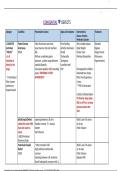
Category Condition Presentation (notes) Signs and Symptoms Interventions: Treatment
Assess, Monitor,
Medicate, Educate
aCYANOTIC Patent Ductus Fetal shunt does not close Poor feeding Strict intake/output Diuretics
(not blue) Arteriosus Loud murmur but not machine- Activity intolerance Daily Weight Digoxin
“HOLES!” (PDA) like (tired) Cluster Care Viagra (treats
L to R Will see a widening pulse Tachycardia Minimal stimulation Pulmonary
shunting of pressure, a wider range between Tachypnea Hypertension)
blood to the systolic/diastolic: (crackles/wet)
lungs Increased capillary refill, bounding CHF Prostaglandin Inhibitor:
pulse. TRENDING IS VERY Indomethacin closes
↑ Pulm Blood IMPORTANT! PDA; then ibuprofen x
Flow (causes 6 mos.
pulmonary **PGE to keep open
Hypertension)
Cardiac Catheterization
#1 Priority: Keep baby
flat for 6-8 hrs. to keep
pressure above the
site!
Atrial Septal Defect: opening between L/R atria Wait & see if it closes
called this when PDA Systolic murmur ↑ L sternal on its on
does not want to border Patch Closure
close! Soft Murmur
(ASD) Persistent
Foramen Ovale
Ventricular Septal *Most common CHD Wait & see if it closes
Defect High pitched machine-like on its own
(VSD) murmur Patch Closure
Opening between L/R ventricles Digoxin (HR)
Harsh holosystolic murmur mid/↓
, L sternal border)
More dangerous than ASD; can
cause hypertrophy of the heart
CYANOTIC Tetralogy of Fallot VSD murmur and/or TET Spell may occur: Managed with
(blue) (TOF) Loud systolic ejection @ L ↑ Nursing Priority: put medications.
R to L sternal border (PS) child in a knee to chest
shunting of Tetra = 4 defects: Cyanosis; Squatting = position, apply oxygen,
blood to the VSD, VH, OA, PS compensation keep calm!!
heart / Boot shaped heart (Xray)
↓ Pulm Blood Hypoxic Spell: baby
Flow turns blue
Tricuspid Atresia (TA) Will also have ASD (or PFO) and Baby will be cyanotic Valve surgery
Atresia = closing! VSD Prostaglandins; to keep
the valve open
OBSTRUCTIVE Coarctation of Aorta Narrowing of the aorta Cardiac Catheterization
(COA) BP discrepancy, weak pulses; Cool
extremities, slow capillary refill
Systolic murmur below shoulder
blades
Aortic Stenosis (AS) AS: late systolic murmur aortic Balloon angioplasty
Pulmonic Stenosis (PS) area
PS: systolic murmur L sternal
Stenosis = narrowing! border
Exertion CP, SOB, fatigue, dizzy,
fainting
MIXED BLOOD Transposition of 2 great arteries leaving heart are Nursing Priority:
FLOW Great Arteries reversed Prostaglandins (keeps
(vessels) Rapid HR, weak pulse PDA open)!
cyanosis
Septal defect or PDA Use oxygen sparingly
Most life must be present! (keep below 80% to
Category Condition Presentation (notes) Signs and Symptoms Interventions: Treatment
Assess, Monitor,
Medicate, Educate
aCYANOTIC Patent Ductus Fetal shunt does not close Poor feeding Strict intake/output Diuretics
(not blue) Arteriosus Loud murmur but not machine- Activity intolerance Daily Weight Digoxin
“HOLES!” (PDA) like (tired) Cluster Care Viagra (treats
L to R Will see a widening pulse Tachycardia Minimal stimulation Pulmonary
shunting of pressure, a wider range between Tachypnea Hypertension)
blood to the systolic/diastolic: (crackles/wet)
lungs Increased capillary refill, bounding CHF Prostaglandin Inhibitor:
pulse. TRENDING IS VERY Indomethacin closes
↑ Pulm Blood IMPORTANT! PDA; then ibuprofen x
Flow (causes 6 mos.
pulmonary **PGE to keep open
Hypertension)
Cardiac Catheterization
#1 Priority: Keep baby
flat for 6-8 hrs. to keep
pressure above the
site!
Atrial Septal Defect: opening between L/R atria Wait & see if it closes
called this when PDA Systolic murmur ↑ L sternal on its on
does not want to border Patch Closure
close! Soft Murmur
(ASD) Persistent
Foramen Ovale
Ventricular Septal *Most common CHD Wait & see if it closes
Defect High pitched machine-like on its own
(VSD) murmur Patch Closure
Opening between L/R ventricles Digoxin (HR)
Harsh holosystolic murmur mid/↓
, L sternal border)
More dangerous than ASD; can
cause hypertrophy of the heart
CYANOTIC Tetralogy of Fallot VSD murmur and/or TET Spell may occur: Managed with
(blue) (TOF) Loud systolic ejection @ L ↑ Nursing Priority: put medications.
R to L sternal border (PS) child in a knee to chest
shunting of Tetra = 4 defects: Cyanosis; Squatting = position, apply oxygen,
blood to the VSD, VH, OA, PS compensation keep calm!!
heart / Boot shaped heart (Xray)
↓ Pulm Blood Hypoxic Spell: baby
Flow turns blue
Tricuspid Atresia (TA) Will also have ASD (or PFO) and Baby will be cyanotic Valve surgery
Atresia = closing! VSD Prostaglandins; to keep
the valve open
OBSTRUCTIVE Coarctation of Aorta Narrowing of the aorta Cardiac Catheterization
(COA) BP discrepancy, weak pulses; Cool
extremities, slow capillary refill
Systolic murmur below shoulder
blades
Aortic Stenosis (AS) AS: late systolic murmur aortic Balloon angioplasty
Pulmonic Stenosis (PS) area
PS: systolic murmur L sternal
Stenosis = narrowing! border
Exertion CP, SOB, fatigue, dizzy,
fainting
MIXED BLOOD Transposition of 2 great arteries leaving heart are Nursing Priority:
FLOW Great Arteries reversed Prostaglandins (keeps
(vessels) Rapid HR, weak pulse PDA open)!
cyanosis
Septal defect or PDA Use oxygen sparingly
Most life must be present! (keep below 80% to