

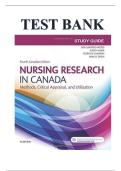
,TEST BANK FOR NURSING RESEARCH IN CANADA, 4TH EDITION
fd fd fd fd fd fd fd fd
by Mina Singh, RN, RP, BSc, BScN MEd, PhD, I-FCNEI, Cherylyn Cameron, RN, PhD,
fd fd fd fd fd fd fd fd fd fd fd fd fd
Geri LoBiondo-Wood, PhD, RN, FAAN and Judith Haber, PhD, RN, FAAN
fd fd fd fd fd fd fd fd fd fd fd
TABLE OF CONTENT fd fd
Part fdI: f d Research f d Overview f d Research f d Vignette: f d A f d Program f d of f d Research f d in f d Transcultural f d Nursing
1. The f d Role f d of f d Research fd in f d Nursing
2. Theoretical f d Framework
3. Critical fd Reading f d Strategies: f d Overview f d of f d the fd Research f d Process
4. Developing f d Research f d Questions, f d Hypotheses, fd and f d Clinical f d Questions
5. Finding f d and fd Appraising f d the f d Literature
6. Legal f d and f d Ethical f d Issues
Part fdII: fd Qualitative f d Research f d Research f d Vignette: fd Creating f d Qualitatively fd Derived fd Knowledge f d for f d a f d Practice fd Discipline
7. Introduction f d to f d Qualitative f d Research
8. Qualitative f d Approaches f d to f d Research
Part fdIII: f d Quantitative f d Research fd Research f d Vignette: f d Tackling f d the fd Prevention f d of f d Falls f d Among f d Older f d Adults
9. Introduction f d to f d Quantitative f d Research
10. Experimental fd and f d Quasiexperimental f d Designs
11. Non-experimental f d Designs
Part fdIV: f d Processes f d Related f d to f d Research f d Research f d Vignette: f d Partnering f d with f d parents f d to f d reduce fd newborn f d pain fd - f d evidence f d and
f d implementation
12. Sampling
13. Data f d Collection fd Methods
14. Rigour f d in f d Research
15. Qualitative f d Data f d Analysis
16. Quantitative f d Data fd Analysis
17. Presenting f d the f d Findings
Part fd V: f d Critiquing f d Research f d Research f d Vignette: f d A f d Program f d of f d Research
18. Critiquing f d Qualitative f d Research
19. Critiquing f d Quantitative f d Research
Part f d VI: f d Application f d of f d Research: f d Evidence-Informed fd Practice fd Research f d Vignette: fd From fd my f d Ph.D. fd to fd her fd Post-Doctoral
fd studies: fd Building fd a f d Survivorship f d Cancer f d Care f d Program
20. Developing fd an f d Evidence-Informed fd Practice f d Research f d Vignette: f d Social f d Support f d Needs fd of f d Older f d Adults
,Chapter 01: The Role of Research in Nursing
fd fd fd fd fd fd fd
LoBiondo-Wood: Nursing Research in Canada, 4th Edition fd fd fd fd fd fd
MULTIPLE CHOICE fd
1. A key step to the development of nursing research was
fd fd fd fd fd fd fd fd fd
a. the endowment of nursing research chairs.
fd fd fd fd fd
b. universities offering baccalaureate nursing programs. fd fd fd fd
c. a baccalaureate degree becoming the entry to practice.
fd fd fd fd fd fd fd
d. the Canadian Nurses Association developing a research mandate.
fd fd fd fd fd fd fd
ANS: f d B
Feedback
A Endowment of nursing research chairs did not occur until the number of
fd fd fd fd fd fd fd fd fd fd fd
nurses with PhD degrees increased.
fd fd fd fd fd
B Universities offering baccalaureate nursing programs provided an introduction
fd fd fd fd fd fd fd
to
fd
research within the BScN programs and led to further nursing education at
fd fd fd fd fd fd fd fd fd fd fd
the MSN and PhD levels.
fd fd fd fd fd
C Baccalaureate degrees becoming the entry to practice did not occur until
fd fd fd fd fd fd fd fd fd fd
the twenty-first century.
fd fd fd
D The Canadian Nurses Association did not develop a research mandate until the
fd fd fd fd fd fd fd fd fd fd fd
end of the twentieth century.
fd fd fd fd fd
DIF: Cognitive Level: Application fd fd
MSC: NCLEX Client Care Needs Category: Safe and Effective Care Environment; Health
f d fd fd fd fd fd fd fd fd fd fd
Promotion and Maintenance
fd fd fd
2. Howxisxnursingxresearchxsignificantxtoxthexprofessionxofxnursing?
a. Responsibilityxisxmorexspecificallyxdefined.
b. Liabilityxwithinxthexpracticexofxnursingxisxdecreased.
c. Axspecializedxbodyxofxknowledgexisxgeneratedxforxusexinxthexdeliveryxofxhealthxcare.
d. Thexscopexofxnursingxpracticexisxexpandedxintoxareasxformerlyxreservedxfor
x other disciplines.
ANS: x fd
C
Feedback
A Research aids in documenting accountability of nurses, but professional
fd fd fd fd fd fd fd fd
guidelines regarding responsibility already exist.
fd fd fd fd fd
B Liability is a legal concept. Research does not promote liability.
fd fd fd fd fd fd fd fd fd
C Theory-based nursing research provides a foundation for evidence-informed
fd fd fd fd fd fd fd
nursing care. fd
D Nursing research expands the discipline of nursing as it pertains to nursing
fd fd fd fd fd fd fd fd fd fd fd
practice.
fd
DIF: Cognitive Level: Comprehension fd fd
MSC: NCLEX Client Care Needs Category: Safe and Effective Care Environment; Health
f d fd fd fd fd fd fd fd fd fd fd
Promotion and Maintenance
fd fd fd
, 3. Whyxarexnursingxpractice–orientedxscientificxinvestigationsxvaluable?
a. Theyxvalidatexthexeffectivenessxofxparticularxnursingxinterventions.
b. Theyxencouragexconsumersxtoxquestionxthexqualityxofxhealthxcare.
c. Theyxlimitxthextheoryxbasexforxclinicalxdecisionxmaking.
d. Theyxmandatexhealthxcarexreform.
ANS: f d A
Feedback
A Practice-focused research supports the effectiveness of nursing interventions
fd fd fd fd fd fd fd
and reinforces quality of nursing care.
fd fd fd fd fd fd
B On the contrary, they help reassure consumers about the quality of health
fd fd fd fd fd fd fd fd fd fd fd
care.
fd
C They support the development of the theory base for clinical decision
fd fd fd fd fd fd fd fd fd fd
making.
fd
D They reinforce the effectiveness of current nursing practice.
fd fd fd fd fd fd fd
DIF: Cognitive Level: Comprehension fd fd
MSC: NCLEX Client Care Needs Category: Safe and Effective Care Environment; Health
f d fd fd fd fd fd fd fd fd fd fd
Promotion and Maintenance
fd fd fd
4. Whenxaxchangexinxnursingxpracticexresultsxinxdecreasedxcostxofxcare, xwhatxadditional df
x factor x mustxbexconsideredxbeforexgeneralximplementationxofxthisxchange?
a. Ensuringxcompliancexofxthexchangexbyxnursesxwithxdiverse
educationalxbackgrounds
x
b. Maintainingxorximprovingxthexqualityxofxcarexresultingxfromxthexchangexinxpractice
fd
c. Encouragingxpatientsxtoxbexactivexpartnersxinxtheirxhealthxcarexdecisions
fd. Disseminatingxthexchangexbeyondxthexdisciplinexofxnursing
d
ANS: x fd
B
Feedback
A Not all nurses are responsible for supervising compliance with new
fd fd fd fd fd fd fd fd fd
measures.
fd
B Nurses are accountable to maintain quality patient care despite cost-cutting
fd fd fd fd fd fd fd fd fd
measures.
fd
C Nurses should encourage patient participation in care despite cost-cutting
fd fd fd fd fd fd fd fd
measures.
fd
D Nurses are not responsible for reforming other disciplines.
fd fd fd fd fd fd fd
DIF: Cognitive Level: Analysis fd fd
MSC: NCLEX Client Care Needs Category: Safe and Effective Care Environment; Health
f d fd fd fd fd fd fd fd fd fd fd
Promotion and Maintenance
fd fd fd
5. Why do nurses who do not conduct research need to understand the nursing
fd fd fd fd fd fd fd fd fd fd fd fd
research process?
fd fd
a. To identify potential participants for clinical research studies
fd fd fd fd fd fd fd
b. To assist in collecting accurate data for clinical research studies
fd fd fd fd fd fd fd fd fd
c. To teach patients and families about the usefulness of participation in research
fd fd fd fd fd fd fd fd fd fd fd
d. To be able to evaluate nursing research reports for relevance to their
fd fd fd fd fd fd fd fd fd fd fd
own clinical practice
fd fd fd
ANS: f d D
fd fd fd fd fd fd fd fd
by Mina Singh, RN, RP, BSc, BScN MEd, PhD, I-FCNEI, Cherylyn Cameron, RN, PhD,
fd fd fd fd fd fd fd fd fd fd fd fd fd
Geri LoBiondo-Wood, PhD, RN, FAAN and Judith Haber, PhD, RN, FAAN
fd fd fd fd fd fd fd fd fd fd fd
TABLE OF CONTENT fd fd
Part fdI: f d Research f d Overview f d Research f d Vignette: f d A f d Program f d of f d Research f d in f d Transcultural f d Nursing
1. The f d Role f d of f d Research fd in f d Nursing
2. Theoretical f d Framework
3. Critical fd Reading f d Strategies: f d Overview f d of f d the fd Research f d Process
4. Developing f d Research f d Questions, f d Hypotheses, fd and f d Clinical f d Questions
5. Finding f d and fd Appraising f d the f d Literature
6. Legal f d and f d Ethical f d Issues
Part fdII: fd Qualitative f d Research f d Research f d Vignette: fd Creating f d Qualitatively fd Derived fd Knowledge f d for f d a f d Practice fd Discipline
7. Introduction f d to f d Qualitative f d Research
8. Qualitative f d Approaches f d to f d Research
Part fdIII: f d Quantitative f d Research fd Research f d Vignette: f d Tackling f d the fd Prevention f d of f d Falls f d Among f d Older f d Adults
9. Introduction f d to f d Quantitative f d Research
10. Experimental fd and f d Quasiexperimental f d Designs
11. Non-experimental f d Designs
Part fdIV: f d Processes f d Related f d to f d Research f d Research f d Vignette: f d Partnering f d with f d parents f d to f d reduce fd newborn f d pain fd - f d evidence f d and
f d implementation
12. Sampling
13. Data f d Collection fd Methods
14. Rigour f d in f d Research
15. Qualitative f d Data f d Analysis
16. Quantitative f d Data fd Analysis
17. Presenting f d the f d Findings
Part fd V: f d Critiquing f d Research f d Research f d Vignette: f d A f d Program f d of f d Research
18. Critiquing f d Qualitative f d Research
19. Critiquing f d Quantitative f d Research
Part f d VI: f d Application f d of f d Research: f d Evidence-Informed fd Practice fd Research f d Vignette: fd From fd my f d Ph.D. fd to fd her fd Post-Doctoral
fd studies: fd Building fd a f d Survivorship f d Cancer f d Care f d Program
20. Developing fd an f d Evidence-Informed fd Practice f d Research f d Vignette: f d Social f d Support f d Needs fd of f d Older f d Adults
,Chapter 01: The Role of Research in Nursing
fd fd fd fd fd fd fd
LoBiondo-Wood: Nursing Research in Canada, 4th Edition fd fd fd fd fd fd
MULTIPLE CHOICE fd
1. A key step to the development of nursing research was
fd fd fd fd fd fd fd fd fd
a. the endowment of nursing research chairs.
fd fd fd fd fd
b. universities offering baccalaureate nursing programs. fd fd fd fd
c. a baccalaureate degree becoming the entry to practice.
fd fd fd fd fd fd fd
d. the Canadian Nurses Association developing a research mandate.
fd fd fd fd fd fd fd
ANS: f d B
Feedback
A Endowment of nursing research chairs did not occur until the number of
fd fd fd fd fd fd fd fd fd fd fd
nurses with PhD degrees increased.
fd fd fd fd fd
B Universities offering baccalaureate nursing programs provided an introduction
fd fd fd fd fd fd fd
to
fd
research within the BScN programs and led to further nursing education at
fd fd fd fd fd fd fd fd fd fd fd
the MSN and PhD levels.
fd fd fd fd fd
C Baccalaureate degrees becoming the entry to practice did not occur until
fd fd fd fd fd fd fd fd fd fd
the twenty-first century.
fd fd fd
D The Canadian Nurses Association did not develop a research mandate until the
fd fd fd fd fd fd fd fd fd fd fd
end of the twentieth century.
fd fd fd fd fd
DIF: Cognitive Level: Application fd fd
MSC: NCLEX Client Care Needs Category: Safe and Effective Care Environment; Health
f d fd fd fd fd fd fd fd fd fd fd
Promotion and Maintenance
fd fd fd
2. Howxisxnursingxresearchxsignificantxtoxthexprofessionxofxnursing?
a. Responsibilityxisxmorexspecificallyxdefined.
b. Liabilityxwithinxthexpracticexofxnursingxisxdecreased.
c. Axspecializedxbodyxofxknowledgexisxgeneratedxforxusexinxthexdeliveryxofxhealthxcare.
d. Thexscopexofxnursingxpracticexisxexpandedxintoxareasxformerlyxreservedxfor
x other disciplines.
ANS: x fd
C
Feedback
A Research aids in documenting accountability of nurses, but professional
fd fd fd fd fd fd fd fd
guidelines regarding responsibility already exist.
fd fd fd fd fd
B Liability is a legal concept. Research does not promote liability.
fd fd fd fd fd fd fd fd fd
C Theory-based nursing research provides a foundation for evidence-informed
fd fd fd fd fd fd fd
nursing care. fd
D Nursing research expands the discipline of nursing as it pertains to nursing
fd fd fd fd fd fd fd fd fd fd fd
practice.
fd
DIF: Cognitive Level: Comprehension fd fd
MSC: NCLEX Client Care Needs Category: Safe and Effective Care Environment; Health
f d fd fd fd fd fd fd fd fd fd fd
Promotion and Maintenance
fd fd fd
, 3. Whyxarexnursingxpractice–orientedxscientificxinvestigationsxvaluable?
a. Theyxvalidatexthexeffectivenessxofxparticularxnursingxinterventions.
b. Theyxencouragexconsumersxtoxquestionxthexqualityxofxhealthxcare.
c. Theyxlimitxthextheoryxbasexforxclinicalxdecisionxmaking.
d. Theyxmandatexhealthxcarexreform.
ANS: f d A
Feedback
A Practice-focused research supports the effectiveness of nursing interventions
fd fd fd fd fd fd fd
and reinforces quality of nursing care.
fd fd fd fd fd fd
B On the contrary, they help reassure consumers about the quality of health
fd fd fd fd fd fd fd fd fd fd fd
care.
fd
C They support the development of the theory base for clinical decision
fd fd fd fd fd fd fd fd fd fd
making.
fd
D They reinforce the effectiveness of current nursing practice.
fd fd fd fd fd fd fd
DIF: Cognitive Level: Comprehension fd fd
MSC: NCLEX Client Care Needs Category: Safe and Effective Care Environment; Health
f d fd fd fd fd fd fd fd fd fd fd
Promotion and Maintenance
fd fd fd
4. Whenxaxchangexinxnursingxpracticexresultsxinxdecreasedxcostxofxcare, xwhatxadditional df
x factor x mustxbexconsideredxbeforexgeneralximplementationxofxthisxchange?
a. Ensuringxcompliancexofxthexchangexbyxnursesxwithxdiverse
educationalxbackgrounds
x
b. Maintainingxorximprovingxthexqualityxofxcarexresultingxfromxthexchangexinxpractice
fd
c. Encouragingxpatientsxtoxbexactivexpartnersxinxtheirxhealthxcarexdecisions
fd. Disseminatingxthexchangexbeyondxthexdisciplinexofxnursing
d
ANS: x fd
B
Feedback
A Not all nurses are responsible for supervising compliance with new
fd fd fd fd fd fd fd fd fd
measures.
fd
B Nurses are accountable to maintain quality patient care despite cost-cutting
fd fd fd fd fd fd fd fd fd
measures.
fd
C Nurses should encourage patient participation in care despite cost-cutting
fd fd fd fd fd fd fd fd
measures.
fd
D Nurses are not responsible for reforming other disciplines.
fd fd fd fd fd fd fd
DIF: Cognitive Level: Analysis fd fd
MSC: NCLEX Client Care Needs Category: Safe and Effective Care Environment; Health
f d fd fd fd fd fd fd fd fd fd fd
Promotion and Maintenance
fd fd fd
5. Why do nurses who do not conduct research need to understand the nursing
fd fd fd fd fd fd fd fd fd fd fd fd
research process?
fd fd
a. To identify potential participants for clinical research studies
fd fd fd fd fd fd fd
b. To assist in collecting accurate data for clinical research studies
fd fd fd fd fd fd fd fd fd
c. To teach patients and families about the usefulness of participation in research
fd fd fd fd fd fd fd fd fd fd fd
d. To be able to evaluate nursing research reports for relevance to their
fd fd fd fd fd fd fd fd fd fd fd
own clinical practice
fd fd fd
ANS: f d D


