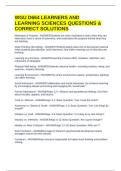
WGU D664 LEARNERS AND
LEARNING SCIENCES QUESTIONS &
CORRECT SOLUTIONS
Motivation & Purpose - ANSWERStudents are more motivated to learn when they are
interested, have a sense of autonomy, and understand the purpose behind what they
are learning.
Deep Thinking (Encoding) - ANSWERThinking deeply about the to-be-learned material
helps students pay attention, build memories, and make meaning out of what they are
learning.
Learning as a Process - ANSWERLearning involves effort, mistakes, reflection, and
refinement of strategies.
Physical Well-being - ANSWERStudents' physical health—including nutrition, sleep, and
exercise—impacts learning.
Learning Environment - ANSWERThe entire environment (space, temperature, lighting)
can affect learning.
Social Interaction - ANSWERCollaboration and social interaction can enhance learning
by encouraging deeper processing and engaging the 'social brain.'
Formal Operational - ANSWERAge: 12+; Abstract and hypothetical thinking; Can think
about morality, algebra, and futures.
Trust vs. Mistrust - ANSWERAge: 0-1; Basic Question: 'Can I trust the world?'
Autonomy vs. Shame & Doubt - ANSWERAge: 1-3; Basic Question: 'Can I do things by
myself?'
Initiative vs. Guilt - ANSWERAge: 3-6; Basic Question: 'Is it okay to try new things?'
Industry vs. Inferiority - ANSWERAge: 6-12; Basic Question: 'Am I good enough?'
Identity vs. Role Confusion - ANSWERAge: 12-18; Basic Question: 'Who am I?'
Role Confusion - ANSWERA stage in Erikson's psychosocial development where
teenagers search for their identity.
Cerebrum - ANSWERBrain structure responsible for higher-level thinking and problem
solving.
LEARNING SCIENCES QUESTIONS &
CORRECT SOLUTIONS
Motivation & Purpose - ANSWERStudents are more motivated to learn when they are
interested, have a sense of autonomy, and understand the purpose behind what they
are learning.
Deep Thinking (Encoding) - ANSWERThinking deeply about the to-be-learned material
helps students pay attention, build memories, and make meaning out of what they are
learning.
Learning as a Process - ANSWERLearning involves effort, mistakes, reflection, and
refinement of strategies.
Physical Well-being - ANSWERStudents' physical health—including nutrition, sleep, and
exercise—impacts learning.
Learning Environment - ANSWERThe entire environment (space, temperature, lighting)
can affect learning.
Social Interaction - ANSWERCollaboration and social interaction can enhance learning
by encouraging deeper processing and engaging the 'social brain.'
Formal Operational - ANSWERAge: 12+; Abstract and hypothetical thinking; Can think
about morality, algebra, and futures.
Trust vs. Mistrust - ANSWERAge: 0-1; Basic Question: 'Can I trust the world?'
Autonomy vs. Shame & Doubt - ANSWERAge: 1-3; Basic Question: 'Can I do things by
myself?'
Initiative vs. Guilt - ANSWERAge: 3-6; Basic Question: 'Is it okay to try new things?'
Industry vs. Inferiority - ANSWERAge: 6-12; Basic Question: 'Am I good enough?'
Identity vs. Role Confusion - ANSWERAge: 12-18; Basic Question: 'Who am I?'
Role Confusion - ANSWERA stage in Erikson's psychosocial development where
teenagers search for their identity.
Cerebrum - ANSWERBrain structure responsible for higher-level thinking and problem
solving.