Pattern Lab Findings Notes
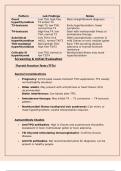
Overt Low TSH, high free Most straightforward diagnosis
hyperthyroidism T4 and/or T3
T3-toxicosis High T3, low TSH, Early hyperthyroidism, fewer
normal free T4 symptoms
T4-toxicosis High free T4, low Seen with nonthyroidal illness or
TSH, normal T3 amiodarone therapy
Subclinical Low TSH (<0.4 Often asymptomatic; common in
hyperthyroidism mU/L), normal T4/T3 mild Graves or toxic nodular goiter
TSH-mediated Normal/high TSH, Rare: TSH-secreting pituitary
hyperthyroidism high free T4/T3 adenoma or thyroid hormone
resistance
Critically ill Low TSH, normal or Nonthyroidal illness may mask
hyperthyroid low T3/T4 hyperthyroidism
Screening & Initial Evaluation
Thyroid Function Tests (TFTs)
Special Considerations
Pregnancy: β-hCG peak causes transient TSH suppression, FT4 usually
normal/slightly elevated.
Older adults: May present with arrhythmias or heart failure; ECG
recommended.
Biotin interference: Can falsely alter TFTs.
Amiodarone therapy: May inhibit T4 → T3 conversion → T4-toxicosis
pattern.
Nonthyroidal illness (euthyroid sick syndrome): Can mimic or
mask hyperthyroidism; careful interpretation required.
Autoantibody Studies
Anti-TPO antibodies: High in Graves and autoimmune thyroiditis;
low/absent in toxic multinodular goiter or toxic adenoma.
TSI (thyroid-stimulating immunoglobulin): Confirms Graves
disease.
Anti-TG antibodies: Not recommended alone for diagnosis; can be
present in healthy people.
, Scintigraphy / Radioactive Iodine Uptake (RAIU)
Used if etiology unclear.
Normal uptake: 24-hour RAIU ~5-20% (varies with dietary iodine)
Patterns in hyperthyroidism:
DISORDER 24-HOUR PATTERN
RAIU
GRAVES DISEASE 40–100% Diffuse, uniform
TOXIC MULTINODULAR 25–60% Nodular, irregular
GOITER
TOXIC ADENOMA 25–60% Hot nodule, suppressed
surrounding tissue
SUBACUTE THYROIDITIS <2% Very low, absent uptake
THYROTOXICOSIS <2% Very low, absent uptake
FACTITIA
Nodule characterization:
o Hot → autonomously functioning, usually benign.
o Cold → consider FNA to rule out malignancy.
Diagnostic Approach
Initial Test: Serum TSH with reflex free T4 & T3 if low.
High Clinical Suspicion: Order TSH, free T4, T3 simultaneously.
Persistent suspicion with normal/elevated TSH: Measure free T4
& T3 (consider TSH-mediated causes).
Critical Illness: Low TSH <0.01 mU/L + normal T4 suggests
hyperthyroidism; re-evaluate post-recovery.
Other Notes
Overt Low TSH, high free Most straightforward diagnosis
hyperthyroidism T4 and/or T3
T3-toxicosis High T3, low TSH, Early hyperthyroidism, fewer
normal free T4 symptoms
T4-toxicosis High free T4, low Seen with nonthyroidal illness or
TSH, normal T3 amiodarone therapy
Subclinical Low TSH (<0.4 Often asymptomatic; common in
hyperthyroidism mU/L), normal T4/T3 mild Graves or toxic nodular goiter
TSH-mediated Normal/high TSH, Rare: TSH-secreting pituitary
hyperthyroidism high free T4/T3 adenoma or thyroid hormone
resistance
Critically ill Low TSH, normal or Nonthyroidal illness may mask
hyperthyroid low T3/T4 hyperthyroidism
Screening & Initial Evaluation
Thyroid Function Tests (TFTs)
Special Considerations
Pregnancy: β-hCG peak causes transient TSH suppression, FT4 usually
normal/slightly elevated.
Older adults: May present with arrhythmias or heart failure; ECG
recommended.
Biotin interference: Can falsely alter TFTs.
Amiodarone therapy: May inhibit T4 → T3 conversion → T4-toxicosis
pattern.
Nonthyroidal illness (euthyroid sick syndrome): Can mimic or
mask hyperthyroidism; careful interpretation required.
Autoantibody Studies
Anti-TPO antibodies: High in Graves and autoimmune thyroiditis;
low/absent in toxic multinodular goiter or toxic adenoma.
TSI (thyroid-stimulating immunoglobulin): Confirms Graves
disease.
Anti-TG antibodies: Not recommended alone for diagnosis; can be
present in healthy people.
, Scintigraphy / Radioactive Iodine Uptake (RAIU)
Used if etiology unclear.
Normal uptake: 24-hour RAIU ~5-20% (varies with dietary iodine)
Patterns in hyperthyroidism:
DISORDER 24-HOUR PATTERN
RAIU
GRAVES DISEASE 40–100% Diffuse, uniform
TOXIC MULTINODULAR 25–60% Nodular, irregular
GOITER
TOXIC ADENOMA 25–60% Hot nodule, suppressed
surrounding tissue
SUBACUTE THYROIDITIS <2% Very low, absent uptake
THYROTOXICOSIS <2% Very low, absent uptake
FACTITIA
Nodule characterization:
o Hot → autonomously functioning, usually benign.
o Cold → consider FNA to rule out malignancy.
Diagnostic Approach
Initial Test: Serum TSH with reflex free T4 & T3 if low.
High Clinical Suspicion: Order TSH, free T4, T3 simultaneously.
Persistent suspicion with normal/elevated TSH: Measure free T4
& T3 (consider TSH-mediated causes).
Critical Illness: Low TSH <0.01 mU/L + normal T4 suggests
hyperthyroidism; re-evaluate post-recovery.
Other Notes