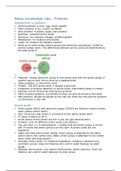
Knowledge clips Lipids
Introduction to lipids
Texture, nutrition, flavour
Lipids are compounds that are soluble in organic solvents
Non-polar so it does not dissolve in polar water
Fat = solid at room temperature, oil = liquid
Alkylglycerol: 3 fatty acids to a glycerol
Carotenoids: give yellow colour to butter
Fat has long carbon chain which is non polar! The compound below has OH
groups so it is more polar and less non-polar
Classification of lipids
Saponifiable lipids
o Largest part
o For instance triacylglycerides, phospholipids
o Contains an ester bond (C with double bonded O and single O) that can
be saponified by adding an alkaline. You get a sterol and free fatty
acid.
Unsaponifiable lipids
o Smallest part
o Tocopherol, sterols, vitamins, carotenoids
SN1 = carbon position 1, SN2 and SN3.
Unsaturated fatty acid: contains a double bond
Naming: 18 carbon bonds and double bond at 9 th position from left: C18:1w9
18 carbon bonds and double bond at 9th position from right: C18:1delta9
You only name the position of the first double bond.
COOH is also a carbon that you should count!!
Fatty acid composition
Depot fats from animals
o For instance beef
o Only 4 different fatty acids
o High amount of saturated fat
Milk fats
o Large amount of fatty acids
o A lot short fatty acids
o Contain trans fatty acids
Fish oils
o Long chain fatty acids – unsaturated
o Sensitive to oxidation reactions
Vegetable oils
o Mainly C16 and C18, just as animal
o But more unsaturated instead of saturated with animal
TAG: triacylglycerides
o Composition can be different, in different order
o P = palmitic acid, S = stearic acid etc.
o For instance MLO or POP
o The order, how they are connected is also important
, o Banded structure makes different crystals
Phospholipids and unsaponifiable compounds
Have specific properties in the lipid
Phospholipids (saponifiable)
o Phosphoric acid group and 2 fatty acids
o Phosphoric acid group is hydrophilic and the fatty acid are hydrophobic
so the compound is surface active
o Egg yolk contains lecithin which contains phospholipids surface
active so acts on surface between oil and water.
Unsaponifiable compounds
o No ester bonds
o Gives colour, or antioxidant activity, or biological function (vitamins)
o Sterols
Occurs in plants and animals
For instance cholesterol
o Carotenoids
Give colour to fat
Present in palm oil (red colour)
Conjugated system: double-single-double-single
Anti-oxidant
o Tocopherol (vitamin E)
Different kinds, depends on substitution
Anti-oxidant in palm oil benzene ring with OH group has anti-
oxidant properties
Does not give colour because there is NO large conjugated
system present
Melting properties of lipids
More unsaturated fat = liquid at room temperature
Molecules line up (crystallize) when you cool fat
When you heat, the structure is lost
Saturated: straight chains (can easily line up, crystalline)
Polyunsaturated fatty acids: banded structure = less easy to line up. You
need a lower temperature before it becomes solid
Longer chain = higher melting point. Long chains make more interactions so
earlier solid.
More double bonds is lower melting point.
Cocoa butter: solid fat decreases with higher temperature
How the fatty acids combine, influences the melting properties of the fat!
Chemical reactions of lipids
Lipid oxidation
o Auto-oxidation initiated by free radical. Radical attacks next to
double bond in the fatty acids.
o Photo-oxidation light initiated this. Sensitizer acts on the double
bond in the fatty acid.
o Enzymatic oxidation caused by an enzyme (lipoxygenase). Acts only
on 1-4-cis-cis-pentadiene. Double-single-single-double is needed.
o Flavour and colour compounds can get lost
o Off flavours are formed oxidative rancidity
Introduction to lipids
Texture, nutrition, flavour
Lipids are compounds that are soluble in organic solvents
Non-polar so it does not dissolve in polar water
Fat = solid at room temperature, oil = liquid
Alkylglycerol: 3 fatty acids to a glycerol
Carotenoids: give yellow colour to butter
Fat has long carbon chain which is non polar! The compound below has OH
groups so it is more polar and less non-polar
Classification of lipids
Saponifiable lipids
o Largest part
o For instance triacylglycerides, phospholipids
o Contains an ester bond (C with double bonded O and single O) that can
be saponified by adding an alkaline. You get a sterol and free fatty
acid.
Unsaponifiable lipids
o Smallest part
o Tocopherol, sterols, vitamins, carotenoids
SN1 = carbon position 1, SN2 and SN3.
Unsaturated fatty acid: contains a double bond
Naming: 18 carbon bonds and double bond at 9 th position from left: C18:1w9
18 carbon bonds and double bond at 9th position from right: C18:1delta9
You only name the position of the first double bond.
COOH is also a carbon that you should count!!
Fatty acid composition
Depot fats from animals
o For instance beef
o Only 4 different fatty acids
o High amount of saturated fat
Milk fats
o Large amount of fatty acids
o A lot short fatty acids
o Contain trans fatty acids
Fish oils
o Long chain fatty acids – unsaturated
o Sensitive to oxidation reactions
Vegetable oils
o Mainly C16 and C18, just as animal
o But more unsaturated instead of saturated with animal
TAG: triacylglycerides
o Composition can be different, in different order
o P = palmitic acid, S = stearic acid etc.
o For instance MLO or POP
o The order, how they are connected is also important
, o Banded structure makes different crystals
Phospholipids and unsaponifiable compounds
Have specific properties in the lipid
Phospholipids (saponifiable)
o Phosphoric acid group and 2 fatty acids
o Phosphoric acid group is hydrophilic and the fatty acid are hydrophobic
so the compound is surface active
o Egg yolk contains lecithin which contains phospholipids surface
active so acts on surface between oil and water.
Unsaponifiable compounds
o No ester bonds
o Gives colour, or antioxidant activity, or biological function (vitamins)
o Sterols
Occurs in plants and animals
For instance cholesterol
o Carotenoids
Give colour to fat
Present in palm oil (red colour)
Conjugated system: double-single-double-single
Anti-oxidant
o Tocopherol (vitamin E)
Different kinds, depends on substitution
Anti-oxidant in palm oil benzene ring with OH group has anti-
oxidant properties
Does not give colour because there is NO large conjugated
system present
Melting properties of lipids
More unsaturated fat = liquid at room temperature
Molecules line up (crystallize) when you cool fat
When you heat, the structure is lost
Saturated: straight chains (can easily line up, crystalline)
Polyunsaturated fatty acids: banded structure = less easy to line up. You
need a lower temperature before it becomes solid
Longer chain = higher melting point. Long chains make more interactions so
earlier solid.
More double bonds is lower melting point.
Cocoa butter: solid fat decreases with higher temperature
How the fatty acids combine, influences the melting properties of the fat!
Chemical reactions of lipids
Lipid oxidation
o Auto-oxidation initiated by free radical. Radical attacks next to
double bond in the fatty acids.
o Photo-oxidation light initiated this. Sensitizer acts on the double
bond in the fatty acid.
o Enzymatic oxidation caused by an enzyme (lipoxygenase). Acts only
on 1-4-cis-cis-pentadiene. Double-single-single-double is needed.
o Flavour and colour compounds can get lost
o Off flavours are formed oxidative rancidity