Summery intro. Research methods
Lecture 1
Chapter 1
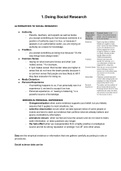
Why social research?
To raise children, reduce crime, improve health, sell products, or just understand life/learn something
new about the social world
Alternative to social research
-The research-based knowledge isn’t perfect, but compared to the alternatives it has fewer flaws and
avoids common mistakes
1. Authority
Contra:
- easy to overestimate the expertise of others
- whom should u believe if authorities disagree?
- authorities may speak on fields about which they know little about
-misuse of authority
2.Tradition
Authority of the past
Contra:
-Accept something because true in the past
- may no longer true
-cling to traditional knowledge without understanding
3. Common sense
Relying on what everyone knows and what “just makes sense “
Contra:
-contradictory ideas that often go unnoticed
4.Media Distortion
Movies, newspaper are important sources for information
Contra:
-scripts “distort reality”, primary goal is to entertain, not represent reality
-cultural misconceptions and myths
-mass media and “hype” can cause that serious problem exist, when it may not
5. personal experiences
“seeing is believing”,
Contra: 4 errors:
• 1.Overgeneralization (smoking is bad for everyone, falsely assume that it applies to most
situations)
• 2.Selective observation (know few people who are healthy still they are smoking, ignore
contradictory information)
• 3.Premature closure (don’t look for all data, because feel that we have the answer)
• 4.Halo effect (believing everything someone said, )
• False consensus (other people thinking the same way like us)
• Media distortion (believe everything from news/media)
What is scientific research?
Science: relying on empirical data (quantitative, qualitative, refers to observation) and systematic (-
>makes it scientific) analysis for drawing conclusions
,Is a social institution and a way to produce knowledge
The scientific community: collection of people who practice science and a set of norms, behaviour,
attitudes that bind them together,
science versus academia
The scientific method: refers to ideas, rules, techniques, and approaches that the scientific community
uses, arises from a loose consensus
Science: all ways of science/doing science, more room for research, more practise based
Academia: world/work in university, writing publications, collecting data, -> help science
Empirical cycle
1.Select a topic
2.focus on question
3.design the study
4. collect data
5. analyse data
6. (interpret data)
7.inform others
Research usage
Two usage: 1. advance understanding (of the fundamental nature of social life and knowledge over the
long term) and 2. apply study results to solve specific, immediate problems or issues
• Not rigidly separated
Basic or fundamental research:1.
Focuses on developing, testing, and supporting theories that explain how the social world operates,
provides foundation for knowledge that advance understanding in many areas of study across many
issues in long term
• Start: knowledge problem
• Contribution to scientific knowledge, theory
• Gap in the literature, science has less info about it, , contrast, error
• Used by scientific community
Applied research:2.
Address a specific concern or offers solutions to a practical problem, clear and practical results that
can be put to use
• Start: policy or practice problem
• Contribution to approach or solution of problem
• Initiative outside scientific community (policy, practise)
• About specific topic, outside academia, help someone
• Many specific types, Evaluation research, action research, social impact assessment study
Action: treats knowledge as a form of power, goal to empower the powerless.
• Ex: Most feminist research’s are action.
Evaluation: finding out if a program, campaign, policy etc. is effective. “Does it work?”
• Ex: Does a Socratic teaching technique improve learning over lecturing?
, Research purposes
Exploratory (explore (new) field with little research, open question, “mapping question”, tends to rely
more on qualitative data and is less likely to use a specific theory)
Descriptive (describing an existing phenomenon, narrow question, have basic information about social
phenomenon and are ready to describe it in greater depth, start with well-defined question, then design
a study to describe it accurately)
Explanatory (explaining an existing phenomenon, often using causal or structural explaining, looking for
connection between concept, identifies the source of social behaviours, beliefs)
Research design: time dimension
Cross-sectional (one timepoint, sometimes comparing groups, interested in one topic not change)
Longitudinal (multiple timepoints, measuring a process or change over time, interesting in change)
➔ Different types of time dimension:
time series study, (longitudinal research, gather same info across different times)
panel study, (observe exactly same people across multiple times)
cohort study, (focused on the same category of people)
case study, (examine numerous diverse features of the case in great depth)
Basic Applied
Exploratory
Cross-sectional
Longitudinal
Descriptive
Cross-sectional
Longitudinal
Explanatory
Cross-sectional
Longitudinal
Research design: Data collection
Quantitative (numbers,) -> positivist approach (only measure reality)
• Experiment
• Survey
• Content analysis
• Existing statistic research
• Non-obtrusive measures
Qualitative (textual/content information) -> interpretive approach
• Field research
• Historical comparative research
• Open questions, interviews
Lecture 1
Chapter 1
Why social research?
To raise children, reduce crime, improve health, sell products, or just understand life/learn something
new about the social world
Alternative to social research
-The research-based knowledge isn’t perfect, but compared to the alternatives it has fewer flaws and
avoids common mistakes
1. Authority
Contra:
- easy to overestimate the expertise of others
- whom should u believe if authorities disagree?
- authorities may speak on fields about which they know little about
-misuse of authority
2.Tradition
Authority of the past
Contra:
-Accept something because true in the past
- may no longer true
-cling to traditional knowledge without understanding
3. Common sense
Relying on what everyone knows and what “just makes sense “
Contra:
-contradictory ideas that often go unnoticed
4.Media Distortion
Movies, newspaper are important sources for information
Contra:
-scripts “distort reality”, primary goal is to entertain, not represent reality
-cultural misconceptions and myths
-mass media and “hype” can cause that serious problem exist, when it may not
5. personal experiences
“seeing is believing”,
Contra: 4 errors:
• 1.Overgeneralization (smoking is bad for everyone, falsely assume that it applies to most
situations)
• 2.Selective observation (know few people who are healthy still they are smoking, ignore
contradictory information)
• 3.Premature closure (don’t look for all data, because feel that we have the answer)
• 4.Halo effect (believing everything someone said, )
• False consensus (other people thinking the same way like us)
• Media distortion (believe everything from news/media)
What is scientific research?
Science: relying on empirical data (quantitative, qualitative, refers to observation) and systematic (-
>makes it scientific) analysis for drawing conclusions
,Is a social institution and a way to produce knowledge
The scientific community: collection of people who practice science and a set of norms, behaviour,
attitudes that bind them together,
science versus academia
The scientific method: refers to ideas, rules, techniques, and approaches that the scientific community
uses, arises from a loose consensus
Science: all ways of science/doing science, more room for research, more practise based
Academia: world/work in university, writing publications, collecting data, -> help science
Empirical cycle
1.Select a topic
2.focus on question
3.design the study
4. collect data
5. analyse data
6. (interpret data)
7.inform others
Research usage
Two usage: 1. advance understanding (of the fundamental nature of social life and knowledge over the
long term) and 2. apply study results to solve specific, immediate problems or issues
• Not rigidly separated
Basic or fundamental research:1.
Focuses on developing, testing, and supporting theories that explain how the social world operates,
provides foundation for knowledge that advance understanding in many areas of study across many
issues in long term
• Start: knowledge problem
• Contribution to scientific knowledge, theory
• Gap in the literature, science has less info about it, , contrast, error
• Used by scientific community
Applied research:2.
Address a specific concern or offers solutions to a practical problem, clear and practical results that
can be put to use
• Start: policy or practice problem
• Contribution to approach or solution of problem
• Initiative outside scientific community (policy, practise)
• About specific topic, outside academia, help someone
• Many specific types, Evaluation research, action research, social impact assessment study
Action: treats knowledge as a form of power, goal to empower the powerless.
• Ex: Most feminist research’s are action.
Evaluation: finding out if a program, campaign, policy etc. is effective. “Does it work?”
• Ex: Does a Socratic teaching technique improve learning over lecturing?
, Research purposes
Exploratory (explore (new) field with little research, open question, “mapping question”, tends to rely
more on qualitative data and is less likely to use a specific theory)
Descriptive (describing an existing phenomenon, narrow question, have basic information about social
phenomenon and are ready to describe it in greater depth, start with well-defined question, then design
a study to describe it accurately)
Explanatory (explaining an existing phenomenon, often using causal or structural explaining, looking for
connection between concept, identifies the source of social behaviours, beliefs)
Research design: time dimension
Cross-sectional (one timepoint, sometimes comparing groups, interested in one topic not change)
Longitudinal (multiple timepoints, measuring a process or change over time, interesting in change)
➔ Different types of time dimension:
time series study, (longitudinal research, gather same info across different times)
panel study, (observe exactly same people across multiple times)
cohort study, (focused on the same category of people)
case study, (examine numerous diverse features of the case in great depth)
Basic Applied
Exploratory
Cross-sectional
Longitudinal
Descriptive
Cross-sectional
Longitudinal
Explanatory
Cross-sectional
Longitudinal
Research design: Data collection
Quantitative (numbers,) -> positivist approach (only measure reality)
• Experiment
• Survey
• Content analysis
• Existing statistic research
• Non-obtrusive measures
Qualitative (textual/content information) -> interpretive approach
• Field research
• Historical comparative research
• Open questions, interviews