

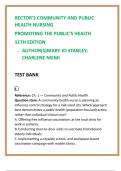
RECTOR'S COMMUNITY AND PUBLIC
HEALTH NURSING
PROMOTING THE PUBLIC'S HEALTH
11TH EDITION
• AUTHOR(S)MARY JO STANLEY;
CHARLENE NIEMI
TEST BANK
1⃣
Reference: Ch. 1 — Community and Public Health
Question stem: A community health nurse is planning an
influenza control strategy for a mid-sized city. Which approach
best demonstrates a public health (population-focused) action
rather than individual clinical care?
A. Offering free influenza vaccinations at the local clinic for
walk-in patients.
B. Conducting door-to-door visits to vaccinate homebound
elderly individuals.
C. Implementing a citywide school- and workplace-based
vaccination campaign with mobile clinics.
,D. Prescribing antiviral medication to symptomatic patients who
present to the ED.
Correct answer: C
Rationales:
• Correct: A citywide, school- and workplace-based
campaign targets the whole population and reduces
community transmission—core to public health practice.
• A incorrect: Clinic walk-ins are individual-level clinical
services; they do not proactively reach the population.
• B incorrect: Door-to-door for homebound individuals is
important individualized outreach, but still targets specific
persons rather than the broader population.
• D incorrect: Prescribing antivirals treats individuals and is
clinical care, not a population-level prevention strategy.
Teaching point: Population-based campaigns reduce
transmission by reaching large groups proactively.
Citation: Stanley, M. J., & Niemi, C. (2023). Community and
Public Health Nursing: Promoting the Public’s Health (11th ed.).
Ch. 1.
Q2
Reference: Ch. 1 — The Concept of Community
Question stem: During a community assessment, a nurse
documents local governance structures, neighborhood
,associations, and shared cultural events. Which dimension of
"community" is the nurse primarily describing?
A. Geographic location only
B. Aggregate demographics only
C. Social system and relationships within the community
D. Health status indicators of the population
Correct answer: C
Rationales:
• Correct: Governance, associations, and cultural events
describe social structures and relationships—key elements
of the community as a social system.
• A incorrect: Geographic location is one dimension but
does not capture governance or social ties.
• B incorrect: Aggregate demographics describe population
composition, not the interactive social system.
• D incorrect: Health status indicators reflect outcomes, not
the social organization and relationships.
Teaching point: Communities are social systems defined by
relationships, norms, and structures, not just place.
Citation: Stanley, M. J., & Niemi, C. (2023). Community and
Public Health Nursing: Promoting the Public’s Health (11th ed.).
Ch. 1.
Q3
, Reference: Ch. 1 — The Concept of Health
Question stem: A community has many residents living with
chronic illnesses who remain active, employed, and socially
engaged. Which statement best reflects the community health
concept discussed in the chapter?
A. Health is the absence of disease.
B. Health is a dynamic continuum influenced by functional
ability and adaptation.
C. Health equals high community income levels.
D. Health is determined solely by access to medical care.
Correct answer: B
Rationales:
• Correct: The chapter describes health as a dynamic
continuum where ability to function and adapt indicates
health despite chronic disease.
• A incorrect: Defining health as absence of disease is a
narrow biomedical view inconsistent with the chapter’s
broader concept.
• C incorrect: Income is a determinant but not a complete
definition of health.
• D incorrect: Access to care is important but not the sole
determinant; health is multifactorial.
Teaching point: Health is dynamic—ability to adapt and
function on a continuum despite disease.
Citation: Stanley, M. J., & Niemi, C. (2023). Community and
HEALTH NURSING
PROMOTING THE PUBLIC'S HEALTH
11TH EDITION
• AUTHOR(S)MARY JO STANLEY;
CHARLENE NIEMI
TEST BANK
1⃣
Reference: Ch. 1 — Community and Public Health
Question stem: A community health nurse is planning an
influenza control strategy for a mid-sized city. Which approach
best demonstrates a public health (population-focused) action
rather than individual clinical care?
A. Offering free influenza vaccinations at the local clinic for
walk-in patients.
B. Conducting door-to-door visits to vaccinate homebound
elderly individuals.
C. Implementing a citywide school- and workplace-based
vaccination campaign with mobile clinics.
,D. Prescribing antiviral medication to symptomatic patients who
present to the ED.
Correct answer: C
Rationales:
• Correct: A citywide, school- and workplace-based
campaign targets the whole population and reduces
community transmission—core to public health practice.
• A incorrect: Clinic walk-ins are individual-level clinical
services; they do not proactively reach the population.
• B incorrect: Door-to-door for homebound individuals is
important individualized outreach, but still targets specific
persons rather than the broader population.
• D incorrect: Prescribing antivirals treats individuals and is
clinical care, not a population-level prevention strategy.
Teaching point: Population-based campaigns reduce
transmission by reaching large groups proactively.
Citation: Stanley, M. J., & Niemi, C. (2023). Community and
Public Health Nursing: Promoting the Public’s Health (11th ed.).
Ch. 1.
Q2
Reference: Ch. 1 — The Concept of Community
Question stem: During a community assessment, a nurse
documents local governance structures, neighborhood
,associations, and shared cultural events. Which dimension of
"community" is the nurse primarily describing?
A. Geographic location only
B. Aggregate demographics only
C. Social system and relationships within the community
D. Health status indicators of the population
Correct answer: C
Rationales:
• Correct: Governance, associations, and cultural events
describe social structures and relationships—key elements
of the community as a social system.
• A incorrect: Geographic location is one dimension but
does not capture governance or social ties.
• B incorrect: Aggregate demographics describe population
composition, not the interactive social system.
• D incorrect: Health status indicators reflect outcomes, not
the social organization and relationships.
Teaching point: Communities are social systems defined by
relationships, norms, and structures, not just place.
Citation: Stanley, M. J., & Niemi, C. (2023). Community and
Public Health Nursing: Promoting the Public’s Health (11th ed.).
Ch. 1.
Q3
, Reference: Ch. 1 — The Concept of Health
Question stem: A community has many residents living with
chronic illnesses who remain active, employed, and socially
engaged. Which statement best reflects the community health
concept discussed in the chapter?
A. Health is the absence of disease.
B. Health is a dynamic continuum influenced by functional
ability and adaptation.
C. Health equals high community income levels.
D. Health is determined solely by access to medical care.
Correct answer: B
Rationales:
• Correct: The chapter describes health as a dynamic
continuum where ability to function and adapt indicates
health despite chronic disease.
• A incorrect: Defining health as absence of disease is a
narrow biomedical view inconsistent with the chapter’s
broader concept.
• C incorrect: Income is a determinant but not a complete
definition of health.
• D incorrect: Access to care is important but not the sole
determinant; health is multifactorial.
Teaching point: Health is dynamic—ability to adapt and
function on a continuum despite disease.
Citation: Stanley, M. J., & Niemi, C. (2023). Community and



