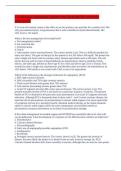
Cardiology Questions Master the Boards(All correctly
answered)
A 51-year-old woman comes to the office to see her primary care provider for a routine visit. Her
only past medical history is hypertension that is well controlled on hydrochlorothiazide. Her
LDL level is 145 mg/dl.
What is the best management of her lipid level?
a. No management needed
b. Fat-restricted diet
c. Cholestyramine
d. Niacin
e. Atorvastatin correct answersAnswer: The correct answer is (a). This is a difficult question for
many test takers. The goal of therapy for this patient is an LDL below 160 mg/dl. The patient has
only a single risk factor and no coronary artery disease equivalents such as dia betes. The risk
factors that are used in terms of hyperlipidemia are hypertension, tobacco smoking, family
history, and older age, defined as above age 45 for a man and above age 55 for a woman. This
woman has only a single risk, hypertension, and therefore does not need to be maintained at an
LDL below 1 00 mm/dl as you would with CAD or one of its equivalents
Which of the following is the strongest indication for angioplasty (PCI)?
a. 80% right coronary stenosis
b. 90% circumflex and 70% right coronary stenosis
c. Three-vessel disease with greater than 70% stenosis
d. Left anterior descending stenosis greater than 75%
e. Acute ST segment elevation Ml correct answersAnswer: The correct answer is (e). The
greatest mortality benefit of PCI is not based on a particular anatomy of stenosis. The greatest
benefit of PCI is obtained in the particular acute presentation of an acute ST segment elevation
infarction. Although PCI is frequently done in those with 1 - and 2-vessel coronary disease, the
main ben efit of percutaneous revascularization in chronic stable angina is for more rapid relief
of symptoms and not for a mortality benefit. Maximal medical therapy as the initial treatment
option in chronic stable angina offers the same symptomatic and mortality benefit as
percutaneous coronary intervention as an initial revascularization strategy.
If the initial management of unstable angina and NSTEMI are essentially iden tical, what will
you do differently if the development of a troponin or CK-MB elevation confirms an infarction?
a. Thrombolytics
b. Calcium channel blockers
c. Echocardiography
d. Early use of angiography/possible angioplasty (PCI)
e. Fondaparinux
f. Bivalirudin
g. Prasugrel correct answersAnswer: The correct answer is (d). The greater the severity of
disease, the more likely the patient is to benefit from an early invasive strategy (ie, PCI).
Calcium channel blockers don't lower mortality in anyone, although they are used in vaso spastic
, (Prinzmetal) angina or with cocaine-induced pain. Fondaparinux is a factor Xa inhibitor that
functions like heparin and is an alternative to heparin. As heparin alternatives, neither the use of
fondaparinux nor that of bivalirudin is based on developing positive troponins.
A 54-year-old woman with a recent anterior wall myocardial infarction is trans ferred to the
intensive care unit after a sudden drop in her blood pressure from 120/76 to 86/40. Her pulse is
125 per minute. She has a 3/6 systolic murmur at the lower left sternal border. A sample of blood
from the right atrium shows a p02 of 42 mm Hg and a sample from the pulmonary artery shows a
p02 of 62 mm Hg.
What is the most likely diagnosis?
a. Papillary muscle rupture
b. Atrial septal rupture
c. Ventricular septal rupture
d. Third-degree AV block
e. Left ventricular free wall rupture
f. Right ventricular rupture correct answersAnswer: The correct answer is (c). The increase in
oxygen saturation between the right atrium (RA) and the pulmonary artery (PA) implies the
presence of a shunt of blood from the left ventricle to the right ventricle. A normal p02 of venous
blood is about 40 mm Hg with a saturation of 75%. The murmur of a ventricular septal defect
(VSD) is best heard at the lower left sternal border. Papillary muscle rupture leads to acute mitral
regurgitation (MR). These murmurs will be heard at the base radiating to the axilla. This would
not lead to a "step-up" in saturation from the RA to the PA. Atrial septal rupture is highly
unlikely as a complication of infarction. Were it present, an atrial septal defect (ASD) would be
associated with shunting into the RA, and the RA oxygen content would be higher than the usual
venous p02 of 40 mm Hg. Even though this is much sooner than you would expect to find a VSD
occurring after an Ml, that is the presentation.
Which of the following is most likely to alter initial management in a person with acute
pulmonary edema?
a. Chest x-ray
b. EKG
c. Arterial blood gas
d. Echocardiography
e. Nuclear ventriculogram (MUGA scan) correct answersAnswer: The correct answer is (b). The
EKG can show two of the most common causes of an acute exacerbation of CHF: ischemia and
arrhythmia. Although infection and nonadherence to medication are two of the most common
causes of an acute decompensation in cardiac function, ischemia and arrhythmia are more
potentially dangerous and, more importantly, can alter acute management. Ischemia alters pump
function and can often present with dyspnea as an "equiva lent" of angina. Atrial arrhythmias can
cause acute pulmonary edema by the loss of atrial contribution to cardiac output. Normally, only
1 0% of cardiac output is based on the contribution of atrial systole. Most ventricular filling is
passive. However, in a person with left ventricular dysfunction, cardiomyopathy, or valvular
heart disease, atrial systole is indispensible in "shoving" blood forward into the left ventricle to
overcome the high pressure there. Hence, in an abnormal heart, atrial systole may provide as
much as 20% to 30% of cardiac output. If an arrhythmia caused the pulmonary edema, the best
initial therapy may be synchronized cardioversion.
answered)
A 51-year-old woman comes to the office to see her primary care provider for a routine visit. Her
only past medical history is hypertension that is well controlled on hydrochlorothiazide. Her
LDL level is 145 mg/dl.
What is the best management of her lipid level?
a. No management needed
b. Fat-restricted diet
c. Cholestyramine
d. Niacin
e. Atorvastatin correct answersAnswer: The correct answer is (a). This is a difficult question for
many test takers. The goal of therapy for this patient is an LDL below 160 mg/dl. The patient has
only a single risk factor and no coronary artery disease equivalents such as dia betes. The risk
factors that are used in terms of hyperlipidemia are hypertension, tobacco smoking, family
history, and older age, defined as above age 45 for a man and above age 55 for a woman. This
woman has only a single risk, hypertension, and therefore does not need to be maintained at an
LDL below 1 00 mm/dl as you would with CAD or one of its equivalents
Which of the following is the strongest indication for angioplasty (PCI)?
a. 80% right coronary stenosis
b. 90% circumflex and 70% right coronary stenosis
c. Three-vessel disease with greater than 70% stenosis
d. Left anterior descending stenosis greater than 75%
e. Acute ST segment elevation Ml correct answersAnswer: The correct answer is (e). The
greatest mortality benefit of PCI is not based on a particular anatomy of stenosis. The greatest
benefit of PCI is obtained in the particular acute presentation of an acute ST segment elevation
infarction. Although PCI is frequently done in those with 1 - and 2-vessel coronary disease, the
main ben efit of percutaneous revascularization in chronic stable angina is for more rapid relief
of symptoms and not for a mortality benefit. Maximal medical therapy as the initial treatment
option in chronic stable angina offers the same symptomatic and mortality benefit as
percutaneous coronary intervention as an initial revascularization strategy.
If the initial management of unstable angina and NSTEMI are essentially iden tical, what will
you do differently if the development of a troponin or CK-MB elevation confirms an infarction?
a. Thrombolytics
b. Calcium channel blockers
c. Echocardiography
d. Early use of angiography/possible angioplasty (PCI)
e. Fondaparinux
f. Bivalirudin
g. Prasugrel correct answersAnswer: The correct answer is (d). The greater the severity of
disease, the more likely the patient is to benefit from an early invasive strategy (ie, PCI).
Calcium channel blockers don't lower mortality in anyone, although they are used in vaso spastic
, (Prinzmetal) angina or with cocaine-induced pain. Fondaparinux is a factor Xa inhibitor that
functions like heparin and is an alternative to heparin. As heparin alternatives, neither the use of
fondaparinux nor that of bivalirudin is based on developing positive troponins.
A 54-year-old woman with a recent anterior wall myocardial infarction is trans ferred to the
intensive care unit after a sudden drop in her blood pressure from 120/76 to 86/40. Her pulse is
125 per minute. She has a 3/6 systolic murmur at the lower left sternal border. A sample of blood
from the right atrium shows a p02 of 42 mm Hg and a sample from the pulmonary artery shows a
p02 of 62 mm Hg.
What is the most likely diagnosis?
a. Papillary muscle rupture
b. Atrial septal rupture
c. Ventricular septal rupture
d. Third-degree AV block
e. Left ventricular free wall rupture
f. Right ventricular rupture correct answersAnswer: The correct answer is (c). The increase in
oxygen saturation between the right atrium (RA) and the pulmonary artery (PA) implies the
presence of a shunt of blood from the left ventricle to the right ventricle. A normal p02 of venous
blood is about 40 mm Hg with a saturation of 75%. The murmur of a ventricular septal defect
(VSD) is best heard at the lower left sternal border. Papillary muscle rupture leads to acute mitral
regurgitation (MR). These murmurs will be heard at the base radiating to the axilla. This would
not lead to a "step-up" in saturation from the RA to the PA. Atrial septal rupture is highly
unlikely as a complication of infarction. Were it present, an atrial septal defect (ASD) would be
associated with shunting into the RA, and the RA oxygen content would be higher than the usual
venous p02 of 40 mm Hg. Even though this is much sooner than you would expect to find a VSD
occurring after an Ml, that is the presentation.
Which of the following is most likely to alter initial management in a person with acute
pulmonary edema?
a. Chest x-ray
b. EKG
c. Arterial blood gas
d. Echocardiography
e. Nuclear ventriculogram (MUGA scan) correct answersAnswer: The correct answer is (b). The
EKG can show two of the most common causes of an acute exacerbation of CHF: ischemia and
arrhythmia. Although infection and nonadherence to medication are two of the most common
causes of an acute decompensation in cardiac function, ischemia and arrhythmia are more
potentially dangerous and, more importantly, can alter acute management. Ischemia alters pump
function and can often present with dyspnea as an "equiva lent" of angina. Atrial arrhythmias can
cause acute pulmonary edema by the loss of atrial contribution to cardiac output. Normally, only
1 0% of cardiac output is based on the contribution of atrial systole. Most ventricular filling is
passive. However, in a person with left ventricular dysfunction, cardiomyopathy, or valvular
heart disease, atrial systole is indispensible in "shoving" blood forward into the left ventricle to
overcome the high pressure there. Hence, in an abnormal heart, atrial systole may provide as
much as 20% to 30% of cardiac output. If an arrhythmia caused the pulmonary edema, the best
initial therapy may be synchronized cardioversion.