

Chapter 11 - Skeletal Muscle Anatomy
Gross Anatomy
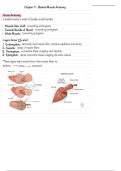
a skeletal muscle is made of bundles inside bundles
• Muscle Fiber (cell): covered by endomysium
• Fascicle (bundle of fibers): covered by perimysium
• Whole Muscle: covered by epimysium
Layers (inner ➡ outer):
1. Endomysium: surrounds each muscle fiber; contains capillaries and nerves
2. Fascicle: group of muscle fibers
3. Perimysium: connective tissue wrapping each fascicle
4. Epimysium: dense connective tissue wrapping the entire muscle
*These layers help transmit force from muscle fibers to
tendons bones movement
, Fascicle Patterns & Muscle Shapes
muscle shape tells you about strength and range of motion
1. Parallel
• Fibers run in same direction
• Large movement, not very strong
• Example: sartorius
2. Convergent
• Fibers fan out toward a single tendon
• Very strong, versatile
• Example: pectoralis major
3. Pennate
• Fibers insert at an angle onto a tendon (like a feather)
• Very strong, less movement
• Unipennate: extensor digitorum
• Bipennate: Rectus femoris
• Multipennate: deltoid
4. Circular (Sphincters)
• Rings that open/close openings
• Example: orbicularis oris
5. Spiral 6. Fusiform
• Fibers twist as they insert • Thick belly, tapered ends
• Example: supinator • Stronger than parallel
• Example: biceps Brachii
Gross Anatomy
a skeletal muscle is made of bundles inside bundles
• Muscle Fiber (cell): covered by endomysium
• Fascicle (bundle of fibers): covered by perimysium
• Whole Muscle: covered by epimysium
Layers (inner ➡ outer):
1. Endomysium: surrounds each muscle fiber; contains capillaries and nerves
2. Fascicle: group of muscle fibers
3. Perimysium: connective tissue wrapping each fascicle
4. Epimysium: dense connective tissue wrapping the entire muscle
*These layers help transmit force from muscle fibers to
tendons bones movement
, Fascicle Patterns & Muscle Shapes
muscle shape tells you about strength and range of motion
1. Parallel
• Fibers run in same direction
• Large movement, not very strong
• Example: sartorius
2. Convergent
• Fibers fan out toward a single tendon
• Very strong, versatile
• Example: pectoralis major
3. Pennate
• Fibers insert at an angle onto a tendon (like a feather)
• Very strong, less movement
• Unipennate: extensor digitorum
• Bipennate: Rectus femoris
• Multipennate: deltoid
4. Circular (Sphincters)
• Rings that open/close openings
• Example: orbicularis oris
5. Spiral 6. Fusiform
• Fibers twist as they insert • Thick belly, tapered ends
• Example: supinator • Stronger than parallel
• Example: biceps Brachii


