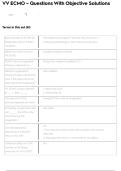
VV ECMO – Questions With Objective Solutions
Save
Terms in this set (61)
Basic premise of ECMO for Decreased vent support= time for recovery from.. 1.
Respiratory failure is that it Underlying pathology 2. Vent induced lung injury.
will allow...
Patient's primary issue for Isolated respiratory failure
VV ECMO
ECMO circuit oxygenation Pump flow relative to patients CO
efficiency depends on...
Patient's oxygenation Recirculation
should increase with ECMO
flow. If this does not occur,
what should be suspected?
VV ECMO is more efficient 1. Removing CO2
at ________ than __________ 2. Delivering O2
The amount of CO2 Sweep/O2 flow rate to oxygenator.
removal depends on what?
Increasing oxygen flow rate Decrease
will __________ the CO2 in the
blood leaving the
oxygenator
No
Are hemodynamics
1. The volume of blood removed is equal to the volume
affected by VV ECMO?
returned.
Why or why not?
2. Drainage and return on same side of circulation
Is there an effect on CVP, No
Volume, or RV filling
pressures on VV ECMO?
, On VV ECMO Systemic True.
blood flow is the native
cardiac output and is
unrelated to the ECMO
flow. True or False?
1. Decrease mechanical vent support=more efficient gas
Myocardial function and exchange=decrease RV afterload=Improved RV function
CO typically improve due
to... 2. Decrease Hypoxia (causing myocardial depression),
acidosis, and reversal of anaerobic metabolism.
Compared to VA ECMO 1. Serious arterial injury
what risks and 2. Air/Clot embolization from circuit are less severe
consequences are avoided
in VV ECMO?
What factors improve 1. Low pressure circuit=Less stress on tubing and
longevity in VV ECMO oxygenator
compared to VA ECMO 2. Less Haemodynamic disturbance
Why does VV ECMO Preservation of pulmonary blood flow.
promote more rapid
recovery from pulmonary
sepsis than VA?
1. Hypoxemic despite max conventional ventilatory
Who needs VV ECMO? support.
2. Significant vent-induced lung injury
ARDS-sepsis
Pneumonia
Bronchiolitis
Near Drowning
Aspiration
VV ECMO Indications
Trauma
(Conditions)
Asthma
Barotraumatic Ventilation
Acute Lung Failure (transplant)
Pulmonary Embolism
Smoke Inhalation.
Save
Terms in this set (61)
Basic premise of ECMO for Decreased vent support= time for recovery from.. 1.
Respiratory failure is that it Underlying pathology 2. Vent induced lung injury.
will allow...
Patient's primary issue for Isolated respiratory failure
VV ECMO
ECMO circuit oxygenation Pump flow relative to patients CO
efficiency depends on...
Patient's oxygenation Recirculation
should increase with ECMO
flow. If this does not occur,
what should be suspected?
VV ECMO is more efficient 1. Removing CO2
at ________ than __________ 2. Delivering O2
The amount of CO2 Sweep/O2 flow rate to oxygenator.
removal depends on what?
Increasing oxygen flow rate Decrease
will __________ the CO2 in the
blood leaving the
oxygenator
No
Are hemodynamics
1. The volume of blood removed is equal to the volume
affected by VV ECMO?
returned.
Why or why not?
2. Drainage and return on same side of circulation
Is there an effect on CVP, No
Volume, or RV filling
pressures on VV ECMO?
, On VV ECMO Systemic True.
blood flow is the native
cardiac output and is
unrelated to the ECMO
flow. True or False?
1. Decrease mechanical vent support=more efficient gas
Myocardial function and exchange=decrease RV afterload=Improved RV function
CO typically improve due
to... 2. Decrease Hypoxia (causing myocardial depression),
acidosis, and reversal of anaerobic metabolism.
Compared to VA ECMO 1. Serious arterial injury
what risks and 2. Air/Clot embolization from circuit are less severe
consequences are avoided
in VV ECMO?
What factors improve 1. Low pressure circuit=Less stress on tubing and
longevity in VV ECMO oxygenator
compared to VA ECMO 2. Less Haemodynamic disturbance
Why does VV ECMO Preservation of pulmonary blood flow.
promote more rapid
recovery from pulmonary
sepsis than VA?
1. Hypoxemic despite max conventional ventilatory
Who needs VV ECMO? support.
2. Significant vent-induced lung injury
ARDS-sepsis
Pneumonia
Bronchiolitis
Near Drowning
Aspiration
VV ECMO Indications
Trauma
(Conditions)
Asthma
Barotraumatic Ventilation
Acute Lung Failure (transplant)
Pulmonary Embolism
Smoke Inhalation.