100% satisfaction guarantee Immediately available after payment Both online and in PDF No strings attached 4.2 TrustPilot
logo-home
Exam (elaborations)

Microbiology Exam 1 Chapters 1,3,4,5,6 Questions and Answers

Rating
-
Sold
-
Pages
8
Grade
A+
Uploaded on
17-11-2025
Written in
2025/2026

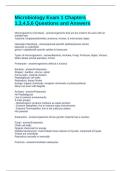
Microbiology Exam 1 Chapters 1,3,4,5,6 Questions and Answers Microorganisms(microbes) organisms that are too small to be seen with an unaided eye -bacteria, fungi(yeast&molds), protozoa, viruses, & microscopic algae Naming& Classifying genus& specific epithet(species name) italicized or underlined genus= capitalized& specific epithet is lowercase Types of microorganisms Bacteria, Archaea, Fungi, Protozoa, Algae, Viruses, Multi-cellular animal parasites, Prions Prokaryote organisms without a nucleus Bacteria Prokaryotes Shapes: -bacillus -coccus -spiral Forms pairs, chains& clusters Peptidoglycan cell walls Reproduce: binary fission Energy: organic chemicals, inorganic chemicals or photosynthesis Many can swim with flagella Archaea Prokaryotic No Peptidogycan Live in extreme environments 3 main groups: - Methanogens: produce methane as waste product - Extreme Halophiles: live in extreme salty environments - Extreme Thermophiles: live in hot sulfurous waters Not parasitic Eukaryotes organisms whose genetic material has a nucleus Fungi Eukaryotes Chitin cell walls Organic chemicals for energy Molds& Mushrooms= multi-cellular have masses of mycelia, composed of hypae Yeasts are unicellular Reproduce sexually or asexually Protozoa Unicellular eukaryotes ingest organic chemicals may be motile bc of pseudopods(false feet) cilia or flagella reproduce sexually or asexually Algae Eukaryotes Cellulose cell walls abundant in fresh& salt water environments Use photosynthesis for energy - produce molecular oxygen& organic compounds -utilizing by other organisms reproduce sexually or asexually Viruses Very small, can be seen with an electron microscope Acellular Consist on DNA or RNA core surrounded by protein coat that may be enclosed in a lipid envelope Viruses are replicated only when they are in living host cell Multicellular Animal Parasites Eukaryotes 2 Major Groups of Parasitic Worms: flatworms& roundworms Anton van Leeuwenhoek described living microorganisms made detailed drawings of "aniimalcules" from rainwater, feces& material from plague Spontaneous Generation living organisms arise from non-living matter; vital force forms life Biogenesis living organisms arise from preexisting life Louis Pasteur Proved microorganisms are present in air with S-shaped flask proved microbes are responsible for fermentation Microbial growth is also responsible for spoilage of food Bacteria could be killed by heats that was hot enough to evaporate alcohol in wine Pasteur's S-shaped Flask kept microbes out but let air in - discovers from basis of aseptic technique - showed microbes can live on nonliving surfaces Proved biogenesis Pasteur's Work Lead to microbiology as a science Pastuerization application of high heat for a short time Germ Theory disease theory microbes cause disease Ignaz Semmelwies used hand washing to prevent transmission of puerperal fever from one OB patient to another Joseph Lister used chemical disinfectant to prevent surgical infections; treated skin before surgery Robert Koch proved anthrax was caused by Bacillus anthracis Edward Jenner inoculated person with cowpox virus, then they were protected from smallpox -Vaccination -vacca-- cow Chemotherapy treatment with chemicals used to treat infectious disease can be synthetic drugs or antibiotics- more toxic to microbes than us Alexander Fleming discovered first antibiotic Bacteriology study of bacteria Mycology study of fungi Virology study of viruses Parasitology study of protozoa & parasitic worms Immunology study of immunity Gene therapy missing or defective genes in human cells can be replaced using harmless virus Genetically modified bacteria used to protect crops from insects& from freezing Normal Microbiota microbes normally present in& on the human body - prevent pathogen growth - produce growth factors such as folic acid and vitamin K Resistance ability of body to ward of disease Resolution ability of lenses to distinguish two points Refractive Index measure of light bending ability of a medium Bright field illumination dark objects visible against bright background Dark field Illumination microbes that cannot be stained Phase contrast microscopy detailed examination of living specimens get sharply defined internal structures Differential Interference Contrast 3-D image, brightly colored Scanning Acoustic Microscopy (SAM) measures sound waves and are reflected back from an object used to study cells attached to surfaces Electron Microscopy Uses electrons instead of light; electromagnetic lens to focus beams of electrons shorter wavelength of electrons gives greater resolution used for images too small to be seen with light microscopes: viruses Transmission Electron Microscopy Ultra thin sections of specimens beams of electrons passes through specimen, then electromagnetic lens, then focused on projector specimens stained with heavy metal salts magnifies objects up to 10,000 to 100,000x Scanning Elecrton Microscopy electron gun produces beam of electrons that scans surface of whole specimen secondary electrons emitted from specimen produce 3-D image Magnifies 1000 to 10,000x Scanned-Probe Microscopy Scanned tunneling microscopy(STM) uses metal probe to scan specimen Atomic force microscopy (AFM) use metal & diamond probe inserted into specimen - produces 3-D images Staining coloring microbe with dye that emphasizes certain structures Smear thin film of solution of microbes on slide Mordant Chemical that intensifies stain; may be used to hold stain or coat specimen to enlarge it Differential stains categorize bacterias: -gram stain -acid-fast stain Special stains categorize parts of cells: -capsule stain -endospore stain -flagella stain Gram Stain Primary stain: Crystal Violet Mordant: Iodine Decolorizing Agent: Alcohol- acetone Counterstain: Safranin Acid-Fast Stain Primary stain: Carbolfuchsin Decolorizing Agent: Acid-Alcohol Counterstain: Methylene Blue Capsules gelatinous covering of microbe; can determine virulence Endospore special resistant, dormant structure formed within a cell to protect it from adverse environmental conditions Endospore Staining Primary stain: Malachite green, usually with heat Decolorize cells: water Counterstain: Safranin 2 types of lenses used in a microscope Objective and Ocular Shape of streptococci Chains of spheres Monotrichous Bacteria with 1 flagella Chemotaxis Chemical Stimuli Phagocytosis cell eating Function of the mitochondria ATP Maker Function of the endospore survival in bad environments to grow when it is good environments what makes up the outer membrane Lipopolusacharides(LPS) Phospholipids Proteins Spirillum helical shape like corkscrew; rigid bodies Spirochete helical shape& flexible bodies Glycocalyx sticky layer of polysaccarides outside of cell wall Capsule: Neatly organized and firmly attached; allows cells to attach and prevents phagosytosis Slime layer: unorganized and loose Pertrichous flagella around the cell Amphitricous flagella on both sides Lophotrichous tuft of flagella coming from 1 side Serovars type of subspecies Fimbrae hairlike appendages that "velcro" to allow for attachment Cell wall Prevents Lysis(destruction) due to pressure being higher outside of the cell Gram positive Thick peptidoglycan Gram Negative Thin peptidoglycan Osmotic Pressure pressure needed to stop movement of water across membrane Isotonic solution solute concentration inside cell= outside cell: no net water movement Hypotonic Solution solute concentration is lower outside the cell then inside; cell lysis Hypertonic soultion concentration is higher outside of the cell than inside; water moves out &cell shrinks Metabolism sum of chemical reactions in organism

Show more Read less
Institution
MICROBIOLOGY
Course
MICROBIOLOGY


Whoops! We can’t load your doc right now. Try again or contact support.

Written for

Institution
MICROBIOLOGY
Course
MICROBIOLOGY

Document information

Uploaded on
November 17, 2025
Number of pages
8
Written in
2025/2026
Type
Exam (elaborations)
Contains
Questions & answers

Subjects

  • bacteria

Content preview

Microbiology Exam 1 Chapters
1,3,4,5,6 Questions and Answers
Microorganisms (microbes) - answerorganisms that are too small to be seen with an
unaided eye
-bacteria, fungi(yeast&molds), protozoa, viruses, & microscopic algae

Naming& Classifying - answergenus& specific epithet(species name)
italicized or underlined
genus= capitalized& specific epithet is lowercase

Types of microorganisms - answerBacteria, Archaea, Fungi, Protozoa, Algae, Viruses,
Multi-cellular animal parasites, Prions

Prokaryote - answerorganisms without a nucleus

Bacteria - answerProkaryotes
Shapes: -bacillus -coccus -spiral
Forms pairs, chains& clusters
Peptidoglycan cell walls
Reproduce: binary fission
Energy: organic chemicals, inorganic chemicals or photosynthesis
Many can swim with flagella

Archaea - answerProkaryotic
No Peptidogycan
Live in extreme environments
3 main groups:
- Methanogens: produce methane as waste product
- Extreme Halophiles: live in extreme salty environments
- Extreme Thermophiles: live in hot sulfurous waters
Not parasitic

Eukaryotes - answerorganisms whose genetic material has a nucleus

Fungi - answerEukaryotes
Chitin cell walls
Organic chemicals for energy
Molds& Mushrooms= multi-cellular have masses of mycelia, composed of hypae
Yeasts are unicellular
Reproduce sexually or asexually

Protozoa - answerUnicellular eukaryotes

, ingest organic chemicals
may be motile bc of pseudopods(false feet) cilia or flagella
reproduce sexually or asexually

Algae - answerEukaryotes
Cellulose cell walls
abundant in fresh& salt water environments
Use photosynthesis for energy
- produce molecular oxygen& organic compounds
-utilizing by other organisms
reproduce sexually or asexually

Viruses - answerVery small, can be seen with an electron microscope
Acellular
Consist on DNA or RNA core surrounded by protein coat that may be enclosed in a lipid
envelope
Viruses are replicated only when they are in living host cell

Multicellular Animal Parasites - answerEukaryotes
2 Major Groups of Parasitic Worms:
flatworms& roundworms

Anton van Leeuwenhoek - answerdescribed living microorganisms
made detailed drawings of "aniimalcules" from rainwater, feces& material from plague

Spontaneous Generation - answerliving organisms arise from non-living matter; vital
force forms life

Biogenesis - answerliving organisms arise from preexisting life

Louis Pasteur - answerProved microorganisms are present in air with S-shaped flask
proved microbes are responsible for fermentation
Microbial growth is also responsible for spoilage of food
Bacteria could be killed by heats that was hot enough to evaporate alcohol in wine

Pasteur's S-shaped Flask - answerkept microbes out but let air in
- discovers from basis of aseptic technique
- showed microbes can live on nonliving surfaces
Proved biogenesis

Pasteur's Work - answerLead to microbiology as a science

Pastuerization - answerapplication of high heat for a short time

Germ Theory disease - answertheory microbes cause disease

Get to know the seller

Seller avatar
Reputation scores are based on the amount of documents a seller has sold for a fee and the reviews they have received for those documents. There are three levels: Bronze, Silver and Gold. The better the reputation, the more your can rely on the quality of the sellers work.
Pogba119 Harvard University
View profile
Follow You need to be logged in order to follow users or courses
Sold
48
Member since
1 year
Number of followers
2
Documents
4870
Last sold
1 month ago
NURSING TEST

BEST EDUCATIONAL RESOURCES FOR STUDENTS

3.9

9 reviews

5
4
4
2
3
2
2
0
1
1

Recently viewed by you

Why students choose Stuvia

Created by fellow students, verified by reviews

Quality you can trust: written by students who passed their tests and reviewed by others who've used these notes.

Didn't get what you expected? Choose another document

No worries! You can instantly pick a different document that better fits what you're looking for.

Pay as you like, start learning right away

No subscription, no commitments. Pay the way you're used to via credit card and download your PDF document instantly.

Student with book image

“Bought, downloaded, and aced it. It really can be that simple.”

Alisha Student

Frequently asked questions