

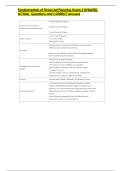
Fundamentals of Financial Planning Exam 2 UPDATED
ACTUAL Questions and CORRECT Answers
Informed Decision Making
Importance of Financial
Tracking Financial Progress
Statements in Personal Finance
Guiding Financial Strategy
• Cash & Cash Equivalents
Types of assets • Investment Assets
• Personal Use Assets
determined by subtracting total liabilities from total assets,
reflecting your overall financial status,
net worth
serves as a key indicator of financial health, guiding personal
financial planning and decisions.
• Why or how an asset increased.
• Did the client buy more or did the asset appreciate?
• Why or how an asset or liability was acquired.
The Balance Sheet does not
• Did the client purchase an asset or inherit the asset?
explain:
• Change in net worth.
• Was the change a result of added savings, inherited asset,
appreciation of assets, or debt retirement?
Income Includes salary, interest, dividends, and business income
• W-2s (reports income and deferred retirement savings)
• Credit card statements (provides insight to expenses and
spending, with year-end statements being especially informative)
Source Documents • Billing statements (such as utilities, telephone, satellite, internet,
water)
• Bank statements (especially those with bill payments)
• Federal and state income tax statement
, • Giving or receiving property other than cash
• Inheriting property other than cash
Example of transactions that
• Employer contributions or matches to retirement savings
would appear on the statement
accounts
of net worth are:
• Appreciation or depreciation of assets such as a primary
residence, investments, auto, jewelry, etc.
• Purchase or sale of a personal use asset, such as a car or house
for cash (decrease in cash)
• Purchase or sale of an investment asset, such as a mutual fund or
stock (increase or decrease)
Investing Activities
• Contributing to a retirement or education savings account
(decrease in cash)
• Receiving or making gifts of cash (increase or decrease)
Cash inheritances (increase in cash)
• Principal reduction of any loans (decrease in cash)
Financing Activities • Taking out any new loans (increase in cash)
• Paying off credit card balances (decrease in cash)
• Be realistic with spending behavior
• Budget a line-item expense for miscellaneous expenses and
3 tips for preparing a budget
unforeseen expenses
• Being successful with a budget takes practice
1. Establish goals with the client
2. Determine the client's income for a time period
3. Determine expenses, both fixed and variable
Steps in the budget process 4. Determine whether the net discretionary cash flow is positive
or negative
5. Present expenses as a percentage of income for the time
period being presented
what is the 1st step in the budget Establish goals with the client
process?
what is the 2nd step in the Determine the client's income for a time period
budget process?
what is the 3rd step in the Determine expenses, both fixed and variable
budget process?
what is the 4th step in the Determine whether the net discretionary cash flow is positive or
budget process? negative
what is the 5th step in the Present expenses as a percentage of income for the time period
budget process? being presented
debt payments should be __ of equal to or less than 36%
gross pay
living expenses should be __ of 50% or less
gross pay
Insurance should be __ of gross 5-9%
pay
taxes should be budgeted at __ 20-25%
of gross pay
ACTUAL Questions and CORRECT Answers
Informed Decision Making
Importance of Financial
Tracking Financial Progress
Statements in Personal Finance
Guiding Financial Strategy
• Cash & Cash Equivalents
Types of assets • Investment Assets
• Personal Use Assets
determined by subtracting total liabilities from total assets,
reflecting your overall financial status,
net worth
serves as a key indicator of financial health, guiding personal
financial planning and decisions.
• Why or how an asset increased.
• Did the client buy more or did the asset appreciate?
• Why or how an asset or liability was acquired.
The Balance Sheet does not
• Did the client purchase an asset or inherit the asset?
explain:
• Change in net worth.
• Was the change a result of added savings, inherited asset,
appreciation of assets, or debt retirement?
Income Includes salary, interest, dividends, and business income
• W-2s (reports income and deferred retirement savings)
• Credit card statements (provides insight to expenses and
spending, with year-end statements being especially informative)
Source Documents • Billing statements (such as utilities, telephone, satellite, internet,
water)
• Bank statements (especially those with bill payments)
• Federal and state income tax statement
, • Giving or receiving property other than cash
• Inheriting property other than cash
Example of transactions that
• Employer contributions or matches to retirement savings
would appear on the statement
accounts
of net worth are:
• Appreciation or depreciation of assets such as a primary
residence, investments, auto, jewelry, etc.
• Purchase or sale of a personal use asset, such as a car or house
for cash (decrease in cash)
• Purchase or sale of an investment asset, such as a mutual fund or
stock (increase or decrease)
Investing Activities
• Contributing to a retirement or education savings account
(decrease in cash)
• Receiving or making gifts of cash (increase or decrease)
Cash inheritances (increase in cash)
• Principal reduction of any loans (decrease in cash)
Financing Activities • Taking out any new loans (increase in cash)
• Paying off credit card balances (decrease in cash)
• Be realistic with spending behavior
• Budget a line-item expense for miscellaneous expenses and
3 tips for preparing a budget
unforeseen expenses
• Being successful with a budget takes practice
1. Establish goals with the client
2. Determine the client's income for a time period
3. Determine expenses, both fixed and variable
Steps in the budget process 4. Determine whether the net discretionary cash flow is positive
or negative
5. Present expenses as a percentage of income for the time
period being presented
what is the 1st step in the budget Establish goals with the client
process?
what is the 2nd step in the Determine the client's income for a time period
budget process?
what is the 3rd step in the Determine expenses, both fixed and variable
budget process?
what is the 4th step in the Determine whether the net discretionary cash flow is positive or
budget process? negative
what is the 5th step in the Present expenses as a percentage of income for the time period
budget process? being presented
debt payments should be __ of equal to or less than 36%
gross pay
living expenses should be __ of 50% or less
gross pay
Insurance should be __ of gross 5-9%
pay
taxes should be budgeted at __ 20-25%
of gross pay


