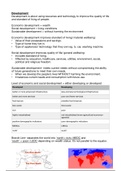
Development
Development is about using resources and technology to improve the quality of life
and standard of living of people.
Economic development = wealth
Social development = living conditions
Sustainable development = without harming the environment
Economic development improves standard of living/ material wellbeing:
• Value of their possessions and savings.
• Type of home they live in.
• Type of appliances/ technology that they own eg. tv, car, washing machine.
Social development improves quality of life/ general wellbeing:
• Includes standard of living.
• A ected by education, healthcare, services, utilities, environment, social,
political and religious freedom.
Sustainable development- meets current needs without compromising the ability
of future generations to meet their own needs.
• When we develop the people’s lives WITHOUT harming the environment.
• It balances current needs and consumption with future use.
Level of economic and social development = either developing or developed
Developed Developing
better or more advanced infrastructure less and less technological infrastructure
better and more services poor and fewer services
food secure possibly food insecure
rst world third world
rich poor
highly industrialised not industrialised (more agricultural economy=
agrarian)
positive demographic indicators poor demographic indicators
MEDCs LEDCs
north’ south’
Brandt Line- separates the world into ‘north’= rich= MEDC and
‘south’ = poor= LEDC depending on wealth status. It’s not parallel to the equator.
fi ff
, Every country has a di erent level of development.
Historically the term is associated with economic development which will lead to
more wealth for the country and per person which impacts the level of social
development in a country.
• Low to middle income generally developing
• High income generally developed
• Newly industrialised countries (NIC) in between developed and developing.
moved away from agriculture based economy towards industrialised, urban
economy. high levels of rural- urban migration with a considerable amount of
free trade
MEDC- more economically developed countries LEDC- less economically developed countries
use their resources e ciently have high levels of poverty
highly industrialised weak and sometimes ine cient education, health
and transport systems
high standard of living export raw materials
good education, health and transport systems import manufacture goods as they can’t make them
manufacture and export goods on the world market receive nancial aid from MEDCs
stable governments that are able to donate nancial
aid to other countries
There are rich people in LEDCs and poor people in MEDCs.
Factors that in uence development are based on averages- do not re ect the
development status of the individuals.
Countries are realising that to develop economically or socially it must also happen
sustainably.
Sustainable development
it provides people with things they need
does not use lots of resources
does not damage the environment
fi fl ffi ffi ff fi fl
Development is about using resources and technology to improve the quality of life
and standard of living of people.
Economic development = wealth
Social development = living conditions
Sustainable development = without harming the environment
Economic development improves standard of living/ material wellbeing:
• Value of their possessions and savings.
• Type of home they live in.
• Type of appliances/ technology that they own eg. tv, car, washing machine.
Social development improves quality of life/ general wellbeing:
• Includes standard of living.
• A ected by education, healthcare, services, utilities, environment, social,
political and religious freedom.
Sustainable development- meets current needs without compromising the ability
of future generations to meet their own needs.
• When we develop the people’s lives WITHOUT harming the environment.
• It balances current needs and consumption with future use.
Level of economic and social development = either developing or developed
Developed Developing
better or more advanced infrastructure less and less technological infrastructure
better and more services poor and fewer services
food secure possibly food insecure
rst world third world
rich poor
highly industrialised not industrialised (more agricultural economy=
agrarian)
positive demographic indicators poor demographic indicators
MEDCs LEDCs
north’ south’
Brandt Line- separates the world into ‘north’= rich= MEDC and
‘south’ = poor= LEDC depending on wealth status. It’s not parallel to the equator.
fi ff
, Every country has a di erent level of development.
Historically the term is associated with economic development which will lead to
more wealth for the country and per person which impacts the level of social
development in a country.
• Low to middle income generally developing
• High income generally developed
• Newly industrialised countries (NIC) in between developed and developing.
moved away from agriculture based economy towards industrialised, urban
economy. high levels of rural- urban migration with a considerable amount of
free trade
MEDC- more economically developed countries LEDC- less economically developed countries
use their resources e ciently have high levels of poverty
highly industrialised weak and sometimes ine cient education, health
and transport systems
high standard of living export raw materials
good education, health and transport systems import manufacture goods as they can’t make them
manufacture and export goods on the world market receive nancial aid from MEDCs
stable governments that are able to donate nancial
aid to other countries
There are rich people in LEDCs and poor people in MEDCs.
Factors that in uence development are based on averages- do not re ect the
development status of the individuals.
Countries are realising that to develop economically or socially it must also happen
sustainably.
Sustainable development
it provides people with things they need
does not use lots of resources
does not damage the environment
fi fl ffi ffi ff fi fl