ECMO And Other Temporary Support Devices –
Questions Answered With Expert Insights
Save
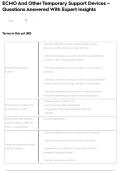
Terms in this set (80)
• Provide sufficient cardiac output and/or oxygen
delivery in order preserve organ function
• Decrease inotropic support and ventricular distention
in order to aid in myocardial healing
What are the goals of • Decrease vasopressor use in order to prevent tissue
ECMO? ischemia
• Decrease ventilator settings in order to avoid ventilator
induced trauma to the lungs and allow their healing
• Decrease sedation and paralytic in order to prevent
muscular weakening and assess neurologic status
Closed system consisting of:
What are the components - pump head (usually centrifugal)
of an ECMO circuit? - oxygenator (with heat exchanger built in)
- blender
What is the most common Polymethylpentene
material used to make the
fibers in oxygenators?
- Quadrox (Bioline, combines albumin and heparin)
- Medos (uncoated, frequently used in Europe)
Name an oxygenator brand
and the coating. - Tandemlife (uncoated, very new, does not have
integrated heat exchanger)
- Euroset (phosphorycholine)
, - Cardiohelp (integratged with an oxygenator, gold
standard for transporting, disposables ~$10k)
- Centrimag (magnetically levitated, reduces hemolysis
due to minimal friction, disposables ~$8k)
List pumps commonly used
for ECMO. - Rotaflow (traditional centrifugal pump, ~$100)
- TandemHeart (~$20k, used with protea cannula)
- Roller pump (usually for infants that require very little
flow)
- Patient size (pick cannulas based on given information)
- Surgical Plan (VA/VV, cannulation sites, cutdown/perc)
What information do you - Current Infusions
want to have before - Allergies
initiating ecmo?
*this is only if time is permitting, minimally patient size
(or best estimate) and surgical plan
approximately 5,000 units
Prior to cannulation how
much heparin should be
this is to keep cannulas anti coagulated until flow is
given?
initiated
- verify the heparin was given (~5k for an adult)
- make sure the ecmo lines are de aired and in the field
During cannulation what
- observe the wet to wet connections in the field to
should we focus on?
ensure there is no air that could be embolized in both
the drainage and reinfusion sides. Must be done by
bulb filling the lines (without a reservoir, you can't bump
up)
, - Initiate blood and gas flow
- Observe adequate color change in circuit blood
- Observe patient monitor to verify increasing SaO2 and
MAPs
Describe the process of
initiaing ECMO. (after - Tailor infusions and volume status in order to achieve
patient information is appropriate flow
gathered and cannulation is
complete). - Draw gasses from patient arterial and venous sites in
order to verify placement
- Draw circuit drainage and reinfusion gasses to
calibrate gas monitoring system
- X-ray or TEE to confirm cannula placement
This indicates a preload dependence issue
- adequate volume must be present and the cannula in
proper position for the pump to flow forward
- come down on RPMs temporarily to alleviate suck
How would you
downs
troubleshoot "chugging" or
- check if the CVP is low (may need to give volume)
"chattering" of the drainage
- If volume does not help the problem it could be
line?
drainage cannula placement (xray can help determine
location)
- chugging may also be caused by the positioning of
the patient. laying the patient flat can help drainage in
post cases
Questions Answered With Expert Insights
Save
Terms in this set (80)
• Provide sufficient cardiac output and/or oxygen
delivery in order preserve organ function
• Decrease inotropic support and ventricular distention
in order to aid in myocardial healing
What are the goals of • Decrease vasopressor use in order to prevent tissue
ECMO? ischemia
• Decrease ventilator settings in order to avoid ventilator
induced trauma to the lungs and allow their healing
• Decrease sedation and paralytic in order to prevent
muscular weakening and assess neurologic status
Closed system consisting of:
What are the components - pump head (usually centrifugal)
of an ECMO circuit? - oxygenator (with heat exchanger built in)
- blender
What is the most common Polymethylpentene
material used to make the
fibers in oxygenators?
- Quadrox (Bioline, combines albumin and heparin)
- Medos (uncoated, frequently used in Europe)
Name an oxygenator brand
and the coating. - Tandemlife (uncoated, very new, does not have
integrated heat exchanger)
- Euroset (phosphorycholine)
, - Cardiohelp (integratged with an oxygenator, gold
standard for transporting, disposables ~$10k)
- Centrimag (magnetically levitated, reduces hemolysis
due to minimal friction, disposables ~$8k)
List pumps commonly used
for ECMO. - Rotaflow (traditional centrifugal pump, ~$100)
- TandemHeart (~$20k, used with protea cannula)
- Roller pump (usually for infants that require very little
flow)
- Patient size (pick cannulas based on given information)
- Surgical Plan (VA/VV, cannulation sites, cutdown/perc)
What information do you - Current Infusions
want to have before - Allergies
initiating ecmo?
*this is only if time is permitting, minimally patient size
(or best estimate) and surgical plan
approximately 5,000 units
Prior to cannulation how
much heparin should be
this is to keep cannulas anti coagulated until flow is
given?
initiated
- verify the heparin was given (~5k for an adult)
- make sure the ecmo lines are de aired and in the field
During cannulation what
- observe the wet to wet connections in the field to
should we focus on?
ensure there is no air that could be embolized in both
the drainage and reinfusion sides. Must be done by
bulb filling the lines (without a reservoir, you can't bump
up)
, - Initiate blood and gas flow
- Observe adequate color change in circuit blood
- Observe patient monitor to verify increasing SaO2 and
MAPs
Describe the process of
initiaing ECMO. (after - Tailor infusions and volume status in order to achieve
patient information is appropriate flow
gathered and cannulation is
complete). - Draw gasses from patient arterial and venous sites in
order to verify placement
- Draw circuit drainage and reinfusion gasses to
calibrate gas monitoring system
- X-ray or TEE to confirm cannula placement
This indicates a preload dependence issue
- adequate volume must be present and the cannula in
proper position for the pump to flow forward
- come down on RPMs temporarily to alleviate suck
How would you
downs
troubleshoot "chugging" or
- check if the CVP is low (may need to give volume)
"chattering" of the drainage
- If volume does not help the problem it could be
line?
drainage cannula placement (xray can help determine
location)
- chugging may also be caused by the positioning of
the patient. laying the patient flat can help drainage in
post cases