Understanding prejudice
Lecture 1: Social identity theory
Minimal group experiments:
Group formation: categorisation process is a central component of social identity
theory
Why do we perceive groups and put people in specific categories?
- Evolutionary perspective: necessary to distinguish friend and enemy
- Cognitive perspective: necessary to process large amount of information
People simplify processing information by ignoring certain differences and
emphasizing certain similarities of that information
Non-social versus social stimuli:
Categorisation of non-social stimuli: similarities within groups and differences
between groups are over-emphasised (similarities are not people that’s why it’s
non-social)
Group formation → discriminatory behaviour (in-group favouritism)
→ even if groups are formed on basis of a trivial category
=> social categorisation → intergroup bias
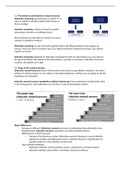
Social identity theory:
Four central concepts:
1. Social categorisation
2. Social identity
3. Social comparison
4. Psychological group distinctiveness
1. Social categorisation
The categorisation of people into groups
Tajfel: Process of bringing together people in groups which are equivalent with
regard to an individual’s actions, intentions and system of beliefs
,→ we perceive more similarity and homogeneity within and more difference between
groups by the process of social categorisation → could lead to de-humanisation
because you don’t see person as a person anymore
2. Social identity
Social identity is the realisation that one belongs to a social category and the positive
or negative evaluation associated with this membership
- Divisive (cause disagreement between people) and exclusive: you belong or
you don’t
- Context dependent: you identify with different groups in different situations
- Cultural component: some behaviours and normative expectations attached to
the identities, this turns category into an identity
- Social identity includes a judgement of nature of people in a certain category
3. Social comparison
Through social comparison with other groups, people try to evaluate their group’s
relative status
→ People strive for a positive social identity!!
They want to belong to a positively evaluated group
They value their own group more than other groups (social identification versus
contra-identification)
4. Psychological group distinctiveness
Need for belonging to a positively evaluated group but also need to be distinct from
others → try to achieve a position of their group that is distinct and positive
You want to be part of a group that has something special
Understanding behaviour:
Intergroup comparison can have two outcomes:
- Adequate social identity: attempt to maintain or extend superiority
- Inadequate social identity: they want to change that → look if there are
cognitive alternatives:
- No: situation is stable or legitimised: then you have an individual
strategy to change your social identity, two ways:
, - Social mobility: you leave your social group to join a higher
status group
- Intra-group comparison: you don’t compare yourself to higher
state group but to lower state group because they are worse off
→ to feel better about yourself
- Yes: situation is not stable or legitimised: you have group strategy to
change your social identity, five ways:
- Absorption: people give up own identity/culture and absorb
identity/culture of the other
- Redefine characteristics: changing way some negative
characteristics are perceived
- Creativity: opening a new dimension about your identity/culture
(emphasising that coffee is made in African country)
- Compare to others: compare your social group to group that
does worse
- Challenge: protesting or demonstrating → only strategy that can
change the status of a social group
Lecture 2: Social identity theory part II
Outgroup homogeneity:
People think of themselves as complex and nuanced and others as simplistic and
one-dimensional
, Outgroup homogeneity: people from a group generalise their attitudes towards the
entire outgroup
Othering:
Distinctiveness threat: people prefer bright boundaries between groups, when a
group’s identity is being eroded, the ingroup identity is no longer meaningfully and
positively distinct from relevant outgroups
Leads to:
- Rejection
- Dislike
- Aggression
Double standard: 2nd generation Dutch people have to prove their dutchness
Social mobility is more than just identifying with other group
Maintain dominance: positive behaviour of an individual outgroup member doesn’t
generalise, but negative behaviour does (that’s why people didn’t become less
prejudiced against black people when Obama became present)
Ways forward:
- Impermeable group boundaries make social mobility difficult
- Positive behaviour of individual outgroup members is not easily generalised
- Becoming aware of a shared superordinate identity can improve intergroup
relations
- Becoming aware of dual identification of outgroup members can improve
intergroup relations
Other-race effect: when individuality of a person from an outgroup isn’t seen, group
stereotypes are more powerful
Positive-negative asymmetry: consistent evidence only for positive discrimination
not negative discrimination
Lecture 1: Social identity theory
Minimal group experiments:
Group formation: categorisation process is a central component of social identity
theory
Why do we perceive groups and put people in specific categories?
- Evolutionary perspective: necessary to distinguish friend and enemy
- Cognitive perspective: necessary to process large amount of information
People simplify processing information by ignoring certain differences and
emphasizing certain similarities of that information
Non-social versus social stimuli:
Categorisation of non-social stimuli: similarities within groups and differences
between groups are over-emphasised (similarities are not people that’s why it’s
non-social)
Group formation → discriminatory behaviour (in-group favouritism)
→ even if groups are formed on basis of a trivial category
=> social categorisation → intergroup bias
Social identity theory:
Four central concepts:
1. Social categorisation
2. Social identity
3. Social comparison
4. Psychological group distinctiveness
1. Social categorisation
The categorisation of people into groups
Tajfel: Process of bringing together people in groups which are equivalent with
regard to an individual’s actions, intentions and system of beliefs
,→ we perceive more similarity and homogeneity within and more difference between
groups by the process of social categorisation → could lead to de-humanisation
because you don’t see person as a person anymore
2. Social identity
Social identity is the realisation that one belongs to a social category and the positive
or negative evaluation associated with this membership
- Divisive (cause disagreement between people) and exclusive: you belong or
you don’t
- Context dependent: you identify with different groups in different situations
- Cultural component: some behaviours and normative expectations attached to
the identities, this turns category into an identity
- Social identity includes a judgement of nature of people in a certain category
3. Social comparison
Through social comparison with other groups, people try to evaluate their group’s
relative status
→ People strive for a positive social identity!!
They want to belong to a positively evaluated group
They value their own group more than other groups (social identification versus
contra-identification)
4. Psychological group distinctiveness
Need for belonging to a positively evaluated group but also need to be distinct from
others → try to achieve a position of their group that is distinct and positive
You want to be part of a group that has something special
Understanding behaviour:
Intergroup comparison can have two outcomes:
- Adequate social identity: attempt to maintain or extend superiority
- Inadequate social identity: they want to change that → look if there are
cognitive alternatives:
- No: situation is stable or legitimised: then you have an individual
strategy to change your social identity, two ways:
, - Social mobility: you leave your social group to join a higher
status group
- Intra-group comparison: you don’t compare yourself to higher
state group but to lower state group because they are worse off
→ to feel better about yourself
- Yes: situation is not stable or legitimised: you have group strategy to
change your social identity, five ways:
- Absorption: people give up own identity/culture and absorb
identity/culture of the other
- Redefine characteristics: changing way some negative
characteristics are perceived
- Creativity: opening a new dimension about your identity/culture
(emphasising that coffee is made in African country)
- Compare to others: compare your social group to group that
does worse
- Challenge: protesting or demonstrating → only strategy that can
change the status of a social group
Lecture 2: Social identity theory part II
Outgroup homogeneity:
People think of themselves as complex and nuanced and others as simplistic and
one-dimensional
, Outgroup homogeneity: people from a group generalise their attitudes towards the
entire outgroup
Othering:
Distinctiveness threat: people prefer bright boundaries between groups, when a
group’s identity is being eroded, the ingroup identity is no longer meaningfully and
positively distinct from relevant outgroups
Leads to:
- Rejection
- Dislike
- Aggression
Double standard: 2nd generation Dutch people have to prove their dutchness
Social mobility is more than just identifying with other group
Maintain dominance: positive behaviour of an individual outgroup member doesn’t
generalise, but negative behaviour does (that’s why people didn’t become less
prejudiced against black people when Obama became present)
Ways forward:
- Impermeable group boundaries make social mobility difficult
- Positive behaviour of individual outgroup members is not easily generalised
- Becoming aware of a shared superordinate identity can improve intergroup
relations
- Becoming aware of dual identification of outgroup members can improve
intergroup relations
Other-race effect: when individuality of a person from an outgroup isn’t seen, group
stereotypes are more powerful
Positive-negative asymmetry: consistent evidence only for positive discrimination
not negative discrimination