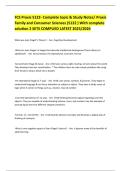
FCS Praxis 5122- Complete topic & Study Notes/ Praxis
Family and Consumer Sciences (5122 ) With complete
solu!on 2 SETS COMPLIED LATEST 2025/2026
What was Jean Piaget"s Theory? - Ans Cogni ve Development
What are Jean Piaget's 4 stages that describe intellectual development from infancy to
adulthood? - Ans Sensorimotor, Pre Opera onal, Concrete, Formal
Sensorimotor Stage (0-2yoa) - Ans Child uses senses, light, hearing, to learn about the world.
They develop hand eye coordina on. * The children learn to solve simple problems like using
their hands to drop a block into a bucket.
Pre Opera onal Stage (2-7 yoa) - Ans Child uses words, symbols, & pictures. They begin to
understand language & can focus a1en on on subject or object. They have a faulty sense of
logic when it comes to things such as, volume, mass & number
Concrete Opera onal (7-11 yoa) - Ans Child thinking becomes logical regarding concrete
objects. They are capable of understanding Volume, mass, and number. Like the example of
pouring liquid into two different shaped containers.
Formal ( 11- end of life) - Ans Understands abstract concepts and develops a logical way of
thinking of concepts.
What is one nega ve aspect of Jean Piaget's theory? - Ans It ignores many of the benefits of
adult learning.
,What are the 3 Basic components of Cogni ve Theory? - Ans Schemas (the building blocks of
knowledge) Adap on Process (Equilibrium, assimila on, accomoda on)
Stages of Cog Development (Sens, Pre-Op, Concrete, Formal)
Why is Jean Piaget's theory so important? - Ans Because it was the 1st theory that recognized
children can ac vely and effec vely learn on their own rather than depending on another
person.
What was Lawerence Kolhberg Theory? - Ans Moral Development (ethical behavior)
Kohlberg Theory - Ans Believed in 6 iden fiable stages classified into 3 Levels. (6 stages & 3
levels)
What are the 3 levels of Kolhberg Theory - Ans Pre-Conven onal(stage 1&2)
Conven onal (stage 3&4)
Post Conven onal (stage 5&6)
* He believed individuals could only progress through stages 1 @ a me. No jumping stages!
Kolhberg Preconven onal Level - Ans 1-Obedience & Punishment (behaving according to
social norms & authority figures)
2- Individualism, Instrumen lisim, & Exchange (ac ng in ones best interest)
Kolhberg Conven onal Level - Ans 3- "Good boy/Girl" (approval of others)
4- Law & Order (abiding by laws & responding to duty)
Kolhberg Post Conven onal Level - Ans 5- Social Contract (understanding social mutuality &
general interest in the welfare of others)
6- Principled Conscience (respect for universal principle & demands of conscience)
,What is Erik Erikson's theory? - Ans Psychosocial Development
What did Erikson's theory involve? - Ans It breaks down the process of human development
into 8 stages necessary for healthy func oning.
* During each stage, the person experiences a psychosocial crisis which could have a posi ve or
nega ve outcome for personality development.
Erikson Stage 1 - Ans Trust vs Mistrust (Infancy 0-1)
* Example- Parent leaving room and child trus ng that they will return*
Erikson Stage 2 - Ans Autonomy vs Shame (Early Childhood 1-3)
*Example- Need to become independent, like using the bathroom by oneself. If completed child
gains independence, if not child will feel shame & doubt *
Erikson Stage 3 - Ans Ini a ve vs Guilt (Play age 3-5)
*Example- A child exploring who they want to become in the future. If child is unable to explore
ambi ons and are expected to func on with too much self-control, they will develope guilt*
Erikson Stage 4 - Ans Industry vs Inferiority (school Age 5-12)
*example- need to develop the ability to complete produc ve task like school work and working
in groups*
Erikson Stage 5-8 - Ans 5- Ego Iden ty vs Role Confusion (Adolescence 12-18)
6- In macy vs Isola on (young adult 18-40)
7- Genera vity vs Stagna on (Adulthood 40-65)
8- Ego Iden ty vs Despair ( Maturity 65 +)
, Benjamin Bloom ( Revised Taxonomy 6 Levels for Educa onal Objec ves) - Ans 1. Knowledge
(recalling data from long term memory)
2. Comprehension (grasping meaning)
3. Applica on (using learned material & applying)
4. Analysis (breaking down material & analyzing how it relates)
5. Synthesis (puMng together separate ideas to est new)
6.Evalua on (reviewing evidence & making appr statements & judgement)
Jerome Bruner Theory - Ans 3 Modes of Representa ons
What were Bruner's 3 Modes of Representa ons - Ans 1. Inac ve Representa on (0-1)--ac on
ex. Shaking a ra1le
2. Iconic Representa on (1-6)--Image ex. pictures
3. Symbolic Representa on (7+)--language ex. words, math, symbols
What were the two theory's associated with Jerome Bruner? - Ans 1. Discovery Learning
Theory- Learners can discover/process info by themselves or in groups
2. Construc vism Theory--students can solve real life problems & make new meaning through
reflec on
What is Abraham Maslow associated with? - Ans
Abraham Maslow later added two needs to his Hierarchy of needs what were they? - Ans
Cogni ve (abstract & concrete knowledge)
Aesthe c Layer ( discove/create & experience beauty & art) * final layer
Family and Consumer Sciences (5122 ) With complete
solu!on 2 SETS COMPLIED LATEST 2025/2026
What was Jean Piaget"s Theory? - Ans Cogni ve Development
What are Jean Piaget's 4 stages that describe intellectual development from infancy to
adulthood? - Ans Sensorimotor, Pre Opera onal, Concrete, Formal
Sensorimotor Stage (0-2yoa) - Ans Child uses senses, light, hearing, to learn about the world.
They develop hand eye coordina on. * The children learn to solve simple problems like using
their hands to drop a block into a bucket.
Pre Opera onal Stage (2-7 yoa) - Ans Child uses words, symbols, & pictures. They begin to
understand language & can focus a1en on on subject or object. They have a faulty sense of
logic when it comes to things such as, volume, mass & number
Concrete Opera onal (7-11 yoa) - Ans Child thinking becomes logical regarding concrete
objects. They are capable of understanding Volume, mass, and number. Like the example of
pouring liquid into two different shaped containers.
Formal ( 11- end of life) - Ans Understands abstract concepts and develops a logical way of
thinking of concepts.
What is one nega ve aspect of Jean Piaget's theory? - Ans It ignores many of the benefits of
adult learning.
,What are the 3 Basic components of Cogni ve Theory? - Ans Schemas (the building blocks of
knowledge) Adap on Process (Equilibrium, assimila on, accomoda on)
Stages of Cog Development (Sens, Pre-Op, Concrete, Formal)
Why is Jean Piaget's theory so important? - Ans Because it was the 1st theory that recognized
children can ac vely and effec vely learn on their own rather than depending on another
person.
What was Lawerence Kolhberg Theory? - Ans Moral Development (ethical behavior)
Kohlberg Theory - Ans Believed in 6 iden fiable stages classified into 3 Levels. (6 stages & 3
levels)
What are the 3 levels of Kolhberg Theory - Ans Pre-Conven onal(stage 1&2)
Conven onal (stage 3&4)
Post Conven onal (stage 5&6)
* He believed individuals could only progress through stages 1 @ a me. No jumping stages!
Kolhberg Preconven onal Level - Ans 1-Obedience & Punishment (behaving according to
social norms & authority figures)
2- Individualism, Instrumen lisim, & Exchange (ac ng in ones best interest)
Kolhberg Conven onal Level - Ans 3- "Good boy/Girl" (approval of others)
4- Law & Order (abiding by laws & responding to duty)
Kolhberg Post Conven onal Level - Ans 5- Social Contract (understanding social mutuality &
general interest in the welfare of others)
6- Principled Conscience (respect for universal principle & demands of conscience)
,What is Erik Erikson's theory? - Ans Psychosocial Development
What did Erikson's theory involve? - Ans It breaks down the process of human development
into 8 stages necessary for healthy func oning.
* During each stage, the person experiences a psychosocial crisis which could have a posi ve or
nega ve outcome for personality development.
Erikson Stage 1 - Ans Trust vs Mistrust (Infancy 0-1)
* Example- Parent leaving room and child trus ng that they will return*
Erikson Stage 2 - Ans Autonomy vs Shame (Early Childhood 1-3)
*Example- Need to become independent, like using the bathroom by oneself. If completed child
gains independence, if not child will feel shame & doubt *
Erikson Stage 3 - Ans Ini a ve vs Guilt (Play age 3-5)
*Example- A child exploring who they want to become in the future. If child is unable to explore
ambi ons and are expected to func on with too much self-control, they will develope guilt*
Erikson Stage 4 - Ans Industry vs Inferiority (school Age 5-12)
*example- need to develop the ability to complete produc ve task like school work and working
in groups*
Erikson Stage 5-8 - Ans 5- Ego Iden ty vs Role Confusion (Adolescence 12-18)
6- In macy vs Isola on (young adult 18-40)
7- Genera vity vs Stagna on (Adulthood 40-65)
8- Ego Iden ty vs Despair ( Maturity 65 +)
, Benjamin Bloom ( Revised Taxonomy 6 Levels for Educa onal Objec ves) - Ans 1. Knowledge
(recalling data from long term memory)
2. Comprehension (grasping meaning)
3. Applica on (using learned material & applying)
4. Analysis (breaking down material & analyzing how it relates)
5. Synthesis (puMng together separate ideas to est new)
6.Evalua on (reviewing evidence & making appr statements & judgement)
Jerome Bruner Theory - Ans 3 Modes of Representa ons
What were Bruner's 3 Modes of Representa ons - Ans 1. Inac ve Representa on (0-1)--ac on
ex. Shaking a ra1le
2. Iconic Representa on (1-6)--Image ex. pictures
3. Symbolic Representa on (7+)--language ex. words, math, symbols
What were the two theory's associated with Jerome Bruner? - Ans 1. Discovery Learning
Theory- Learners can discover/process info by themselves or in groups
2. Construc vism Theory--students can solve real life problems & make new meaning through
reflec on
What is Abraham Maslow associated with? - Ans
Abraham Maslow later added two needs to his Hierarchy of needs what were they? - Ans
Cogni ve (abstract & concrete knowledge)
Aesthe c Layer ( discove/create & experience beauty & art) * final layer