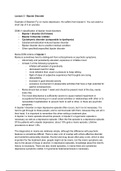
Lecture 3 - Bipolar Disorder
Example of Stephen Fry on manic depression. He suffers from bipolar II. You can watch a
short clip of it on youtube.
DSM-V classification of bipolar mood disorders
- Bipolar I disorder (full blown)
- Bipolar II disorder (milder)
- Cyclothymic disorder (comparable to dysthymia)
- Substance/medication-induced bipolar disorder
- Bipolar disorder due to another medical condition
- Other specified/unspecified bipolar disorder
Mania DSM criteria of bipolar I
Mania is sometimes hard to distinguish from schizophrenia or psychotic symptoms.
- Abnormally and persistently elevated, expansive or irritable mood
- At least 3 of the following symptoms:
- inflated self-esteem of grandiosity
- decreased need for sleep
- more talkative than usual or pressure to keep talking
- flight of ideas of subjective experience that thoughts are racing
- distractibility
- increase in goal-directed activity
- excessive involvement in pleasurable activities that have a high potential for
painful consequences
- Mania should last at least 1 week and should be present most of the day, nearly
every day
- The mood disturbance is sufficiently severe to cause marked impairment in
occupational functioning or in usual social activities or relationships with other or to
necessitate hospitalization to prevent harm to self or other, or there are psychotic
symptoms.
In bipolar I disorder a major depressive episode often occurs, but it is not necessary. It is
hard to get through to these people, and to communicate with them, because they are all in
their head. It is important to remember this when writing a treatment plan.
In bipolar I a manic episode should be present, in bipolar II a hypomanic episode is
necessary as well as a depressive episode. Often the first episode is a depressive episode.
Of the patients with unipolar depression, about 10% gets a manic episode. Lifetime
prevalence is about 1,8%.
The diagnostics in mania are relatively simple, although the difference with psychotic
features is sometimes difficult. There is also a lot of overlap with schizo-affective disorder
and borderline personality disorder. Alcohol and drug abuse often play a role, which is also
important for the treatment plan, people might not be manic, but the manic symptoms are
due to the abuse of drugs or alcohol. In depressive episodes, knowledge about the client's
history is necessary. There are also mixed episodes, in mania there are sometimes
depressive symptoms visible. In hypomania heteroanamnesis is necessary.
Example of Stephen Fry on manic depression. He suffers from bipolar II. You can watch a
short clip of it on youtube.
DSM-V classification of bipolar mood disorders
- Bipolar I disorder (full blown)
- Bipolar II disorder (milder)
- Cyclothymic disorder (comparable to dysthymia)
- Substance/medication-induced bipolar disorder
- Bipolar disorder due to another medical condition
- Other specified/unspecified bipolar disorder
Mania DSM criteria of bipolar I
Mania is sometimes hard to distinguish from schizophrenia or psychotic symptoms.
- Abnormally and persistently elevated, expansive or irritable mood
- At least 3 of the following symptoms:
- inflated self-esteem of grandiosity
- decreased need for sleep
- more talkative than usual or pressure to keep talking
- flight of ideas of subjective experience that thoughts are racing
- distractibility
- increase in goal-directed activity
- excessive involvement in pleasurable activities that have a high potential for
painful consequences
- Mania should last at least 1 week and should be present most of the day, nearly
every day
- The mood disturbance is sufficiently severe to cause marked impairment in
occupational functioning or in usual social activities or relationships with other or to
necessitate hospitalization to prevent harm to self or other, or there are psychotic
symptoms.
In bipolar I disorder a major depressive episode often occurs, but it is not necessary. It is
hard to get through to these people, and to communicate with them, because they are all in
their head. It is important to remember this when writing a treatment plan.
In bipolar I a manic episode should be present, in bipolar II a hypomanic episode is
necessary as well as a depressive episode. Often the first episode is a depressive episode.
Of the patients with unipolar depression, about 10% gets a manic episode. Lifetime
prevalence is about 1,8%.
The diagnostics in mania are relatively simple, although the difference with psychotic
features is sometimes difficult. There is also a lot of overlap with schizo-affective disorder
and borderline personality disorder. Alcohol and drug abuse often play a role, which is also
important for the treatment plan, people might not be manic, but the manic symptoms are
due to the abuse of drugs or alcohol. In depressive episodes, knowledge about the client's
history is necessary. There are also mixed episodes, in mania there are sometimes
depressive symptoms visible. In hypomania heteroanamnesis is necessary.