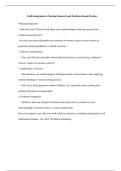
Faith Integration in Nursing Research and Evidence-Based Practice
Personal Integration
- How does your Christian faith shape your understanding of nursing research and
evidence-based practice?
- In what ways does faith guide your selection of research topics or your interest in
particular patient populations or health concerns?
2. Ethical Considerations
- How can Christian principles inform ethical decisions in research (e.g., informed
consent, respect for persons, justice)?
3. Application to Practice
- Describe how you would integrate faith-based values with evidence when applying
research findings to clinical nursing practice.
- How can a faith perspective enhance holistic care, especially when working with
patients from diverse backgrounds?
4. Scripture Integration
- Include at least one Scripture reference and explain how it connects to your
understanding of research, ethics, or clinical application.
Be sure to support your reflection with scholarly references, including nursing ethics and
faith-based literature. Use APA 7th edition formatting.
, Introduction
Nursing is both a science and a ministry—a calling that aligns compassion, skill, and
knowledge to serve others. For Christian nurses, research and evidence-based practice
(EBP) are not merely professional tools but expressions of stewardship and service to
God. Faith provides a moral compass that directs inquiry, shapes ethical integrity, and
enhances the depth of care. This paper explores how Christian beliefs influence the
understanding, application, and ethical conduct of nursing research, while emphasizing
the integration of Scripture in guiding clinical practice and promoting holistic,
compassionate care.
Personal Integration of Faith in Nursing Research
Christian faith fundamentally shapes a nurse’s approach to research and evidence-based
practice by grounding it in values of truth, compassion, and justice. Nursing research,
when viewed through a faith lens, becomes a means of fulfilling the biblical command to
love one’s neighbor (Mark 12:31). Faith directs attention to vulnerable populations—the
poor, the elderly, the marginalized—whose suffering might otherwise be overlooked. For
instance, a Christian nurse may feel called to research topics like palliative care for
terminal patients or interventions for families experiencing medical poverty. These
choices stem from the belief that every human being is created in God’s image (Genesis
1:27), deserving of dignity and holistic care. Faith also fosters humility, acknowledging
that while science uncovers truths about creation, divine wisdom transcends human
understanding. Thus, faith and reason coexist harmoniously in nursing research,
encouraging moral accountability and compassion-driven inquiry.
Personal Integration
- How does your Christian faith shape your understanding of nursing research and
evidence-based practice?
- In what ways does faith guide your selection of research topics or your interest in
particular patient populations or health concerns?
2. Ethical Considerations
- How can Christian principles inform ethical decisions in research (e.g., informed
consent, respect for persons, justice)?
3. Application to Practice
- Describe how you would integrate faith-based values with evidence when applying
research findings to clinical nursing practice.
- How can a faith perspective enhance holistic care, especially when working with
patients from diverse backgrounds?
4. Scripture Integration
- Include at least one Scripture reference and explain how it connects to your
understanding of research, ethics, or clinical application.
Be sure to support your reflection with scholarly references, including nursing ethics and
faith-based literature. Use APA 7th edition formatting.
, Introduction
Nursing is both a science and a ministry—a calling that aligns compassion, skill, and
knowledge to serve others. For Christian nurses, research and evidence-based practice
(EBP) are not merely professional tools but expressions of stewardship and service to
God. Faith provides a moral compass that directs inquiry, shapes ethical integrity, and
enhances the depth of care. This paper explores how Christian beliefs influence the
understanding, application, and ethical conduct of nursing research, while emphasizing
the integration of Scripture in guiding clinical practice and promoting holistic,
compassionate care.
Personal Integration of Faith in Nursing Research
Christian faith fundamentally shapes a nurse’s approach to research and evidence-based
practice by grounding it in values of truth, compassion, and justice. Nursing research,
when viewed through a faith lens, becomes a means of fulfilling the biblical command to
love one’s neighbor (Mark 12:31). Faith directs attention to vulnerable populations—the
poor, the elderly, the marginalized—whose suffering might otherwise be overlooked. For
instance, a Christian nurse may feel called to research topics like palliative care for
terminal patients or interventions for families experiencing medical poverty. These
choices stem from the belief that every human being is created in God’s image (Genesis
1:27), deserving of dignity and holistic care. Faith also fosters humility, acknowledging
that while science uncovers truths about creation, divine wisdom transcends human
understanding. Thus, faith and reason coexist harmoniously in nursing research,
encouraging moral accountability and compassion-driven inquiry.