AP PHYSICS 1 Scoring Guide
Applications of Circular Motion and Gravitation Quiz
1.
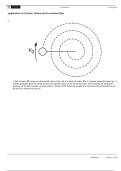
A ball of mass swings in a horizontal circle at the end of a string of radius at a constant tangential speed . A
student gradually pulls the string inward such that the radius of the circle decreases while keeping the tangential
speed of the ball constant, as shown above. Which of the following graphs best represents the acceleration of
the ball as a function of time ?
AP Physics 1 Page 1 of 39
, Scoring Guide
Applications of Circular Motion and Gravitation Quiz
(A)
(B)
(C)
(D)
Page 2 of 39 AP Physics 1
, Scoring Guide
Applications of Circular Motion and Gravitation Quiz
2.
During an experiment, a block of mass is placed on a disk that rotates about an axle through its
center, as shown in the diagram. The block is moved to different distances from the axle, and the tangential speed
of the block is gradually increased until the mass begins to slip. The distance and maximum tangential speed before
slipping, , are recorded. A student creates a graph of as a function of , as shown. How should the
student use the graph to most accurately determine the experimental value of the coefficient of static friction
between the block and the disk?
(A) Determine the slope of the best fit line, and it will be equal to .
(B) Determine the slope of the best fit line and set it equal to .
Determine the maximum value on the curve and use the data from that point in the equation
(C)
.
(D) Determine the midpoint value on the curve and use the data from that point in the equation .
AP Physics 1 Page 3 of 39
, Scoring Guide
Applications of Circular Motion and Gravitation Quiz
3. This question is a long free-response question. Show your work for each part of the question.
Students want to verify that the centripetal acceleration of an object undergoing uniform circular motion with
tangential speed and radius can be described by the equation . In the experiment, the students use a
variable speed turntable that can rotate about a pole at its center. A track is attached to the top of the turntable such
that a cart of mass can freely move toward and away from the center pole of the turntable. One end of a force
probe is attached to the pole, and the other end is attached to the cart, as shown above. All frictional forces are
negligible.
(a) The dot below represents the cart while undergoing uniform circular motion and at the location shown in the
figure above. On the dot, draw and label the forces (not components) exerted on the cart. Each force must be
represented by a distinct arrow starting on, and pointing away from, the appropriate dot.
Note: Draw the relative lengths of all vectors to reflect the relative magnitudes of all the forces.
Page 4 of 39 AP Physics 1
Applications of Circular Motion and Gravitation Quiz
1.
A ball of mass swings in a horizontal circle at the end of a string of radius at a constant tangential speed . A
student gradually pulls the string inward such that the radius of the circle decreases while keeping the tangential
speed of the ball constant, as shown above. Which of the following graphs best represents the acceleration of
the ball as a function of time ?
AP Physics 1 Page 1 of 39
, Scoring Guide
Applications of Circular Motion and Gravitation Quiz
(A)
(B)
(C)
(D)
Page 2 of 39 AP Physics 1
, Scoring Guide
Applications of Circular Motion and Gravitation Quiz
2.
During an experiment, a block of mass is placed on a disk that rotates about an axle through its
center, as shown in the diagram. The block is moved to different distances from the axle, and the tangential speed
of the block is gradually increased until the mass begins to slip. The distance and maximum tangential speed before
slipping, , are recorded. A student creates a graph of as a function of , as shown. How should the
student use the graph to most accurately determine the experimental value of the coefficient of static friction
between the block and the disk?
(A) Determine the slope of the best fit line, and it will be equal to .
(B) Determine the slope of the best fit line and set it equal to .
Determine the maximum value on the curve and use the data from that point in the equation
(C)
.
(D) Determine the midpoint value on the curve and use the data from that point in the equation .
AP Physics 1 Page 3 of 39
, Scoring Guide
Applications of Circular Motion and Gravitation Quiz
3. This question is a long free-response question. Show your work for each part of the question.
Students want to verify that the centripetal acceleration of an object undergoing uniform circular motion with
tangential speed and radius can be described by the equation . In the experiment, the students use a
variable speed turntable that can rotate about a pole at its center. A track is attached to the top of the turntable such
that a cart of mass can freely move toward and away from the center pole of the turntable. One end of a force
probe is attached to the pole, and the other end is attached to the cart, as shown above. All frictional forces are
negligible.
(a) The dot below represents the cart while undergoing uniform circular motion and at the location shown in the
figure above. On the dot, draw and label the forces (not components) exerted on the cart. Each force must be
represented by a distinct arrow starting on, and pointing away from, the appropriate dot.
Note: Draw the relative lengths of all vectors to reflect the relative magnitudes of all the forces.
Page 4 of 39 AP Physics 1