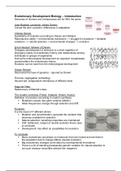
Evolutionary Development Biology – Introduction
Genomes of humans and chimpanzees are for 98% the same
Jean-Baptiste Lamarack; before Darwin
Coined the term evolution; differences in adaptation
Charles Darwin
Ingredients of evolution according to Darwin and Wallace:
Reproductive ability + environmental restrictions --> struggle for existence + heritable
variations --> natural selection + environmental changes --> evolution
Ernst Haeckel; follower of Darwin
Ontogeny (development of embryos) is a short repetition of
phylogeny (study of evolutionary history and relationships among
individuals or groups of organisms)
During the embryological development an organism recapitulates
(samenvatten) the evolutionary history
Evolution can be read from the embryological development
Gregor Mendel
Discovered the laws of genetics – ignored by Darwin
First law: segregation (scheiding)
Second law: independent inheritance of different traits
Hugo de Vries
Rediscovery of Mendel’s laws
The modern synthesis (Fisher, Haldane, Wright, Huxley)
Definition of evolution according to modern synthesis:
Mutations causes new gene variants (alleles)
Allele frequencies change through selection and drift
Evolution
It is the result of 4 different drivers
Mutation and recombination; generate the variation that
becomes available for selection
Natural selection; beneficial properties are maintained
Drift, bottleneck; subject of neutral evolution theory (see
to conclude)
Development; has effect on possibilities for evolution
To conclude
Many evolutionary processes on molecular level are neutral and are fixed in
the population due to change effects (neutral evolution)
Big evolutionary changes come about by developmental innovations
There is a lot of standing (bestaande) genetic variation for natural selection to
act upon (waarop natuurlijke selectie kan reageren)
Genomes of humans and chimpanzees are for 98% the same
Jean-Baptiste Lamarack; before Darwin
Coined the term evolution; differences in adaptation
Charles Darwin
Ingredients of evolution according to Darwin and Wallace:
Reproductive ability + environmental restrictions --> struggle for existence + heritable
variations --> natural selection + environmental changes --> evolution
Ernst Haeckel; follower of Darwin
Ontogeny (development of embryos) is a short repetition of
phylogeny (study of evolutionary history and relationships among
individuals or groups of organisms)
During the embryological development an organism recapitulates
(samenvatten) the evolutionary history
Evolution can be read from the embryological development
Gregor Mendel
Discovered the laws of genetics – ignored by Darwin
First law: segregation (scheiding)
Second law: independent inheritance of different traits
Hugo de Vries
Rediscovery of Mendel’s laws
The modern synthesis (Fisher, Haldane, Wright, Huxley)
Definition of evolution according to modern synthesis:
Mutations causes new gene variants (alleles)
Allele frequencies change through selection and drift
Evolution
It is the result of 4 different drivers
Mutation and recombination; generate the variation that
becomes available for selection
Natural selection; beneficial properties are maintained
Drift, bottleneck; subject of neutral evolution theory (see
to conclude)
Development; has effect on possibilities for evolution
To conclude
Many evolutionary processes on molecular level are neutral and are fixed in
the population due to change effects (neutral evolution)
Big evolutionary changes come about by developmental innovations
There is a lot of standing (bestaande) genetic variation for natural selection to
act upon (waarop natuurlijke selectie kan reageren)