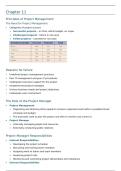
Chapter 11
Principles of Project Management:
The Need for Project Management
Categories of project success
Successful projects – on time, within budget, on scope
Challenged projects – failure in one area
Failed projects – cancelled or not used
Reasons for failure
Undefined project management practices
Poor IT management and poor IT procedures
Inadequate executive support for the project
Inexperienced project managers
Unclear business needs and project objectives
Inadequate user involvement
The Role of the Project Manager
Project Management
Organizing and directing other people to achieve a planned result within a predetermined
schedule and budget
The processes used to plan the project and then to monitor and control it.
Project Manager
Internally managing people and resources
Externally conducting public relations
Project Manager Responsibilities
Internal Responsibilities
Developing the project schedule
Recruiting and training team members
Assigning work to teams and team members
Assessing project risks
Monitoring and controlling project deliverables and milestones
External Responsibilities
, Reporting the project’s status and progress
Working directly with the client (the project’s sponsor) and other stakeholders
Identifying resource needs and obtaining resources
Additional Project Stakeholders
Client
the person or group that funds the project
Oversight Committee
clients and key managers who review the progress and direct the project
Users
the person or group of people who will use the new system
Project Management and Ceremony
Ceremony
The level of formality of a project; the rigor of holding meetings and producing documentation
High Ceremony
Meetings are often held on a predefined schedule, with specific participants, agendas,
minutes, and follow-through
Specifications are formally documented with an abundance of diagrams and documentation
and are frequently verified through formal review meetings between developers and users.
Low Ceremony
Meetings occur in the hallway or around the water cooler.
Written documentation, formal specifications, and detailed models are kept to a minimum
Developers and users usually work closely together on a daily basis to define requirements
and develop the system
Project Management Body of Knowledge (PMBOK)
PMPOK is organized into 10 knowledge areas:
1. Project Integration Management - Integrating all the other knowledge areas into one
seamless whole
2. Project Scope Management - Defining and controlling the functions that are to be included in
the system as well as the scope of the work to be done by the project team
3. Project Time Management - Creating a detailed schedule of all project tasks and then
monitoring the progress of the project against defined milestones
4. Project Cost Management - Calculating the initial cost/benefit analysis and its later updates
and monitoring expenditures as the project progresses
5. Project Quality Management - Establishing a comprehensive plan for ensuring quality, which
includes quality control activities for every phase of a project
6. Project Human Resource Management - Recruiting and hiring project team members;
training, motivating, and team building; and implementing related activities to ensure a happy,
productive team
Principles of Project Management:
The Need for Project Management
Categories of project success
Successful projects – on time, within budget, on scope
Challenged projects – failure in one area
Failed projects – cancelled or not used
Reasons for failure
Undefined project management practices
Poor IT management and poor IT procedures
Inadequate executive support for the project
Inexperienced project managers
Unclear business needs and project objectives
Inadequate user involvement
The Role of the Project Manager
Project Management
Organizing and directing other people to achieve a planned result within a predetermined
schedule and budget
The processes used to plan the project and then to monitor and control it.
Project Manager
Internally managing people and resources
Externally conducting public relations
Project Manager Responsibilities
Internal Responsibilities
Developing the project schedule
Recruiting and training team members
Assigning work to teams and team members
Assessing project risks
Monitoring and controlling project deliverables and milestones
External Responsibilities
, Reporting the project’s status and progress
Working directly with the client (the project’s sponsor) and other stakeholders
Identifying resource needs and obtaining resources
Additional Project Stakeholders
Client
the person or group that funds the project
Oversight Committee
clients and key managers who review the progress and direct the project
Users
the person or group of people who will use the new system
Project Management and Ceremony
Ceremony
The level of formality of a project; the rigor of holding meetings and producing documentation
High Ceremony
Meetings are often held on a predefined schedule, with specific participants, agendas,
minutes, and follow-through
Specifications are formally documented with an abundance of diagrams and documentation
and are frequently verified through formal review meetings between developers and users.
Low Ceremony
Meetings occur in the hallway or around the water cooler.
Written documentation, formal specifications, and detailed models are kept to a minimum
Developers and users usually work closely together on a daily basis to define requirements
and develop the system
Project Management Body of Knowledge (PMBOK)
PMPOK is organized into 10 knowledge areas:
1. Project Integration Management - Integrating all the other knowledge areas into one
seamless whole
2. Project Scope Management - Defining and controlling the functions that are to be included in
the system as well as the scope of the work to be done by the project team
3. Project Time Management - Creating a detailed schedule of all project tasks and then
monitoring the progress of the project against defined milestones
4. Project Cost Management - Calculating the initial cost/benefit analysis and its later updates
and monitoring expenditures as the project progresses
5. Project Quality Management - Establishing a comprehensive plan for ensuring quality, which
includes quality control activities for every phase of a project
6. Project Human Resource Management - Recruiting and hiring project team members;
training, motivating, and team building; and implementing related activities to ensure a happy,
productive team