Chapter 1
Software development
Information system
Set of interrelated components that collects, processes, stores, and provides as output the
information needed to complete business tasks
Computer application
Computer software program that executes on computing device to carry out specific functions
Systems analysis
Activities that enable a person to understand and specify what a system should accomplish
Specifies what system must do to satisfy need or solve problem
Systems design
Activities that enable a person to define and describe in detail the system that solves the need
Describes how the system will work
System analysis and design provide you with the tools needed to complete the development process
Development Process
1. Understand the need (business need)
2. Capture the vision
3. Define a solution
4. Communicate the vision and solution
5. Build the solution
6. Confirm that the solution meets the need
7. Launch the solution system
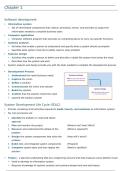
System Development Life Cycle (SDLC)
Process consisting of all activities required to build, launch, and maintain an information system
Six core processes are:
1. Identify the problem or need and obtain
approval
2. Plan and monitor the project (What to do? How? Who?)
3. Discover and understand the details of the (What is required?)
problem
4. Design the system components that solve the (How will it work?)
problem
5. Build, test, and integrate system components (Program)
6. Complete system tests and then deploy the (Need is satisfied)
solution
Project – a planned undertaking that has a beginning and end and that produces some definite result
Used to develop an information system
Requires knowledge of systems analysis and systems design tools and techniques
, System development process – guidelines for carrying out all activities of each core process SDLC
(methodology)
Iterative development
Agile development - development process that emphasizes flexibility to adapt to new requirements
during development
Fast on feet, responsive to change
Iterative development – approach to system development where system is “grown” piece by piece
through multiple iterations, starting with core components and then adding additional ones.
Involves repeating six core development processes per component
Divides system components into manageable pieces
Components chosen based on priority, most needed or riskiest first
Iteration 1: Problem identification and planning
Iteration 2: Emphasizes problem id and planning
Iteration 3: Build/test is most effort-intensive process
Benefits:
Allows early deployment of core functions for basic user support
Identifies and addresses difficult problems early in the project
Reduces complexity of complex systems by focusing on a small portion
Makes the development process more flexible, addressing new requirements and issues
Key documents used for planning projects
1. System vision document
Identifies and describes problem
Identifies system capabilities (functionalities)
Identifies business benefits
2. Work breakdown structure (WBS)
Estimates how long each task will take
Each task that needs to be done is identified and organized
3. Work sequence draft
Helps create tasks in order
Elaborates work breakdown structure
Initial Activities – pre-project
Identify the problem and document the objective of the system (core process 1)
Preliminary (initial) investigation
System Vision Document
Obtain approval to start the project (core process 1)
Meet with key stakeholders
Software development
Information system
Set of interrelated components that collects, processes, stores, and provides as output the
information needed to complete business tasks
Computer application
Computer software program that executes on computing device to carry out specific functions
Systems analysis
Activities that enable a person to understand and specify what a system should accomplish
Specifies what system must do to satisfy need or solve problem
Systems design
Activities that enable a person to define and describe in detail the system that solves the need
Describes how the system will work
System analysis and design provide you with the tools needed to complete the development process
Development Process
1. Understand the need (business need)
2. Capture the vision
3. Define a solution
4. Communicate the vision and solution
5. Build the solution
6. Confirm that the solution meets the need
7. Launch the solution system
System Development Life Cycle (SDLC)
Process consisting of all activities required to build, launch, and maintain an information system
Six core processes are:
1. Identify the problem or need and obtain
approval
2. Plan and monitor the project (What to do? How? Who?)
3. Discover and understand the details of the (What is required?)
problem
4. Design the system components that solve the (How will it work?)
problem
5. Build, test, and integrate system components (Program)
6. Complete system tests and then deploy the (Need is satisfied)
solution
Project – a planned undertaking that has a beginning and end and that produces some definite result
Used to develop an information system
Requires knowledge of systems analysis and systems design tools and techniques
, System development process – guidelines for carrying out all activities of each core process SDLC
(methodology)
Iterative development
Agile development - development process that emphasizes flexibility to adapt to new requirements
during development
Fast on feet, responsive to change
Iterative development – approach to system development where system is “grown” piece by piece
through multiple iterations, starting with core components and then adding additional ones.
Involves repeating six core development processes per component
Divides system components into manageable pieces
Components chosen based on priority, most needed or riskiest first
Iteration 1: Problem identification and planning
Iteration 2: Emphasizes problem id and planning
Iteration 3: Build/test is most effort-intensive process
Benefits:
Allows early deployment of core functions for basic user support
Identifies and addresses difficult problems early in the project
Reduces complexity of complex systems by focusing on a small portion
Makes the development process more flexible, addressing new requirements and issues
Key documents used for planning projects
1. System vision document
Identifies and describes problem
Identifies system capabilities (functionalities)
Identifies business benefits
2. Work breakdown structure (WBS)
Estimates how long each task will take
Each task that needs to be done is identified and organized
3. Work sequence draft
Helps create tasks in order
Elaborates work breakdown structure
Initial Activities – pre-project
Identify the problem and document the objective of the system (core process 1)
Preliminary (initial) investigation
System Vision Document
Obtain approval to start the project (core process 1)
Meet with key stakeholders