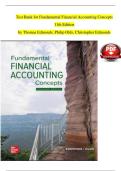
Test Bank for Fundamental Financial
Accounting Concepts
11th Edition
by Thomas Edmonds, Philip Olds,
Christopher Edmonds
,
,Student name:
1) Indicate whether each of the following statements about markets is true or false.
a) Financial resources can be provided to a business by investors.
b) Resource owners are the businesses that transform resources into products that
satisfy consumer desires.
c) Labor resources include both the physical and intellectual labor of a business's
employees.
d) Businesses purchase their resources from resource owners.
e) Consumers are the main providers of resources in any market.
2) Indicate whether each of the following statements about accounting information is true or
false.
a) Financial accounting is primarily intended to satisfy the information needs of
internal stakeholders.
b) Managerial accounting information includes financial and nonfinancial
information.
c) The accounting information intended to satisfy the needs of a company's
employees is managerial accounting information.
d) GAAP requires that companies adhere to financial accounting standards.
e) Managerial accounting information is usually less detailed than financial
accounting information.
3) Indicate whether each of the following statements about liabilities is true or false.
a) A net loss on the income statement decreases liabilities.
b) The acquisition of a bank sloan sincreases sboth sassets sand sliabilities.
c) sThe saccounting sequation srequires sthat sliabilities sbe sequal sto sstockholders’
sequity.
d) sThe samount sof sa scompany's sliabilities sis sequal sto sthe sdifference
sbetween sits sassets sand sits sstockholders’ sequity.
e) sLiabilities sare sreported son sthe sstatement sof scash sflows sof sa sbusiness.
, 4) Indicate swhether seach sof sthe sfollowing sstatements sabout sretained searnings sis strue sor
sfalse.
a) sA sdividend spaid sto sstockholders sdecreases sretained searnings.
b) sIssuing scommon sstock sfor scash sincreases sretained searnings.
c) sThe samount sof snet s income sfor sa speriod smust sequal sretained searnings.
d) sThe spurchase sof sa struck sdecreases sretained searnings.
e) sNet sincome sincreases sretained searnings.
5) Indicate swhether seach sof sthe sfollowing sstatements sabout sthe stypes sof
stransactions sis strue sor sfalse.
a) sAn sasset ssource stransaction sincreases stotal sassets sand sincreases sclaims sto
sassets.
b) sThe sissuance sof sstock sto sowners sfor scash swould sbe san sexample
sof san sasset sexchange stransaction.
c) sPurchasing sequipment sfor scash sis san sexample sof san sasset suse stransaction.
d) sPaying sa sdividend sto sstockholders sis san sexample sof san sasset suse stransaction.
e) sMaking sa spayment son sa sbank sloan sis san sexample sof san sasset sexchange
stransaction.
6) Indicate swhether seach sof sthe sfollowing sstatements sabout sfinancial sstatements
sis strue sor sfalse.
a) sA scash sdividend spaid sto sstockholders sis sreported sin sthe sinvesting
sactivities ssection sof sthe sstatement sof scash sflows.
b) sA scash sdividend spaid sto sstockholders sis sreported son sthe sstatement sof
schanges sin sstockholders' sequity.
c) sA scash sdividend spaid sto sstockholders sis sreported son sthe sincome sstatement.
d) sThe sbalance ssheet sreports sthe sending sbalances sof spermanent saccounts sas
sof sthe slast sday sof sthe saccounting speriod.
e) sChanges sin sretained searnings sduring sthe saccounting speriod sare
sreported son sthe sincome sstatement.
Accounting Concepts
11th Edition
by Thomas Edmonds, Philip Olds,
Christopher Edmonds
,
,Student name:
1) Indicate whether each of the following statements about markets is true or false.
a) Financial resources can be provided to a business by investors.
b) Resource owners are the businesses that transform resources into products that
satisfy consumer desires.
c) Labor resources include both the physical and intellectual labor of a business's
employees.
d) Businesses purchase their resources from resource owners.
e) Consumers are the main providers of resources in any market.
2) Indicate whether each of the following statements about accounting information is true or
false.
a) Financial accounting is primarily intended to satisfy the information needs of
internal stakeholders.
b) Managerial accounting information includes financial and nonfinancial
information.
c) The accounting information intended to satisfy the needs of a company's
employees is managerial accounting information.
d) GAAP requires that companies adhere to financial accounting standards.
e) Managerial accounting information is usually less detailed than financial
accounting information.
3) Indicate whether each of the following statements about liabilities is true or false.
a) A net loss on the income statement decreases liabilities.
b) The acquisition of a bank sloan sincreases sboth sassets sand sliabilities.
c) sThe saccounting sequation srequires sthat sliabilities sbe sequal sto sstockholders’
sequity.
d) sThe samount sof sa scompany's sliabilities sis sequal sto sthe sdifference
sbetween sits sassets sand sits sstockholders’ sequity.
e) sLiabilities sare sreported son sthe sstatement sof scash sflows sof sa sbusiness.
, 4) Indicate swhether seach sof sthe sfollowing sstatements sabout sretained searnings sis strue sor
sfalse.
a) sA sdividend spaid sto sstockholders sdecreases sretained searnings.
b) sIssuing scommon sstock sfor scash sincreases sretained searnings.
c) sThe samount sof snet s income sfor sa speriod smust sequal sretained searnings.
d) sThe spurchase sof sa struck sdecreases sretained searnings.
e) sNet sincome sincreases sretained searnings.
5) Indicate swhether seach sof sthe sfollowing sstatements sabout sthe stypes sof
stransactions sis strue sor sfalse.
a) sAn sasset ssource stransaction sincreases stotal sassets sand sincreases sclaims sto
sassets.
b) sThe sissuance sof sstock sto sowners sfor scash swould sbe san sexample
sof san sasset sexchange stransaction.
c) sPurchasing sequipment sfor scash sis san sexample sof san sasset suse stransaction.
d) sPaying sa sdividend sto sstockholders sis san sexample sof san sasset suse stransaction.
e) sMaking sa spayment son sa sbank sloan sis san sexample sof san sasset sexchange
stransaction.
6) Indicate swhether seach sof sthe sfollowing sstatements sabout sfinancial sstatements
sis strue sor sfalse.
a) sA scash sdividend spaid sto sstockholders sis sreported sin sthe sinvesting
sactivities ssection sof sthe sstatement sof scash sflows.
b) sA scash sdividend spaid sto sstockholders sis sreported son sthe sstatement sof
schanges sin sstockholders' sequity.
c) sA scash sdividend spaid sto sstockholders sis sreported son sthe sincome sstatement.
d) sThe sbalance ssheet sreports sthe sending sbalances sof spermanent saccounts sas
sof sthe slast sday sof sthe saccounting speriod.
e) sChanges sin sretained searnings sduring sthe saccounting speriod sare
sreported son sthe sincome sstatement.