

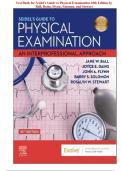
eidel’s Guide to Physical Examination: An Interprofessional Approach, 10th Edition by Jane W. Ball, Joyce E. Dains, John A. Flynn, Barry S. Solomon, and Rosalyn W. Stewart. (10th Edition – published March 2022)
eidel’s Guide to Physical Examination: An Interprofessional Approach, 10th Edition by Jane W. Ball, Joyce E. Dains, John A. Flynn, Barry S. Solomon, and Rosalyn W. Stewart. (10th Edition – published March 2022) Unlock full value from the 10th edition of Seidel’s Guide to Physical Examination: An Interprofessional Approach with this comprehensive Test Bank designed for educators, students and clinical learners in physical examination and health assessment. This Test Bank is meticulously aligned with each chapter of the 10th edition, offering high-quality questions, rationales, and assessment-ready resources to strengthen competency, build confidence and enhance educational outcomes in physical examination across lifespan and interprofessional contexts. Why this Test Bank is Essential The 10th edition of Seidel’s Guide adopts a modern, interprofessional approach to health assessment—emphasizing not only how to perform history taking and physical examinations, but also how to think critically, apply differential diagnosis, recognize abnormalities across the lifespan (infants → older adults) and collaborate across healthcare professions. It incorporates updated content such as cultural competency, LGBTQ+ health considerations, human-trafficking screening, genomics, updated “Patient Record” chapter and new videos/illustrations. +1 Merely reading the textbook, however, is not enough to guarantee mastery. Learners must practice application—history interviewing, physical exam techniques, recognizing findings, distinguishing normal from abnormal, charting, clinical reasoning. This Test Bank bridges that gap: offering a structured, question-based approach aligned with the textbook’s structure and learning objectives. For instructors, it means having ready-to-use assessment items; for students, it means targeted practice and self-evaluation. What’s Included This Test Bank offers a rich and diverse set of resources: Chapter-by-Chapter Question Sets: Every chapter from the 10th edition (typically 1 through 26) is covered, from "The History and Interviewing Process" through "Emergency or Life-Threatening Situations". Stuvia +1 Multiple Question Formats: Multiple-choice items are standard, but the bank also includes fill-in-the-blank, matching, short-answer/essay prompts, scenario/case-based questions, and clinical reasoning items. This variation ensures depth of learning beyond recall. Rationales & Answer Key: Every question is accompanied by a correct answer, and a detailed rationale explaining why that answer is correct and why the distractors are incorrect. This helps both students and instructors understand the underlying reasoning. Learning-Objective Alignment: Each question is tagged to textbook learning objectives (e.g., “Examination Techniques and Equipment”, “Cultural Competency”, “Musculoskeletal System – Adult vs. Older Adult”, etc.), allowing targeted use of the bank for specific topics or weak areas. Instructor-Friendly Organization: The bank is structured for ease of use in quiz creation, mid-term/final exams, review sessions, group study, or self-test modes. Questions are grouped by chapter, enabling efficient extraction for specific modules. Clinical-Reasoning Focus: Given the interprofessional and lifespan approach of the textbook, many items focus on applying knowledge in clinical scenarios—e.g., assessing infants vs older adults, cultural variations, LGBTQ+ patient considerations, differential diagnosis of abnormal findings. Student Self-Study Use: Students can use the Test Bank for timed quizzes, self-assessment, tracking performance, identifying knowledge gaps, and building test-taking confidence. Benefits for Students Deepened Understanding: Instead of passive reading, the Test Bank forces active engagement—selecting answers, thinking through reasoning, confronting “what if” abnormal findings, and comparing expected vs unexpected exam results. Confidence Building: Regular exposure to exam-style questions reduces anxiety and increases familiarity with question formats and terminology. Students feel more prepared for course exams, clinical practicals, and licensing/assessment situations. Targeted Remediation: After every practice session, students can identify topics or question types they struggle with (e.g., head/neck exam in older adults, genital/rectal exam sensitivities, culturally competent interviewing) and revisit those textbook sections with focus. Lifespan & Interprofessional Context: Because the textbook addresses infants → children → adolescents → pregnant patients → older adults, the Test Bank likewise ensures practice across lifespan variations and interprofessional scenarios, preparing students for diverse patient populations. Improved Clinical Reasoning: Case-based questions push learners beyond “What is the normal heart rate?” to “What physical exam findings might change in a pregnant adolescent with this history?” or “How does the exam differ for a transgender patient in this context?” These higher-order questions build critical thinking and clinical application. Exam‐Ready Practice: The structure and format mimic typical quiz/exam experiences—thus students can practice under timed conditions, develop pacing strategies, learn to eliminate distractors, and build test-taking skill alongside content mastery. Benefits for Instructors Time-Savings: Preparing quality assessment questions is time-consuming. With this Test Bank, instructors get fully-prepared, textbook-aligned question sets, allowing more time for teaching, feedback, and student interaction. Flexible Use: Instructors can easily pick and choose questions by chapter, difficulty level, format, or topic. Use them directly for quizzes, midterms, finals, review games, or group activities. High-Quality & Relevant Content: Because the bank aligns with the 10th edition’s interprofessional, lifespan, evidence-based approach, instructors can trust the questions are current, relevant and reflective of contemporary health-assessment practice. Learning-Objective Mapping: The tagging of questions to textbook objectives makes it easier to ensure alignment between learning activities, lectures, assessments and outcomes—a key accreditation consideration. Adaptability: Instructors can modify or adapt questions, add own case details, or convert them to classroom clicker/polling formats, group discussions, or online quizzes. How to Use It Effectively Here are suggestions for both students and instructors to maximize value: For Students Chapter-by-Chapter Practice: After reading each textbook chapter, immediately work through the corresponding question set from the Test Bank. Timed Quizzes: Simulate test conditions by setting a time limit (e.g., 10–15 minutes for 10 questions) to build pacing and test-taking stamina. Mistake Log: Keep a log of all questions you answer incorrectly or are unsure of. Note the learning objective, concept misunderstood, and plan to revisit the textbook or supplementary material. Review Rationales: Review the rationale for each question (correct and incorrect options) to deepen understanding of why a given answer is correct. Mixed Topic Reviews: Periodically mix questions from various chapters (e.g., anatomy/physiology, cultural competency, neurologic system, emergency situations) to practice retrieval across domains. Group Study Sessions: Work with peers—one student reads the question, others attempt answers, then discuss the rationale together. Teaching others helps reinforce your own knowledge. Pre-Exam Simulation: Before major exams, select a large bundle of questions (e.g., 40–50) under timed conditions and treat it as a mock exam to simulate pressure, pace, and breadth. For Instructors Quiz/Bite-Sized Assessment: For each lecture or module, pick 8–12 questions from the respective chapter, and run a short quiz at the start or end of class to reinforce learning. Midterm/Final Exams: Combine questions from multiple chapters, vary formats (MC, matching, short answer, case scenario) to create robust assessments. Review Sessions: Before major tests, use question sets as group review, converting some into clicker questions, team competitions, or discussion prompts—especially clinical reasoning items. Remediation Tools: Identify questions that many students miss, then assign those as take-home reviews with rationales; hold remediation sessions or supplemental workshops on those topics. Learning Outcome Alignment: Use the objective-tagging to ensure your assessments cover all key learning outcomes, helping with curriculum mapping and accreditation requirements. Edition & Alignment Assurance The 10th edition of the textbook (March 2022) was published by Elsevier and structured such that each core chapter begins with Anatomy & Physiology, then Review of Related History, then Examination and Findings, and Abnormalities—and integrates lifespan content (infants, children, adolescents, pregnant patients, older adults) in each chapter. Elsevier Shop +1 This Test Bank is crafted specifically to align with that structure: chapters correspond to those sections and the question sets reflect the updated content and emphasis (e.g., cultural competency, EMR documentation in “The Patient Record” chapter, LGBTQ+ health issues) found in the 10th edition. Because physical examination is a practical, skill-based discipline, this Test Bank emphasizes not only knowledge recall but also application: examination steps, expected vs unexpected findings, variations across lifespan and populations, charting/documentation, clinical reasoning—matching the textbook’s aims. Who Should Use It? Undergraduate Nursing/Health-Assessment Students: Those enrolled in courses based on Seidel’s Guide (10th edition) will find this Test Bank a perfect augmentation to their textbook and labs. Graduate/Advanced Practice Students: APRN, NP, PA, clinical nurse specialists can use the bank to refine their physical-examination knowledge across lifespan, complex patients, and interprofessional settings. Instructors & Faculty: Teaching physical examination, health assessment, advanced assessment, clinical skills labs—whether in nursing, medicine, allied health, physician-assistant programs—will appreciate this bank as a ready resource for quizzes, exams, and review activities. Self-Directed Learners/Clinicians: Practitioners refreshing their examination skills, preparing for remediation, or entering new fields (e.g., moving from adult to older-adult care, pediatric assessment, or seeing diverse populations) will find value in structured question practice. Clinical Skills Lab Coordinators: Those who design simulation labs, OSCEs (Objective Structured Clinical Examinations) or peer-assessment sessions can draw from the question items to design scenarios and assessment tools. Why This Is a Smart Investment Efficiency: Instead of creating your own thousands of questions and rationales from scratch, you get a fully prepared bank aligned with your course text. Relevance: Because it matches the 10th edition and the interprofessional, lifespan-inclusive approach of the textbook, you avoid outdated content that doesn’t reflect current practice. Improved Performance: Students who regularly practice with aligned questions tend to perform better on exams, identify weak areas sooner, and build confidence in clinical reasoning and examination skills. Versatility: Whether you’re a student, instructor, or clinician, this Test Bank adapts to your setting—quizzes, self-tests, team reviews, OSCE prep. Confidence & Clinical Readiness: Because physical examination requires more than memorisation—it demands skill, communication, reasoning and adaptation—this bank helps build that deeper competence. Final Thoughts In today’s healthcare environment, physical examination remains a cornerstone of patient-centred care—but it is also more complex than ever. The 10th edition of Seidel’s Guide to Physical Examination: An Interprofessional Approach emphasises not only the “how to” of examination, but also the “why”, the context, the interprofessional collaboration, lifespan variations, documentation in an EMR world, cultural competency, and differential diagnosis of abnormalities. This Test Bank becomes the perfect companion to make that learning practical, measurable and repeatable. Whether you’re a student preparing for clinical competency, an instructor designing assessments and review materials, or a clinician refreshing your assessment skill-set, this Test Bank offers the structure, variety, depth and alignment you need. Invest in it—and move from knowledge to mastery in patient assessment, one question at a time. Purchase it today and elevate your physical-examination education, assessment, and confidence.
Document information
- Uploaded on
- November 15, 2025
- Number of pages
- 199
- Written in
- 2025/2026
- Type
- Exam (elaborations)
- Contains
- Questions & answers


