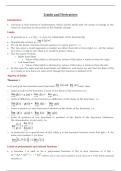
Limits and Derivatives
Introduction
• Calculus is that branch of mathematics which mainly deals with the study of change in the
value of a function as the points in the domain change.
Limits
• In general as x → a, f(x) → l, then l is called limit of the function f(x)
• Symbolically written as
• For all the limits, function should assume at a given point x = a
• The two ways x could approach a number an either from left or from right, i.e., all the values
of x near a could be less than a or could be greater than a.
• The two types of limits
o Right hand limit
▪ Value of f(x) which is dictated by values of f(x) when x tends to from the right.
o Left hand limit.
▪ Value of f(x) which is dictated by values of f(x) when x tends to from the left.
• In this case the right and left hand limits are different, and hence we say that the limit of f(x)
as x tends to zero does not exist (even though the function is defined at 0).
Algebra of limits
Theorem 1
Let f and g be two functions such that both exist, then
o Limit of sum of two functions is sum of the limits of the function s,i.e
o Limit of difference of two functions is difference of the limits of the functions, i.e.
o Limit of product of two functions is product of the limits of the functions, i.e.,
o Limit of quotient of two functions is quotient of the limits of the functions (whenever
the denominator is non zero), i.e.,
o In particular as a special case of (iii), when g is the constant function such that g(x) = λ, for
some real number λ, we have
Limits of polynomials and rational functions
• A function f is said to be a polynomial function if f(x) is zero function or if f(x) =
where aiS is are real numbers such that an ≠ 0 for some natural
number n.
, • We know that
Hence,
• Let be a polynomial function
• A function f is said to be a rational function, if f(x) = where g(x) and h(x) are polynomials
such that h(x) ≠ 0.
Then
• However, if h(a) = 0, there are two scenarios –
o when g(a) ≠ 0
▪ limit does not exist
o When g (a) = 0.
▪ g(x) = (x – a)k g1(x), where k is the maximum of powers of (x – a) in g(x)
▪ Similarly, h(x) = (x – a)l h1 (x) as h (a) = 0. Now, if k ≥ l, we have
If k < l, the limit is not defined.
Theorem 2
For any positive integer n
Introduction
• Calculus is that branch of mathematics which mainly deals with the study of change in the
value of a function as the points in the domain change.
Limits
• In general as x → a, f(x) → l, then l is called limit of the function f(x)
• Symbolically written as
• For all the limits, function should assume at a given point x = a
• The two ways x could approach a number an either from left or from right, i.e., all the values
of x near a could be less than a or could be greater than a.
• The two types of limits
o Right hand limit
▪ Value of f(x) which is dictated by values of f(x) when x tends to from the right.
o Left hand limit.
▪ Value of f(x) which is dictated by values of f(x) when x tends to from the left.
• In this case the right and left hand limits are different, and hence we say that the limit of f(x)
as x tends to zero does not exist (even though the function is defined at 0).
Algebra of limits
Theorem 1
Let f and g be two functions such that both exist, then
o Limit of sum of two functions is sum of the limits of the function s,i.e
o Limit of difference of two functions is difference of the limits of the functions, i.e.
o Limit of product of two functions is product of the limits of the functions, i.e.,
o Limit of quotient of two functions is quotient of the limits of the functions (whenever
the denominator is non zero), i.e.,
o In particular as a special case of (iii), when g is the constant function such that g(x) = λ, for
some real number λ, we have
Limits of polynomials and rational functions
• A function f is said to be a polynomial function if f(x) is zero function or if f(x) =
where aiS is are real numbers such that an ≠ 0 for some natural
number n.
, • We know that
Hence,
• Let be a polynomial function
• A function f is said to be a rational function, if f(x) = where g(x) and h(x) are polynomials
such that h(x) ≠ 0.
Then
• However, if h(a) = 0, there are two scenarios –
o when g(a) ≠ 0
▪ limit does not exist
o When g (a) = 0.
▪ g(x) = (x – a)k g1(x), where k is the maximum of powers of (x – a) in g(x)
▪ Similarly, h(x) = (x – a)l h1 (x) as h (a) = 0. Now, if k ≥ l, we have
If k < l, the limit is not defined.
Theorem 2
For any positive integer n