BIOS 2150 Microbiology Thursday 10/25/18
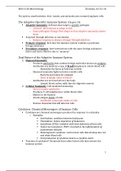
The spleen, small intestine, liver, tonsils, and adenoids also contain lymphatic cells
The Adaptive (Specific) Immune System (Chapter 18)
Adaptive immunity: defenses that target a specific pathogen
o Learned- the body has to adapt to this
o Some pathogens change their shape so that adaptive immunity misses
them
Acquired through infection or vaccination
o Immune response is always stronger through infection
Primary response: first time the immune system combats a particular
foreign substance
Secondary response: later interactions with the same foreign substance;
faster and more effective due to “memory”
Dual Nature of the Adaptive Immune System
1. Humoral immunity
. Produces antibodies that combat foreign molecules known as antigens
. Antibodies are made by a type of B cell lymphocyte (white blood cell)
. Named for the bursa of Fabricius in birds
. Humoral immunity fights invaders outside cells
. Bacteria and toxins for example
. Done in lymph (done in blood)
. Antibodies are secreted all over the body
. Lymph, blood, saliva, milk, line the digestive system
2. Cellular Immunity (cell-mediated immunity)
. Does not make antibodies
. Produces T cell lymphocytes (white blood cells)
. Mature in the thymus
. Attack antigen inside of cells
. Antibodies cannot get inside of cells
. Release chemicals that kill infected cells
Cytokines: Chemical Messengers of Immune Cells
Cytokines are chemical messengers produced in response to a stimulus
o Examples:
Interleukins: cytokines between leukocytes
Chemokines: induce migration of leukocytes
Interferons (IFNs): interfere with viral infections of host cells
Tumor necrosis factor (TNF): involved in the inflammation of
autoimmune diseases
Hematopoietic cytokines: control stem cells that develop into red
and white blood cells
Overproduction of cytokines lead to a cytokine storm
Function of cytokines? Chemicals from white blood cells that activate the
immune system
1
The spleen, small intestine, liver, tonsils, and adenoids also contain lymphatic cells
The Adaptive (Specific) Immune System (Chapter 18)
Adaptive immunity: defenses that target a specific pathogen
o Learned- the body has to adapt to this
o Some pathogens change their shape so that adaptive immunity misses
them
Acquired through infection or vaccination
o Immune response is always stronger through infection
Primary response: first time the immune system combats a particular
foreign substance
Secondary response: later interactions with the same foreign substance;
faster and more effective due to “memory”
Dual Nature of the Adaptive Immune System
1. Humoral immunity
. Produces antibodies that combat foreign molecules known as antigens
. Antibodies are made by a type of B cell lymphocyte (white blood cell)
. Named for the bursa of Fabricius in birds
. Humoral immunity fights invaders outside cells
. Bacteria and toxins for example
. Done in lymph (done in blood)
. Antibodies are secreted all over the body
. Lymph, blood, saliva, milk, line the digestive system
2. Cellular Immunity (cell-mediated immunity)
. Does not make antibodies
. Produces T cell lymphocytes (white blood cells)
. Mature in the thymus
. Attack antigen inside of cells
. Antibodies cannot get inside of cells
. Release chemicals that kill infected cells
Cytokines: Chemical Messengers of Immune Cells
Cytokines are chemical messengers produced in response to a stimulus
o Examples:
Interleukins: cytokines between leukocytes
Chemokines: induce migration of leukocytes
Interferons (IFNs): interfere with viral infections of host cells
Tumor necrosis factor (TNF): involved in the inflammation of
autoimmune diseases
Hematopoietic cytokines: control stem cells that develop into red
and white blood cells
Overproduction of cytokines lead to a cytokine storm
Function of cytokines? Chemicals from white blood cells that activate the
immune system
1