NR552 Discussion Week 8, Influencing Policy through Healthcare Economics
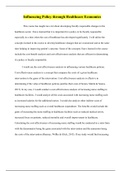
Influencing Policy through Healthcare Economics This course has taught me a lot about developing fiscally responsible changes in the healthcare sector. I have learned that it is important for a policy to be fiscally responsible especially in a time when the cost of healthcare has developed significantly. I will utilize the concepts learned in the course to develop healthcare changes that are economical and at the same time helping in improving patient’s outcome. Some of the concepts I have learned in the course include the cost-benefit analysis and cost-effectiveness analysis that are efficient in determining if a policy is fiscally responsible. I would use the cost-effectiveness analysis in influencing various healthcare policies. Cost-effectiveness analysis is a concept that compares the costs of a given healthcare intervention to the gains of the intervention. Cost-effectiveness analysis is effective in determining if the value of healthcare policies justifies their costs (Claxton, Martin & Soares, 2015). In my case, I would conduct a cost-effectiveness analysis of increasing nurse staffing in healthcare facilities. I would analyze all the costs associated with increasing nurse staffing such as increased salaries for the additional nurses. I would also analyze other indirect costs of increasing nurse staffing such as overall healthcare expenditure. The benefits would include the gains of increasing the nurse staffing in healthcare facilities such as reduced medical errors, increased focus on patients, reduced mortality and overall improvement in healthcare. Calculating the cost-effectiveness of increasing nurse staffing would be conducted in a ratio form with the denominator being the gains associated with the intervention and the numerator being the costs of the intervention (Ramsey, Willke & Glick, 2015). If my study would find increasing nurse staffing a cost-effective policy, then I would greatly advocate for the enactment of the policy. References Ramsey, S. D., Willke, R. J., Glick, H., Reed, S. D., Augustovski, F., Jonsson, B., & Sullivan, S. D. (2015). Cost-effectiveness analysis alongside clinical trials II—an ISPOR Good Research Practices Task Force report. Value in Health, 18(2), 161-172. Claxton, K., Martin, S., Soares, M., Rice, N., Spackman, E., Hinde, S., & Sculpher, M. (2015). Methods for the estimation of the National Institute for Health and Care Excellence cost- effectiveness threshold. Health technology assessment (Winchester, England), 19(14), 1. RESPONSE TO STUDENTS: Christie and Najiba, I have enjoyed reading both your post during this class session. I must admit, I’m a novice when it comes to cost-benefit analysis. This was definitely an eye-opener for me. To advocate successfully for the resources needed to staff and operate their units, nurses need to become more financially savvy and increase their understanding of healthcare costs. Cost-benefit analysis (CBA) is one way to demonstrate to funders, government agencies, managed care organizations (MCOs), and other audiences that your program is effective. The cost-benefit analysis allows nurses to consider all costs and benefits over time, even those beyond the length of an intervention. With preventative intervention, the costs of the intervention can occur in the immediate future and the benefits of that intervention can occur in the distant future. With CBA, costs, and benefits, regardless of when they occur, are included in the analysis. One area of interest that I believe CBA could prove to be useful is the cost analysis of telemedicine service delivery in providing cost-effective psychological treatments to patients suffering from mental health disorders. Currently, telemental health care has multiple capabilities and technologies for providing effective interventions to patients with various mental illnesses. It provides clinicians with a wide variety of innovative choices and strategies for mental interventions, in addition to significant future potentials. RESPONSE TO STUDENT: Linda, You took the words right out of my mouth. I initially wanted to earn my MSN to pursue a career in quality and process improvement, but after meeting with my local congressman and having a mentor who is actively interested in shaping public policy, my goals have shifted tremendously. Advocacy is the cornerstone of nursing. RNs are educated to practice within a holistic framework that places a major emphasis on advocacy. So, nurses not only have the ability to be an incredible force by sheer numbers, but policymakers also rely upon nurses’ expertise. I’m learning that effective advocacy requires knowledge of the process, a relationship with policymakers, clarity of the issue and planning. It is important that nurses prepare themselves to take legitimate seats at the various tables where healthcare decisions are made so they can incorporate experiences and insights into the healthcare dialogue. It is our obligation to strengthen skills that enable us to influence public policies so we can better serve patients.
Written for
- Institution
-
Chamberlain College Nursing
- Course
-
NR 552 (NR552)
Document information
- Uploaded on
- January 27, 2021
- Number of pages
- 3
- Written in
- 2020/2021
- Type
- Case
- Professor(s)
- Professor
- Grade
- A+
Subjects
- nr552 discussion week 8
-
influencing policy through healthcare economics
-
influencing policy through healthcare economics this course has taught me a lot about developing fiscally responsible change

Also available in package deal