100% satisfaction guarantee Immediately available after payment Both online and in PDF No strings attached 4.2 TrustPilot
logo-home
Exam (elaborations)

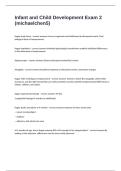
Infant and Child Development Exam 2 (michaelchen5) Review Questions And Answers

Rating
-
Sold
-
Pages
27
Grade
A+
Uploaded on
11-11-2025
Written in
2025/2026

Kagan study focus - correct answers Focus on approach and withdrawal to discrepant events. Find biological basis of temperament. Kagan hypothesis - correct answers Inherited physiological mechanisms underlie individual differences in this dimension of temperament Hippocampus - correct answers Detects discrepant (unfamiliar) events Amygdala - correct answers Emotional response to discrepant events; autonomic changes Kagan: Role of biology in temperament - correct answers Extent to which the amygdala, other limbic structures, and the right frontal lobe are easily excited by novelty underlie temperamental differences in infants, children, and adults. Kagan experimental design - correct answers-N=462 -Longitudinal design (4 months to adulthood) Kagan study: procedure at 4 months - correct answers-response to three novel tasks ---visual: moving object ---auditory ---olfactory, dab alcohol on nose At 4 months of age, why is Kagan missing 40% of his sample in his categorization? - correct answers By looking at the extremes, differences may be more easily observed Kagan study: 4 months findings for infants - correct answers-20% High reactive (high motor activity, distressed, easily upset by novelty) -40% Low reactive (relaxed, no distress, comfortable with novelty) Kagan study: 14-21 months Tasks - correct answers-reaction to large mask -interact with stranger -reaction to loud alarm -reaction to robot Kagan study: 14-21 months findings for infants - correct answers-1/3 of high reactive infants were highly fearful (inhibited) toddlers -1/3 of low reactive infants showed minimal fear; (uninhibited) At 14-21 months of age, why don't all infants who were highly reactive at 4 months stay highly reactive? - correct answers-As kids get older, they are better able to cope with new stimuli -Parenting helps children cope -Social referencing Kagan study: re-assessed at 4-5 years, findings - correct answersReaction to an unfamiliar adult ---> preschoolers who had been high-reactive infants showed less extreme fear to an unfamiliar adult, but still less sociable and less spontaneous Kagan study: re-assessed at 14-17 years - correct answersWere asked what things made them worry, anxious, or nervous. ---61% of LOW reactive infants: quality of performance in school/extracurriculars ---61% of HIGH reactive infants: uncertainty of encounters with unfamiliar people, places, situations, or the inability to know the future Kagan study: results: High reactive infants became __________children and adults, meaning they were: - correct answers-Excessively cautious -Socially withdrawn and lonely -Anxiety disorders (generalized and social phobia) Kagan study: results: Low reactive infants who became very uninhibited children and adults - correct answers-Low levels of anticipatory anxiety, shame, guilt -Less restrained -Conduct disorders and antisocial behaviors Implications of Kagan study - correct answersShows the importance of parenting and other's influence as a buffer or mediating factor Kagan: Evidence for Physiological Explanation - correct answers-Heart rate-more variability in high reactivity -Cortisol (stress hormone) high levels even in non stress situations -Muscle tension: higher in high reactive -Pupil Dilation: greater in high reactive -Blood Pressure: greater in high reactive -Skin temp: high reactive have cooler -'Weird' markers: blue eyes, narrow face, hay fever -Adult MRI data: amygdala activation for adults who had been classified as inhibited vs. uninhibited children when exposed to familiar vs. unfamiliar faces. Kagan: Evidence for Physiological Explanation: conclusion - correct answersWe inherit a physiology that biases us towards a specific result Schwartz, Wright, Shin, Kagan, Rauch study procedure - correct answers-"Familiarize" subjects with novel faces -Test: alternate images with novel faces and recently familiarized faces Schwartz, Wright, Shin, Kagan, Rauch study results - correct answers-Inhibited: larger response to novel faces than familiar faces; amygdala more active when seeing novel faces -Uninhibited: no difference in amygdala activity between novel and familiar faces Normative Attachement - correct answers-A strong emotional tie that develops between two individuals that is characterized by mutual affection, pleasure, and joy in each other's company, and a desire to bear each other in time of stress Defining features of attachment - correct answers-Reciprocal (emotionally tied) -Developmental universal (primary attachments serve as foundation to future relationships) -NOT dependency -NOT general sociability Phases of Normative attachment: pre-attachment - correct answers-birth to 6 weeks -Indiscriminate social responsiveness -No attachment yet, babies prefer social over non social Phases of Normative attachment: attachment in the making - correct answers-6wks-18/24mths -discriminate social responsiveness Phases of Normative attachment: clear cut attachment - correct answers-6/8 months -Focused attachment -proximity seeking: emotional connection ---safe haven in times of stress (toy robot) ---secure base from which to explore (social referencing) -Stranger fear or anxiety peaks at 15mo -Separation distress or anxiety peaks at 15mo Phases of Normative attachment: formation of a reciprocal relationship - correct answers-18/24 mo and beyond -qualitative shift -physical contact not needed -Infants realize that attachment more reciprocal -availability of the attachment figure (not physical prox) becomes the set goal of the attachment system; --->belief that lines of communication with the attachment figure remain open --->belief that attachment figure will respond if called upon for help --->belief that physical accessibility is possible Attachment and future relationships - correct answers-attachment to figure sets the stage for future relationships, but doesn't set it in stone -first relationship develop your internal workings model internal workings model - correct answersdevelopment of expectations, beliefs, about yourself, others, in relationships. Ethological Theory (Bowlby) - correct answers-Infants possess innate mechanisms that promote the development of attachment (have preference for people who care for them) --->facilitate, ensure, but don't guarantee attachment --->naturally selected --->survival value ---->we are attracted to babies, and babies are attracted to us Ethological Theory: Experience expectant neurological system - correct answersExpect interaction within species Ethological Theory: Species specific behaviors - correct answersSpecies-specific behaviors that possess a signaling function that serve to activate behavior and bring the adult into proximity with the infant Quality of the Mother-Infant Attachment Relationship - correct answers Individual Differences Approach - correct answersIn order to see differences, we must set up mild to moderate stress, which activates primary attachment Strange Situation Episodes Procedures (Mary Ainsworth) - correct answers1. Researcher introduces parent and baby to playroom (30s) 2. Parent is seated while baby plays with toys (3min), parent doesn't control child's behavior but is secure base 3. Stranger enters, talks to parent for 3min (stranger anxiety) 4. Parent leaves (separation anxiety). Stranger interacts with baby (3min) Can baby be comforted by stranger? 5. Parent returns, stranger leaves, parent interacts with baby 6. Parent leaves baby alone (3min) separation anxiety 7. Stranger enters and interacts with baby (3min) 8. Parent returns, stranger leaves, parent interacts with baby Four patterns of Attachment - correct answers-Secure ("ideal") -Insecure ("not ideal) ----> avoidant ----> resistant ----> disorganized/disoriented Secure attachment - correct answers-60% of North American infants in middle SES families -Uses parent as secure base (explores when parent present) -May be distressed upon separation -May be soothed by stranger, but clearly prefers parent (treats mom and stranger differently) -Happy to se parent return, actively seeks contact, will allow self to be soothed by parent if upset Insecure attachment: avoidant attachment - correct answers-15% of North American infants in middle SES families -Will explore but doesn't try to include parent in play -Not distressed by separation -Treats stranger same as parent -Ignores or avoids parent upon return of slow to greet parent, often fails to cling when picked up but not resist contact Insecure attachment: resistant attachment - correct answers-10% of North American infants in middle SES families -Will not explore, even when parent present. Seeks closeness. -Very distressed by separation and by stranger -Not calmed by stranger -Seeks contact with parent upon return, but resists angrily when achieved; clingy yet angry, resistant behavior. Not easily comforted. -Most distressed; don't play with toys much, not much exploration of room Insecure attachment: Disorganized Infants - correct answers-15% of North American Families in middle SES families -Child shows conflicted, odd, contradictory, exaggerated behaviors: -frozen postures -repetitive movements -clear apprehension -look away while being held -approach while divert gaze, flat affect -dazed or disoriented facial expression -Greatest insecurity -Conflicted in how they want to interact with mom -strange, contradicting behavior -wants to be picked up, but looks away from parent -Afraid of parent, but want to be picked up at same time Construct Validity of Strange Situation and the Classification System - correct answersCross-Cultural beliefs -cultural beliefs, values, expectations about infants/children and about parenting -Infants' experiences with strangers & maternal separation Infant care data -infant temperament (measuring) -implies 'secure' as ideal -assumes attachment bw mother and child -assumes abandonment is stressful for baby ---> avoidant babies might not be stressed out --->avoidant babies may be: independent, mature, better self regulation Factors that affect the attachment of children - correct answers-initial attachment quality -family circumstances -quality of child care -developmentally appropriate practice -protective influence of child care -extent of child care What makes 'strange situation' the gold standard? - correct answers-It is predictive -babies have expectations Signs of developmentally appropriate child care - correct answers-physical setting clean and safe -appropriate toys and equipment -low caregiver-child ratio -flexible daily schedule -adult-child interactions -parents welcome anytime -licensing/accreditation

Show more Read less
Institution
INFANT AND CHILD DEVELOPMENT
Course
INFANT AND CHILD DEVELOPMENT


Whoops! We can’t load your doc right now. Try again or contact support.

Written for

Institution
INFANT AND CHILD DEVELOPMENT
Course
INFANT AND CHILD DEVELOPMENT

Document information

Uploaded on
November 11, 2025
Number of pages
27
Written in
2025/2026
Type
Exam (elaborations)
Contains
Questions & answers

Subjects

Content preview

Infant and Child Development Exam 2
(michaelchen5)

Kagan study focus - correct answers Focus on approach and withdrawal to discrepant events. Find
biological basis of temperament.


Kagan hypothesis - correct answers Inherited physiological mechanisms underlie individual differences
in this dimension of temperament


Hippocampus - correct answers Detects discrepant (unfamiliar) events


Amygdala - correct answers Emotional response to discrepant events; autonomic changes


Kagan: Role of biology in temperament - correct answers Extent to which the amygdala, other limbic
structures, and the right frontal lobe are easily excited by novelty underlie temperamental differences in
infants, children, and adults.


Kagan experimental design - correct answers-N=462

-Longitudinal design (4 months to adulthood)


Kagan study: procedure at 4 months - correct answers-response to three novel tasks

---visual: moving object

---auditory

---olfactory, dab alcohol on nose


At 4 months of age, why is Kagan missing 40% of his sample in his categorization? - correct answers By
looking at the extremes, differences may be more easily observed

,Kagan study: 4 months findings for infants - correct answers-20% High reactive (high motor activity,
distressed, easily upset by novelty)

-40% Low reactive (relaxed, no distress, comfortable with novelty)


Kagan study: 14-21 months Tasks - correct answers-reaction to large mask

-interact with stranger

-reaction to loud alarm

-reaction to robot


Kagan study: 14-21 months findings for infants - correct answers-1/3 of high reactive infants were highly
fearful (inhibited) toddlers

-1/3 of low reactive infants showed minimal fear; (uninhibited)


At 14-21 months of age, why don't all infants who were highly reactive at 4 months stay highly reactive?
- correct answers-As kids get older, they are better able to cope with new stimuli

-Parenting helps children cope

-Social referencing


Kagan study: re-assessed at 4-5 years, findings - correct answersReaction to an unfamiliar adult

---> preschoolers who had been high-reactive infants showed less extreme fear to an unfamiliar adult,
but still less sociable and less spontaneous


Kagan study: re-assessed at 14-17 years - correct answersWere asked what things made them worry,
anxious, or nervous.

---61% of LOW reactive infants: quality of performance in school/extracurriculars

---61% of HIGH reactive infants: uncertainty of encounters with unfamiliar people, places, situations, or
the inability to know the future


Kagan study: results: High reactive infants became __________children and adults, meaning they were: -
correct answers-Excessively cautious

-Socially withdrawn and lonely

, -Anxiety disorders (generalized and social phobia)


Kagan study: results: Low reactive infants who became very uninhibited children and adults - correct
answers-Low levels of anticipatory anxiety, shame, guilt

-Less restrained

-Conduct disorders and antisocial behaviors


Implications of Kagan study - correct answersShows the importance of parenting and other's influence
as a buffer or mediating factor


Kagan: Evidence for Physiological Explanation - correct answers-Heart rate-more variability in high
reactivity

-Cortisol (stress hormone) high levels even in non stress situations

-Muscle tension: higher in high reactive

-Pupil Dilation: greater in high reactive

-Blood Pressure: greater in high reactive

-Skin temp: high reactive have cooler

-'Weird' markers: blue eyes, narrow face, hay fever

-Adult MRI data: amygdala activation for adults who had been classified as inhibited vs. uninhibited
children when exposed to familiar vs. unfamiliar faces.


Kagan: Evidence for Physiological Explanation: conclusion - correct answersWe inherit a physiology that
biases us towards a specific result


Schwartz, Wright, Shin, Kagan, Rauch study procedure - correct answers-"Familiarize" subjects with
novel faces

-Test: alternate images with novel faces and recently familiarized faces


Schwartz, Wright, Shin, Kagan, Rauch study results - correct answers-Inhibited: larger response to novel
faces than familiar faces; amygdala more active when seeing novel faces

-Uninhibited: no difference in amygdala activity between novel and familiar faces
Get to know the seller

Seller avatar
Reputation scores are based on the amount of documents a seller has sold for a fee and the reviews they have received for those documents. There are three levels: Bronze, Silver and Gold. The better the reputation, the more your can rely on the quality of the sellers work.
RealGrades Nursing
View profile
Follow You need to be logged in order to follow users or courses
Sold
169
Member since
2 year
Number of followers
52
Documents
11575
Last sold
2 days ago

4.0

26 reviews

5
12
4
5
3
7
2
1
1
1

Recently viewed by you

Why students choose Stuvia

Created by fellow students, verified by reviews

Quality you can trust: written by students who passed their tests and reviewed by others who've used these notes.

Didn't get what you expected? Choose another document

No worries! You can instantly pick a different document that better fits what you're looking for.

Pay as you like, start learning right away

No subscription, no commitments. Pay the way you're used to via credit card and download your PDF document instantly.

Student with book image

“Bought, downloaded, and aced it. It really can be that simple.”

Alisha Student

Frequently asked questions