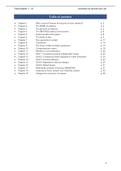
CLASS XII
BIOLOGY
CBSE BOARD QUESTIONS CHAPTERWISE
CHAPTER 1
REPRODUCTION IN ORGANISMS
CHAPTER 2
SEXUAL REPRODUCTION IN FLOWERING PLANTS
CHAPTER-3
HUMAN REPRODUCTION
CHAPTER-4
REPRODUCTIVE HEALTH
CHAPTER-5
PRINCIPLES OF INHERITANCE AND VARIATION
CHAPTER-6
MOLECULAR BASIS OF INHERITANCE
CHAPTER-7
EVOLUTION
CHAPTER-8
HUMAN HEALTH AND DISEASES
CHAPTER-9
STRATEGIES FOR ENHANCEMENT IN FOOD PRODUCTION
CHAPTER-10
MICROBES IN HUMAN WELFARE
CHAPTER-11
BIOTECHNOLOGY : PRINCIPLES AND PROCESSES
CHAPTER-12
BIOTECHNOLOGY AND ITS APPLICATIONS
CHAPTER-13
ORGANISMS AND POPULATION
CHAPTER-14
ECOSYSTEM
CHAPTER 15
BIODIVERSITY AND CONSERVATION
CHAPTER 16
ENVIRONMENTAL ISSUES
1
, BIOLOGY Class XII
BLUEPRINT OF CBSE QUESTION PAPER W.R.T. UNIT WISE DISTRIBUTION OF
MARKS
UNIT NO. TITLE MARKS
I Reproduction 14
II Genetics and Evolution 18
III Biology in Human Welfare 14
IV Biotechnology and its 10
Applications
V Ecology and Environment 14
Total 70
Question Type QUESTIONS AND MARKS DISTRIBUTION
No. of No. of No. of SA No. of No. of Total Marks
VSA SA I II VBQ LA (%
(Mark 1) (Marks (Marks 3) (Marks (Marks Weightage)
2) 4) 5)
Remembering 2 1 1 - - 7 (10%)
Understanding - 2 4 - 1 21 (30%)
Application - 2 4 - 1 21 (30%)
Higher Order 2 - 1 - 1 10 (14%)
Thinking Skills
Evaluation and 1 - 2 1 - 11 (16%)
Multidisciplinary
Total 5 Total 5 Total 12 Total 1 Total 3 Total 70(100%)
(Marks (Marks (Marks (Marks (Marks
5) 10) 36) 4) 15)
2
, CHAPTER 1
REPRODUCTION IN ORGANISMS
Q.1 Mention the sites where syngamy occurs in amphibians and reptiles respectively.
(C.B.S.E 2010)
Q.2 Offspring derived by asexual reproduction are called clones. Justify giving two
reasons. (C.B.S.E 2010)
Q.3 Mention the characteristic features and a function of zoospores in some algae.
(C.B.S.E 2010)
Q.4 Name an organism where cell division is itself a mode of reproduction. (C.B.S.E
2010)
Q.5 In Yeast and Amoeba, the parent cell divides to give rise to two new individual cells.
How does the cell division differ in these two organisms?
(C.B.S.E 2010)
Q.6 Name the type of cell division that takes place in the zygote of an orgnaism exhibiting
haplontic life cycle. (C.B.S.E 2010)
Q.7 How does Penicillium reproduce asexually? (C.B.S.E 2011)
Q.8 Name the phase all organisms have to pass through before they can reproduce
sexually. (C.B.S.E 2011)
Q.9 Name the group of orgnisms that produces non-motile male gametes. How do they
reach the female gamete for fertilization (C.B.S.E 2011)
Q.10 Mention the unique flowering phenomenon exhibited by Strobilantheskunthiana.
(C.B.S.E 2012)
Q.11 Cucurbits and Papaya plants bear staminate and pistillate flowers. Mention the
categories they are put separately on the basis of type of flowers they bear. (C.B.S.E
2012)
Q.12 Give reason : some organisms like honeybees are called parthengenetic animals.
(C.B.S.E 2012)
Q.13 A moss plant produces a large number of antherozoids but relatively only a few egg
cells. Why? (C.B.S.E 2010)
Q.14 Why are Papaya and Data Palm plants said to be dioecious whereas cucurbits and
coconut palms are monoecious, inspite of all of them bearing unisexual flowers ?
(C.B.S.E 2010)
Q.15 The cell division involved in gamete formation is not of the same type in different
orgnaims justify (C.B.S.E. 2011)
Q.16 A list of three flowering plants is given below. Which ones out of them are
(i) monoecious and
(ii) bearingpistillate flowers. Date Palm, Cucurbits, Pea. (C.B.S.E 2011)
Q.17 (a) State the difference between meiocyte and gamete with respect to
chromosome number.
(b)Why is whiptail lizard referred to as parthenogenetic? (C.B.S.E, 2012)
3
, 18.(a) Coconut palm is monoecious, while date palm is dioecious. Why are they so called?
(b) Draw a labelled diagram of sectional view of a mature embryo sac of an angiosperm.
(2014)
19. Why do algae and fungi shift to sexual mode of reproduction just before the onset
of adverse conditions? .(2014)
CHAPTER 2
SEXUAL REPRODUCTION IN FLOWERING PLANTS
Q.1 Write briefly the role of pollination in the growth and development in an angiosperm.
(C.B.S.E 2007)
Q.2 Describe the structure of a typical/polygonum type embryo sac found in flowering
plants. Why is it called monosporic? (C.B.S.E 2007)
Q.3 Why is the process of fertilization in a flowering plant referred to as double
fertilization? (C.B.S.E 2007)
Q.4 What is the process of fertilization in flowering plant referred to as double
fertilization ? (C.B.S.E 2007)
Q.5 The flower of Brinajal is referred to as chasmoganous while that of Bean is
cleistogamous. How are they different from each other.
Q.6 Coconut Palm is monoecious while Date Palm is dioecious. Why are they called so ?
(C.B.S.E 2008)
Q.7 Banana is a parthenocarpic fruit whereas oranges show polyembryony. How are they
different from each other with respect to seeds? (C.B.S.E 2009)
Q.8 Name the cell from which the endosperm of Coconut develops. Give the characteristic
features of endosperm of coconut. (C.B.S.E 2009)
Q.9 Draw a vertical section of a Maize grain and label.
(i) pericarp (ii) scutellum (iii) coleoptile (iv) radicle (C.B.S.E 2009)
Q.10 Fertilization is essential for production of seeds
(i) Give one example of an angiosperm that produces seed without fertilization. Name
the process.
(ii) Explain two ways by which seeds develop without fertilization. (C.B.S.E 2009)
Q.11 Explain any two devices by which autogamy is prevented in flowering plants.
(C.B.S.E 2009)
Q.12 Mention the reasons for difference in ploidy of zygote and primary endosperm
nucleus in an angiosperm . (C.B.S.E 2010)
Q.13 How does the floral pattern of Mediterranean orchid, Ophrys, guarantee cross
pollination ? (C.B.S.E 2010)
Q.14 Draw a longitudnal section of a post pollinated pistil to who entry of pollen tube into
mature embryo sac. Label filiform apparatus, chalazal end, hilum, antipodals, male
gametes and secondary nucleus. (C.B.S.E 2010)
Q.15 Where does triple fusion take place in a flowering plant. Why is it so called ? Mention
its significance. (C.B.S.E 2010)
Q.16 If you squeeze a seed of orange, you might observe many embryos of different sizes.
How is it possible ? Explain. (C.B.S.E 2010)
Q.17 (a) Mention any four strategies adopted by flowering plants to prevent self
pollination.
4
BIOLOGY
CBSE BOARD QUESTIONS CHAPTERWISE
CHAPTER 1
REPRODUCTION IN ORGANISMS
CHAPTER 2
SEXUAL REPRODUCTION IN FLOWERING PLANTS
CHAPTER-3
HUMAN REPRODUCTION
CHAPTER-4
REPRODUCTIVE HEALTH
CHAPTER-5
PRINCIPLES OF INHERITANCE AND VARIATION
CHAPTER-6
MOLECULAR BASIS OF INHERITANCE
CHAPTER-7
EVOLUTION
CHAPTER-8
HUMAN HEALTH AND DISEASES
CHAPTER-9
STRATEGIES FOR ENHANCEMENT IN FOOD PRODUCTION
CHAPTER-10
MICROBES IN HUMAN WELFARE
CHAPTER-11
BIOTECHNOLOGY : PRINCIPLES AND PROCESSES
CHAPTER-12
BIOTECHNOLOGY AND ITS APPLICATIONS
CHAPTER-13
ORGANISMS AND POPULATION
CHAPTER-14
ECOSYSTEM
CHAPTER 15
BIODIVERSITY AND CONSERVATION
CHAPTER 16
ENVIRONMENTAL ISSUES
1
, BIOLOGY Class XII
BLUEPRINT OF CBSE QUESTION PAPER W.R.T. UNIT WISE DISTRIBUTION OF
MARKS
UNIT NO. TITLE MARKS
I Reproduction 14
II Genetics and Evolution 18
III Biology in Human Welfare 14
IV Biotechnology and its 10
Applications
V Ecology and Environment 14
Total 70
Question Type QUESTIONS AND MARKS DISTRIBUTION
No. of No. of No. of SA No. of No. of Total Marks
VSA SA I II VBQ LA (%
(Mark 1) (Marks (Marks 3) (Marks (Marks Weightage)
2) 4) 5)
Remembering 2 1 1 - - 7 (10%)
Understanding - 2 4 - 1 21 (30%)
Application - 2 4 - 1 21 (30%)
Higher Order 2 - 1 - 1 10 (14%)
Thinking Skills
Evaluation and 1 - 2 1 - 11 (16%)
Multidisciplinary
Total 5 Total 5 Total 12 Total 1 Total 3 Total 70(100%)
(Marks (Marks (Marks (Marks (Marks
5) 10) 36) 4) 15)
2
, CHAPTER 1
REPRODUCTION IN ORGANISMS
Q.1 Mention the sites where syngamy occurs in amphibians and reptiles respectively.
(C.B.S.E 2010)
Q.2 Offspring derived by asexual reproduction are called clones. Justify giving two
reasons. (C.B.S.E 2010)
Q.3 Mention the characteristic features and a function of zoospores in some algae.
(C.B.S.E 2010)
Q.4 Name an organism where cell division is itself a mode of reproduction. (C.B.S.E
2010)
Q.5 In Yeast and Amoeba, the parent cell divides to give rise to two new individual cells.
How does the cell division differ in these two organisms?
(C.B.S.E 2010)
Q.6 Name the type of cell division that takes place in the zygote of an orgnaism exhibiting
haplontic life cycle. (C.B.S.E 2010)
Q.7 How does Penicillium reproduce asexually? (C.B.S.E 2011)
Q.8 Name the phase all organisms have to pass through before they can reproduce
sexually. (C.B.S.E 2011)
Q.9 Name the group of orgnisms that produces non-motile male gametes. How do they
reach the female gamete for fertilization (C.B.S.E 2011)
Q.10 Mention the unique flowering phenomenon exhibited by Strobilantheskunthiana.
(C.B.S.E 2012)
Q.11 Cucurbits and Papaya plants bear staminate and pistillate flowers. Mention the
categories they are put separately on the basis of type of flowers they bear. (C.B.S.E
2012)
Q.12 Give reason : some organisms like honeybees are called parthengenetic animals.
(C.B.S.E 2012)
Q.13 A moss plant produces a large number of antherozoids but relatively only a few egg
cells. Why? (C.B.S.E 2010)
Q.14 Why are Papaya and Data Palm plants said to be dioecious whereas cucurbits and
coconut palms are monoecious, inspite of all of them bearing unisexual flowers ?
(C.B.S.E 2010)
Q.15 The cell division involved in gamete formation is not of the same type in different
orgnaims justify (C.B.S.E. 2011)
Q.16 A list of three flowering plants is given below. Which ones out of them are
(i) monoecious and
(ii) bearingpistillate flowers. Date Palm, Cucurbits, Pea. (C.B.S.E 2011)
Q.17 (a) State the difference between meiocyte and gamete with respect to
chromosome number.
(b)Why is whiptail lizard referred to as parthenogenetic? (C.B.S.E, 2012)
3
, 18.(a) Coconut palm is monoecious, while date palm is dioecious. Why are they so called?
(b) Draw a labelled diagram of sectional view of a mature embryo sac of an angiosperm.
(2014)
19. Why do algae and fungi shift to sexual mode of reproduction just before the onset
of adverse conditions? .(2014)
CHAPTER 2
SEXUAL REPRODUCTION IN FLOWERING PLANTS
Q.1 Write briefly the role of pollination in the growth and development in an angiosperm.
(C.B.S.E 2007)
Q.2 Describe the structure of a typical/polygonum type embryo sac found in flowering
plants. Why is it called monosporic? (C.B.S.E 2007)
Q.3 Why is the process of fertilization in a flowering plant referred to as double
fertilization? (C.B.S.E 2007)
Q.4 What is the process of fertilization in flowering plant referred to as double
fertilization ? (C.B.S.E 2007)
Q.5 The flower of Brinajal is referred to as chasmoganous while that of Bean is
cleistogamous. How are they different from each other.
Q.6 Coconut Palm is monoecious while Date Palm is dioecious. Why are they called so ?
(C.B.S.E 2008)
Q.7 Banana is a parthenocarpic fruit whereas oranges show polyembryony. How are they
different from each other with respect to seeds? (C.B.S.E 2009)
Q.8 Name the cell from which the endosperm of Coconut develops. Give the characteristic
features of endosperm of coconut. (C.B.S.E 2009)
Q.9 Draw a vertical section of a Maize grain and label.
(i) pericarp (ii) scutellum (iii) coleoptile (iv) radicle (C.B.S.E 2009)
Q.10 Fertilization is essential for production of seeds
(i) Give one example of an angiosperm that produces seed without fertilization. Name
the process.
(ii) Explain two ways by which seeds develop without fertilization. (C.B.S.E 2009)
Q.11 Explain any two devices by which autogamy is prevented in flowering plants.
(C.B.S.E 2009)
Q.12 Mention the reasons for difference in ploidy of zygote and primary endosperm
nucleus in an angiosperm . (C.B.S.E 2010)
Q.13 How does the floral pattern of Mediterranean orchid, Ophrys, guarantee cross
pollination ? (C.B.S.E 2010)
Q.14 Draw a longitudnal section of a post pollinated pistil to who entry of pollen tube into
mature embryo sac. Label filiform apparatus, chalazal end, hilum, antipodals, male
gametes and secondary nucleus. (C.B.S.E 2010)
Q.15 Where does triple fusion take place in a flowering plant. Why is it so called ? Mention
its significance. (C.B.S.E 2010)
Q.16 If you squeeze a seed of orange, you might observe many embryos of different sizes.
How is it possible ? Explain. (C.B.S.E 2010)
Q.17 (a) Mention any four strategies adopted by flowering plants to prevent self
pollination.
4