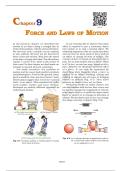
Chapter 9
FORCE AND LAWS OF MOTION
In the previous chapter, we described the In our everyday life we observe that some
motion of an object along a straight line in effort is required to put a stationary object
terms of its position, velocity and acceleration. into motion or to stop a moving object. We
We saw that such a motion can be uniform ordinarily experience this as a muscular effort
or non-uniform. We have not yet discovered and say that we must push or hit or pull on
what causes the motion. Why does the speed an object to change its state of motion. The
of an object change with time? Do all motions concept of force is based on this push, hit or
require a cause? If so, what is the nature of pull. Let us now ponder about a ‘force’. What
this cause? In this chapter we shall make an is it? In fact, no one has seen, tasted or felt a
attempt to quench all such curiosities. force. However, we always see or feel the effect
For many centuries, the problem of of a force. It can only be explained by
motion and its causes had puzzled scientists describing what happens when a force is
and philosophers. A ball on the ground, when applied to an object. Pushing, hitting and
given a small hit, does not move forever. Such pulling of objects are all ways of bringing
observations suggest that rest is the “natural objects in motion (Fig. 9.1). They move
state” of an object. This remained the belief because we make a force act on them.
until Galileo Galilei and Isaac Newton From your studies in earlier classes, you
developed an entirely different approach to are also familiar with the fact that a force can
understand motion. be used to change the magnitude of velocity
of an object (that is, to make the object move
faster or slower) or to change its direction of
motion. We also know that a force can change
the shape and size of objects (Fig. 9.2).
(a) The trolley moves along the (b) The drawer is pulled.
direction we push it.
(a)
(b)
(c) The hockey stick hits the ball forward Fig. 9.2: (a) A spring expands on application of force;
Fig. 9.1: Pushing, pulling, or hitting objects change (b) A spherical rubber ball becomes oblong
their state of motion. as we apply force on it.
2020-21
,9.1 Balanced and Unbalanced box with a small force, the box does not move
because of friction acting in a direction
Forces opposite to the push [Fig. 9.4(a)]. This friction
force arises between two surfaces in contact;
Fig. 9.3 shows a wooden block on a horizontal
in this case, between the bottom of the box
table. Two strings X and Y are tied to the two
and floor’s rough surface. It balances the
opposite faces of the block as shown. If we
pushing force and therefore the box does not
apply a force by pulling the string X, the block
move. In Fig. 9.4(b), the children push the
begins to move to the right. Similarly, if we
box harder but the box still does not move.
pull the string Y, the block moves to the left.
This is because the friction force still balances
But, if the block is pulled from both the sides
the pushing force. If the children push the
with equal forces, the block will not move.
box harder still, the pushing force becomes
Such forces are called balanced forces and
bigger than the friction force [Fig. 9.4(c)].
do not change the state of rest or of motion of
There is an unbalanced force. So the box
an object. Now, let us consider a situation in
starts moving.
which two opposite forces of different
magnitudes pull the block. In this case, the What happens when we ride a bicycle?
block would begin to move in the direction of When we stop pedalling, the bicycle begins
the greater force. Thus, the two forces are to slow down. This is again because of the
not balanced and the unbalanced force acts friction forces acting opposite to the direction
in the direction the block moves. This of motion. In order to keep the bicycle moving,
suggests that an unbalanced force acting on we have to start pedalling again. It thus
an object brings it in motion. appears that an object maintains its motion
under the continuous application of an
unbalanced force. However, it is quite
incorrect. An object moves with a uniform
velocity when the forces (pushing force and
frictional force) acting on the object are
balanced and there is no net external force
on it. If an unbalanced force is applied on
the object, there will be a change either in its
speed or in the direction of its motion. Thus,
to accelerate the motion of an object, an
Fig. 9.3: Two forces acting on a wooden block unbalanced force is required. And the change
in its speed (or in the direction of motion)
What happens when some children try to would continue as long as this unbalanced
push a box on a rough floor? If they push the force is applied. However, if this force is
(a) (b) (c)
Fig. 9.4
FORCE AND LAWS OF MOTION 115
2020-21
, removed completely, the object would
continue to move with the velocity it has
acquired till then.
9.2 First Law of Motion
By observing the motion of objects on an
inclined plane Galileo deduced that objects
move with a constant speed when no force
acts on them. He observed that when a marble
rolls down an inclined plane, its velocity
increases [Fig. 9.5(a)]. In the next chapter,
you will learn that the marble falls under the
unbalanced force of gravity as it rolls down
and attains a definite velocity by the time it
reaches the bottom. Its velocity decreases
when it climbs up as shown in Fig. 9.5(b).
Fig. 9.5(c) shows a marble resting on an ideal
frictionless plane inclined on both sides. Fig. 9.5: (a) the downward motion; (b) the upward
Galileo argued that when the marble is motion of a marble on an inclined plane;
released from left, it would roll down the slope and (c) on a double inclined plane.
and go up on the opposite side to the same
Newton further studied Galileo’s ideas on
height from which it was released. If the
force and motion and presented three
inclinations of the planes on both sides are
fundamental laws that govern the motion of
equal then the marble will climb the same
objects. These three laws are known as
distance that it covered while rolling down. If
Newton’s laws of motion. The first law of
the angle of inclination of the right-side plane
motion is stated as:
were gradually decreased, then the marble An object remains in a state of rest or of
would travel further distances till it reaches uniform motion in a straight line unless
the original height. If the right-side plane were compelled to change that state by an applied
ultimately made horizontal (that is, the slope force.
is reduced to zero), the marble would continue In other words, all objects resist a change
to travel forever trying to reach the same in their state of motion. In a qualitative way,
height that it was released from. The the tendency of undisturbed objects to stay
unbalanced forces on the marble in this case at rest or to keep moving with the same
are zero. It thus suggests that an unbalanced velocity is called inertia. This is why, the first
(external) force is required to change the law of motion is also known as the law of
motion of the marble but no net force is inertia.
needed to sustain the uniform motion of the Certain experiences that we come across
marble. In practical situations it is difficult while travelling in a motorcar can be
to achieve a zero unbalanced force. This is explained on the basis of the law of inertia.
because of the presence of the frictional force We tend to remain at rest with respect to the
acting opposite to the direction of motion. seat until the driver applies a braking force
Thus, in practice the marble stops after to stop the motorcar. With the application of
travelling some distance. The effect of the brakes, the car slows down but our body
frictional force may be minimised by using a tends to continue in the same state of motion
smooth marble and a smooth plane and because of its inertia. A sudden application
providing a lubricant on top of the planes. of brakes may thus cause injury to us by
116 SCIENCE
2020-21
FORCE AND LAWS OF MOTION
In the previous chapter, we described the In our everyday life we observe that some
motion of an object along a straight line in effort is required to put a stationary object
terms of its position, velocity and acceleration. into motion or to stop a moving object. We
We saw that such a motion can be uniform ordinarily experience this as a muscular effort
or non-uniform. We have not yet discovered and say that we must push or hit or pull on
what causes the motion. Why does the speed an object to change its state of motion. The
of an object change with time? Do all motions concept of force is based on this push, hit or
require a cause? If so, what is the nature of pull. Let us now ponder about a ‘force’. What
this cause? In this chapter we shall make an is it? In fact, no one has seen, tasted or felt a
attempt to quench all such curiosities. force. However, we always see or feel the effect
For many centuries, the problem of of a force. It can only be explained by
motion and its causes had puzzled scientists describing what happens when a force is
and philosophers. A ball on the ground, when applied to an object. Pushing, hitting and
given a small hit, does not move forever. Such pulling of objects are all ways of bringing
observations suggest that rest is the “natural objects in motion (Fig. 9.1). They move
state” of an object. This remained the belief because we make a force act on them.
until Galileo Galilei and Isaac Newton From your studies in earlier classes, you
developed an entirely different approach to are also familiar with the fact that a force can
understand motion. be used to change the magnitude of velocity
of an object (that is, to make the object move
faster or slower) or to change its direction of
motion. We also know that a force can change
the shape and size of objects (Fig. 9.2).
(a) The trolley moves along the (b) The drawer is pulled.
direction we push it.
(a)
(b)
(c) The hockey stick hits the ball forward Fig. 9.2: (a) A spring expands on application of force;
Fig. 9.1: Pushing, pulling, or hitting objects change (b) A spherical rubber ball becomes oblong
their state of motion. as we apply force on it.
2020-21
,9.1 Balanced and Unbalanced box with a small force, the box does not move
because of friction acting in a direction
Forces opposite to the push [Fig. 9.4(a)]. This friction
force arises between two surfaces in contact;
Fig. 9.3 shows a wooden block on a horizontal
in this case, between the bottom of the box
table. Two strings X and Y are tied to the two
and floor’s rough surface. It balances the
opposite faces of the block as shown. If we
pushing force and therefore the box does not
apply a force by pulling the string X, the block
move. In Fig. 9.4(b), the children push the
begins to move to the right. Similarly, if we
box harder but the box still does not move.
pull the string Y, the block moves to the left.
This is because the friction force still balances
But, if the block is pulled from both the sides
the pushing force. If the children push the
with equal forces, the block will not move.
box harder still, the pushing force becomes
Such forces are called balanced forces and
bigger than the friction force [Fig. 9.4(c)].
do not change the state of rest or of motion of
There is an unbalanced force. So the box
an object. Now, let us consider a situation in
starts moving.
which two opposite forces of different
magnitudes pull the block. In this case, the What happens when we ride a bicycle?
block would begin to move in the direction of When we stop pedalling, the bicycle begins
the greater force. Thus, the two forces are to slow down. This is again because of the
not balanced and the unbalanced force acts friction forces acting opposite to the direction
in the direction the block moves. This of motion. In order to keep the bicycle moving,
suggests that an unbalanced force acting on we have to start pedalling again. It thus
an object brings it in motion. appears that an object maintains its motion
under the continuous application of an
unbalanced force. However, it is quite
incorrect. An object moves with a uniform
velocity when the forces (pushing force and
frictional force) acting on the object are
balanced and there is no net external force
on it. If an unbalanced force is applied on
the object, there will be a change either in its
speed or in the direction of its motion. Thus,
to accelerate the motion of an object, an
Fig. 9.3: Two forces acting on a wooden block unbalanced force is required. And the change
in its speed (or in the direction of motion)
What happens when some children try to would continue as long as this unbalanced
push a box on a rough floor? If they push the force is applied. However, if this force is
(a) (b) (c)
Fig. 9.4
FORCE AND LAWS OF MOTION 115
2020-21
, removed completely, the object would
continue to move with the velocity it has
acquired till then.
9.2 First Law of Motion
By observing the motion of objects on an
inclined plane Galileo deduced that objects
move with a constant speed when no force
acts on them. He observed that when a marble
rolls down an inclined plane, its velocity
increases [Fig. 9.5(a)]. In the next chapter,
you will learn that the marble falls under the
unbalanced force of gravity as it rolls down
and attains a definite velocity by the time it
reaches the bottom. Its velocity decreases
when it climbs up as shown in Fig. 9.5(b).
Fig. 9.5(c) shows a marble resting on an ideal
frictionless plane inclined on both sides. Fig. 9.5: (a) the downward motion; (b) the upward
Galileo argued that when the marble is motion of a marble on an inclined plane;
released from left, it would roll down the slope and (c) on a double inclined plane.
and go up on the opposite side to the same
Newton further studied Galileo’s ideas on
height from which it was released. If the
force and motion and presented three
inclinations of the planes on both sides are
fundamental laws that govern the motion of
equal then the marble will climb the same
objects. These three laws are known as
distance that it covered while rolling down. If
Newton’s laws of motion. The first law of
the angle of inclination of the right-side plane
motion is stated as:
were gradually decreased, then the marble An object remains in a state of rest or of
would travel further distances till it reaches uniform motion in a straight line unless
the original height. If the right-side plane were compelled to change that state by an applied
ultimately made horizontal (that is, the slope force.
is reduced to zero), the marble would continue In other words, all objects resist a change
to travel forever trying to reach the same in their state of motion. In a qualitative way,
height that it was released from. The the tendency of undisturbed objects to stay
unbalanced forces on the marble in this case at rest or to keep moving with the same
are zero. It thus suggests that an unbalanced velocity is called inertia. This is why, the first
(external) force is required to change the law of motion is also known as the law of
motion of the marble but no net force is inertia.
needed to sustain the uniform motion of the Certain experiences that we come across
marble. In practical situations it is difficult while travelling in a motorcar can be
to achieve a zero unbalanced force. This is explained on the basis of the law of inertia.
because of the presence of the frictional force We tend to remain at rest with respect to the
acting opposite to the direction of motion. seat until the driver applies a braking force
Thus, in practice the marble stops after to stop the motorcar. With the application of
travelling some distance. The effect of the brakes, the car slows down but our body
frictional force may be minimised by using a tends to continue in the same state of motion
smooth marble and a smooth plane and because of its inertia. A sudden application
providing a lubricant on top of the planes. of brakes may thus cause injury to us by
116 SCIENCE
2020-21