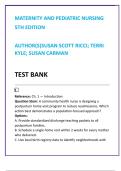
MATERNITY AND PEDIATRIC NURSING
5TH EDITION
AUTHOR(S)SUSAN SCOTT RICCI; TERRI
KYLE; SUSAN CARMAN
TEST BANK
1️⃣
Reference
Ch. 1 — Introduction
Question Stem
A community health nurse is designing a prenatal outreach
program focused on populations with the highest maternal
morbidity. Which initial action most appropriately reflects a
population-health approach?
Options
A. Schedule free prenatal clinic days once per month.
B. Use local maternal morbidity data to target neighborhoods
with highest rates.
,C. Provide educational brochures at all community pharmacies.
D. Offer a single large prenatal seminar at the community
center.
Correct Answer
B
Rationales
• Correct (B): Using local maternal morbidity data identifies
at-risk neighborhoods and allows targeted interventions,
aligning with population-health and resource prioritization.
• A: Free clinics help access but may not reach highest-risk
populations without targeted planning.
• C: Brochures increase awareness but are passive and
unlikely to reach those most affected.
• D: A one-time seminar has limited reach and sustainability
for reducing morbidity.
Teaching Point
Use local epidemiologic data to target high-risk populations for
greatest impact.
Citation
Ricci, S. S., Kyle, T., & Carman, S. (2024). Maternity and Pediatric
Nursing (5th Ed.). Ch. 1.
2️⃣
,Reference
Ch. 1 — Historical Development
Question Stem
When teaching nursing students about the evolution of
maternal–child care, which statement best illustrates how
historical shifts influence current practice?
Options
A. Maternal care has always emphasized community-based
models.
B. Advances in obstetric technology eliminated the need for
family-centered care.
C. Shifts from home births to hospital-based care changed
nursing roles and specialization.
D. Pediatric nursing developed later than obstetric nursing
because child health was historically unimportant.
Correct Answer
C
Rationales
• Correct (C): The move to hospital births expanded
specialized nursing roles and technologies, shaping
modern maternal–newborn and pediatric practice.
• A: Community-based care has varied historically; it wasn’t
always the emphasis.
• B: Technology enhanced care but did not eliminate the
need for family-centered approaches.
, • D: Pediatric nursing's development reflects changing social
values and science, not lack of importance.
Teaching Point
Historical shifts to hospitals shaped specialization and roles in
maternal-child nursing.
Citation
Ricci, S. S., Kyle, T., & Carman, S. (2024). Maternity and Pediatric
Nursing (5th Ed.). Ch. 1.
3️⃣
Reference
Ch. 1 — The History of Maternal and Newborn Health and
Health Care
Question Stem
A nurse educator asks students to analyze how past maternal
mortality trends inform present priorities. Which course of
action best demonstrates application of that historical analysis?
Options
A. Creating a campaign that emphasizes early prenatal care in
areas with high historic maternal mortality.
B. Advising hospitals to revert to historical birthing practices.
C. Focusing only on neonatal outcomes because maternal
mortality is now rare.
D. Eliminating data collection on maternal deaths since trends
are well known.
5TH EDITION
AUTHOR(S)SUSAN SCOTT RICCI; TERRI
KYLE; SUSAN CARMAN
TEST BANK
1️⃣
Reference
Ch. 1 — Introduction
Question Stem
A community health nurse is designing a prenatal outreach
program focused on populations with the highest maternal
morbidity. Which initial action most appropriately reflects a
population-health approach?
Options
A. Schedule free prenatal clinic days once per month.
B. Use local maternal morbidity data to target neighborhoods
with highest rates.
,C. Provide educational brochures at all community pharmacies.
D. Offer a single large prenatal seminar at the community
center.
Correct Answer
B
Rationales
• Correct (B): Using local maternal morbidity data identifies
at-risk neighborhoods and allows targeted interventions,
aligning with population-health and resource prioritization.
• A: Free clinics help access but may not reach highest-risk
populations without targeted planning.
• C: Brochures increase awareness but are passive and
unlikely to reach those most affected.
• D: A one-time seminar has limited reach and sustainability
for reducing morbidity.
Teaching Point
Use local epidemiologic data to target high-risk populations for
greatest impact.
Citation
Ricci, S. S., Kyle, T., & Carman, S. (2024). Maternity and Pediatric
Nursing (5th Ed.). Ch. 1.
2️⃣
,Reference
Ch. 1 — Historical Development
Question Stem
When teaching nursing students about the evolution of
maternal–child care, which statement best illustrates how
historical shifts influence current practice?
Options
A. Maternal care has always emphasized community-based
models.
B. Advances in obstetric technology eliminated the need for
family-centered care.
C. Shifts from home births to hospital-based care changed
nursing roles and specialization.
D. Pediatric nursing developed later than obstetric nursing
because child health was historically unimportant.
Correct Answer
C
Rationales
• Correct (C): The move to hospital births expanded
specialized nursing roles and technologies, shaping
modern maternal–newborn and pediatric practice.
• A: Community-based care has varied historically; it wasn’t
always the emphasis.
• B: Technology enhanced care but did not eliminate the
need for family-centered approaches.
, • D: Pediatric nursing's development reflects changing social
values and science, not lack of importance.
Teaching Point
Historical shifts to hospitals shaped specialization and roles in
maternal-child nursing.
Citation
Ricci, S. S., Kyle, T., & Carman, S. (2024). Maternity and Pediatric
Nursing (5th Ed.). Ch. 1.
3️⃣
Reference
Ch. 1 — The History of Maternal and Newborn Health and
Health Care
Question Stem
A nurse educator asks students to analyze how past maternal
mortality trends inform present priorities. Which course of
action best demonstrates application of that historical analysis?
Options
A. Creating a campaign that emphasizes early prenatal care in
areas with high historic maternal mortality.
B. Advising hospitals to revert to historical birthing practices.
C. Focusing only on neonatal outcomes because maternal
mortality is now rare.
D. Eliminating data collection on maternal deaths since trends
are well known.