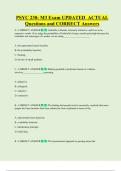
PSYC 230: M3 Exam UPDATED ACTUAL
Questions and CORRECT Answers
A - CORRECT ANSWER -Gabrielle is blonde, extremely attractive, and lives in an
expensive condo. If we judge the probability of Gabrielle's being a model quite high because she
resembles our stereotype of a model, we are using _____________________
A. the representativeness heuristic.
B. the availability heuristic.
C. framing.
D. the law of small numbers.
C - CORRECT ANSWER -Making probable conclusions based on evidence
involves_________________reasoning.
A. deductive
B. syllogistic
C. inductive
D. connective
B - CORRECT ANSWER -The finding that people tend to incorrectly conclude that more
people die from tornados than from asthma has been explained in terms of the
A. representativeness heuristic.
B. availability heuristic.
C. falsification principle.
D. belief bias.
B - CORRECT ANSWER -The interactionist approach to parsing states that
,A. semantics is activated only at the end of a sentence.
B. semantics is activated as a sentence is being read.
C. the grammatical structure of a sentence determines the initial parsing.
D. semantics is only activated to clear up ambiguity.
A - CORRECT ANSWER -The word frequency effect refers to the fact that we respond
more
A. slowly to low-frequency words than high-frequency words.
B. slowly to letters appearing in non-words than letters appearing in words.
C. quickly to letters that appear multiple times in a word than just once in a word.
D. quickly to phonemes that appear multiple times in a word than just once in a word.
B - CORRECT ANSWER -In a lexical decision task, participants have to decide whether
A. a statement is true.
B. a letter string is a word.
C. a stimulus is presented.
D. two stimuli are associated.
A - CORRECT ANSWER -Discounting refers to
A. the tendency to reduce the value of a reward if there is a cost associated with it.
B. the tendency to represent value in a propositional code.
C. the tendency for reaction times to decrease under time pressure.
D. the rate at which people reduce the value of an outcome
C - CORRECT ANSWER -In the Ultimatum Game, people usually _____ offers that are
less than 20% of the total amount of money when playing with another person.
,A. accept
B. consider
C. reject
D. prefer
((Two players are given an endowments
Player 1 is the proposer - proposes a split of a certain amount of money
Player 2 can either accept or reject
If player 2 rejects the offer, then neither receives any money
People usually reject offers that are less than 20% of the endowment when playing with people -
viewed as unfair
People don't behave "irrationally" (rejecting money) if they think they are playing with a
computer
Suggests us rejecting the money from an unfair split by a person acts as a punishment for
unfairness, how we work as a society))
A - CORRECT ANSWER -Which of the following students provides the most accurate
summary of System 1 and System 2 processing, in connection with decision making?
A. Frank: "System 1 processing doesn't require much conscious attention; System 2 processing is
slow, and we need to pay close attention."
A. - CORRECT ANSWER -Imagine that you read about research in which students study
a map of an imaginary college campus. Then they are instructed to mentally travel between two
points on this map. According to their results, the mental travel time increases as the distance
increases between the two points. These results seem to support
A. the spatial code.
B. the propositional code.
C. the alignment heuristic
D. the spatial framework model.
, C - CORRECT ANSWER -Suppose that you have a mental image of your favorite male
actor. If that image is stored in a propositional code, the representation would emphasize
A. spatial relationships, including information about angles and lines.
B. a correspondence between the mental imagery and perceptual imagery.
C. a language-like description.
D. spatial relationships for the actor's general shape, but a language-like description for the
details of his face.
D - CORRECT ANSWER -How does mental imagery compare with perception?
A. Perception relies exclusively on bottom-up processing.
B. Perception relies exclusively on top-down processing.
C. Mental imagery relies exclusively on bottom-up processing.
D. Mental imagery relies exclusively on top-down processing.
A - CORRECT ANSWER -Mental imagery involves
A. experiencing a sensory impression in the absence of sensory input.
B. mental representations of the current sensory inputs.
C. sensory representations of a stimulus.
D. all of these.
Mental Imagery - CORRECT ANSWER -Experiencing a sensory impression without a
sensory input
Ex. athletes visualizing plays or moves to improve performance
Ex. Imagining
Questions and CORRECT Answers
A - CORRECT ANSWER -Gabrielle is blonde, extremely attractive, and lives in an
expensive condo. If we judge the probability of Gabrielle's being a model quite high because she
resembles our stereotype of a model, we are using _____________________
A. the representativeness heuristic.
B. the availability heuristic.
C. framing.
D. the law of small numbers.
C - CORRECT ANSWER -Making probable conclusions based on evidence
involves_________________reasoning.
A. deductive
B. syllogistic
C. inductive
D. connective
B - CORRECT ANSWER -The finding that people tend to incorrectly conclude that more
people die from tornados than from asthma has been explained in terms of the
A. representativeness heuristic.
B. availability heuristic.
C. falsification principle.
D. belief bias.
B - CORRECT ANSWER -The interactionist approach to parsing states that
,A. semantics is activated only at the end of a sentence.
B. semantics is activated as a sentence is being read.
C. the grammatical structure of a sentence determines the initial parsing.
D. semantics is only activated to clear up ambiguity.
A - CORRECT ANSWER -The word frequency effect refers to the fact that we respond
more
A. slowly to low-frequency words than high-frequency words.
B. slowly to letters appearing in non-words than letters appearing in words.
C. quickly to letters that appear multiple times in a word than just once in a word.
D. quickly to phonemes that appear multiple times in a word than just once in a word.
B - CORRECT ANSWER -In a lexical decision task, participants have to decide whether
A. a statement is true.
B. a letter string is a word.
C. a stimulus is presented.
D. two stimuli are associated.
A - CORRECT ANSWER -Discounting refers to
A. the tendency to reduce the value of a reward if there is a cost associated with it.
B. the tendency to represent value in a propositional code.
C. the tendency for reaction times to decrease under time pressure.
D. the rate at which people reduce the value of an outcome
C - CORRECT ANSWER -In the Ultimatum Game, people usually _____ offers that are
less than 20% of the total amount of money when playing with another person.
,A. accept
B. consider
C. reject
D. prefer
((Two players are given an endowments
Player 1 is the proposer - proposes a split of a certain amount of money
Player 2 can either accept or reject
If player 2 rejects the offer, then neither receives any money
People usually reject offers that are less than 20% of the endowment when playing with people -
viewed as unfair
People don't behave "irrationally" (rejecting money) if they think they are playing with a
computer
Suggests us rejecting the money from an unfair split by a person acts as a punishment for
unfairness, how we work as a society))
A - CORRECT ANSWER -Which of the following students provides the most accurate
summary of System 1 and System 2 processing, in connection with decision making?
A. Frank: "System 1 processing doesn't require much conscious attention; System 2 processing is
slow, and we need to pay close attention."
A. - CORRECT ANSWER -Imagine that you read about research in which students study
a map of an imaginary college campus. Then they are instructed to mentally travel between two
points on this map. According to their results, the mental travel time increases as the distance
increases between the two points. These results seem to support
A. the spatial code.
B. the propositional code.
C. the alignment heuristic
D. the spatial framework model.
, C - CORRECT ANSWER -Suppose that you have a mental image of your favorite male
actor. If that image is stored in a propositional code, the representation would emphasize
A. spatial relationships, including information about angles and lines.
B. a correspondence between the mental imagery and perceptual imagery.
C. a language-like description.
D. spatial relationships for the actor's general shape, but a language-like description for the
details of his face.
D - CORRECT ANSWER -How does mental imagery compare with perception?
A. Perception relies exclusively on bottom-up processing.
B. Perception relies exclusively on top-down processing.
C. Mental imagery relies exclusively on bottom-up processing.
D. Mental imagery relies exclusively on top-down processing.
A - CORRECT ANSWER -Mental imagery involves
A. experiencing a sensory impression in the absence of sensory input.
B. mental representations of the current sensory inputs.
C. sensory representations of a stimulus.
D. all of these.
Mental Imagery - CORRECT ANSWER -Experiencing a sensory impression without a
sensory input
Ex. athletes visualizing plays or moves to improve performance
Ex. Imagining