
CS 6400 Exam 4
Study online at https://quizlet.com/_g2mf1p
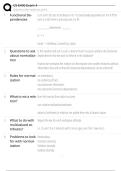
1. Functional De- Let X and Y be sets of attributes in R. Y is functionally dependent on X in R iff for
pendencies each x in RX, there is precisely one y in RY.
_________ determines _______
X --> Y
Email --> BirthYear, CurrentCity, Salary
2. Questions to ask Is this relation laid out in such a manner that it is easy to enforce the functional
about normaliza- dependencies that we want to enforce in the database?
tion
How do we normalize the relation (or decompose into smaller relations) without
information loss and so that the functional dependencies can be enforced?
3. Rules for normal- no redundancy
ization no cluttering of facts
must preserve information
must preserve functional dependencies
4. What is not a rela- Non-first normal form data structures
tion?
can contain multivalued attributes
values of attributes in relations are pulled from sets of atomic values
5. What to do with Repeat the key for each multivalue attribute
multivalued at-
tributes? i.e., if user1 has 3 interests with 3 since ages, turn the 1 row into 3
6. Problems to look Redundancy
for with normal- Insertion anomaly
ization Deletion anomaly
Update anomaly
, CS 6400 Exam 4
Study online at https://quizlet.com/_g2mf1p
7. Redundancy Leads to inconsistency
Database can be useless from the point of view of understanding repetitive fields
8. Insertion anom- occurs when certain attributes cannot be inserted into the database without the
aly presence of other attributes, leads to many NULL values or duplicates
9. Deletion anomaly deleting rows may cause a loss of data that would be needed for other future rows
10. Update anomaly improper database organization where a non-primary key item is stored multiple
times; updating the item in one location and not the others causes data inconsis-
tencies
redundant data may not be properly updated
11. Information loss getting more or less information from decomposing a relation into smaller tables
in normalization that doesn't reflect reality
12. Dependency Loss If we decompose a table into multiple tables, then we cannot enforce the functional
in normalization dependencies, or may lose the ability to enforce them, that are split between the
two relations
dependencies should be together in the tables (Except transitive)
13. A perfect decom- no redundancies
position has no insertion anomalies
no deletion anomalies
no update anomalies
no information loss
no dependency loss
the idea is to decompose and if we need to see the original view, we join the
decomposed tables
Study online at https://quizlet.com/_g2mf1p
1. Functional De- Let X and Y be sets of attributes in R. Y is functionally dependent on X in R iff for
pendencies each x in RX, there is precisely one y in RY.
_________ determines _______
X --> Y
Email --> BirthYear, CurrentCity, Salary
2. Questions to ask Is this relation laid out in such a manner that it is easy to enforce the functional
about normaliza- dependencies that we want to enforce in the database?
tion
How do we normalize the relation (or decompose into smaller relations) without
information loss and so that the functional dependencies can be enforced?
3. Rules for normal- no redundancy
ization no cluttering of facts
must preserve information
must preserve functional dependencies
4. What is not a rela- Non-first normal form data structures
tion?
can contain multivalued attributes
values of attributes in relations are pulled from sets of atomic values
5. What to do with Repeat the key for each multivalue attribute
multivalued at-
tributes? i.e., if user1 has 3 interests with 3 since ages, turn the 1 row into 3
6. Problems to look Redundancy
for with normal- Insertion anomaly
ization Deletion anomaly
Update anomaly
, CS 6400 Exam 4
Study online at https://quizlet.com/_g2mf1p
7. Redundancy Leads to inconsistency
Database can be useless from the point of view of understanding repetitive fields
8. Insertion anom- occurs when certain attributes cannot be inserted into the database without the
aly presence of other attributes, leads to many NULL values or duplicates
9. Deletion anomaly deleting rows may cause a loss of data that would be needed for other future rows
10. Update anomaly improper database organization where a non-primary key item is stored multiple
times; updating the item in one location and not the others causes data inconsis-
tencies
redundant data may not be properly updated
11. Information loss getting more or less information from decomposing a relation into smaller tables
in normalization that doesn't reflect reality
12. Dependency Loss If we decompose a table into multiple tables, then we cannot enforce the functional
in normalization dependencies, or may lose the ability to enforce them, that are split between the
two relations
dependencies should be together in the tables (Except transitive)
13. A perfect decom- no redundancies
position has no insertion anomalies
no deletion anomalies
no update anomalies
no information loss
no dependency loss
the idea is to decompose and if we need to see the original view, we join the
decomposed tables


